live Hopes for Hormuz deal fade as Trump adds new demands to Iran peace talks
U.S. President Donald Trump has called for Iran to pay compensation for decades of deaths and damage, adding a new demand to peace talks as Tehran see...
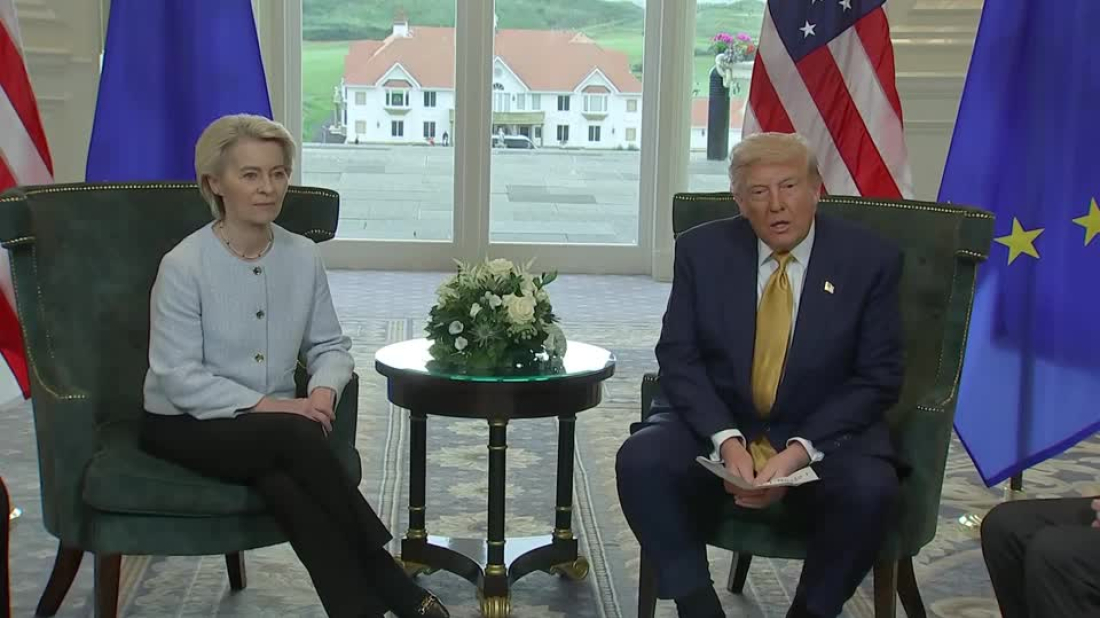
U.S. President Trump and European Union’s von der Leyen moved closer to a trade deal Sunday that may impose a 15% tariff on most EU goods, averting steeper U.S. levies.
European Commission President Ursula von der Leyen met with U.S. President Donald Trump on Sunday in Scotland, aiming to finalize a high-stakes trade deal that could see a broad 15% tariff imposed on most EU goods entering the U.S.
The negotiations held at Trump’s Turnberry golf resort come as both sides try to avert the imposition of steep new tariffs, particularly a threatened 30% U.S. tariff on EU products set to take effect 1 August. U.S. and EU negotiators were locked in last-minute talks on key sectors including automobiles, steel, aluminium, and pharmaceuticals.
President Trump, speaking ahead of the talks, called the current trade arrangement “very unfair to the United States,” while von der Leyen admitted there was a need for “rebalancing,” acknowledging the EU's trade surplus with the U.S.
U.S. Commerce Secretary Howard Lutnick warned that unless the EU opened its markets further to American exports, Trump may go ahead with the 30% tariff plan. EU diplomats say counter-tariffs targeting $109 billion in U.S. goods are ready if talks fail.
According to EU officials, the deal under discussion includes a uniform 15% tariff similar to the U.S.-Japan agreement along with a 50% tariff on steel and aluminium, potentially offset by export quotas. The auto sector may also see a significant adjustment, with hopes of reducing the current 27.5% tariff to 15%.
Both sides expressed cautious optimism, with a senior U.S. official saying a deal was "within reach," though not yet guaranteed.

One hundred years after the First World War and more than eighty years after the devastation of the Second World War gave rise to the United Nations, humanity once again finds itself living in an age of permanent crisis.
For months, efforts to secure the Red Sea have focused on what is happening in the water. Naval deployments have increased, governments have expanded maritime cooperation and shipping companies have adapted to persistent security threats.
Flights arriving at Catania airport in eastern Sicily were suspended after volcanic ash from a new eruption of Mount Etna drifted into the airspace around the airport, disrupting operations at one of Italy’s busiest aviation hubs.
Greenland has issued a “strong warning” to a U.S. oil company linked to President Donald Trump after drilling equipment was brought ashore without the required government approvals, according to British media.
Iran said it was nearing a final pact with Oman defining new shipping lanes between them through the Strait of Hormuz but repeated that the U.S. must meet other conditions.
UK Prime Minister Andy Burnham faces an early test of his climate commitments as his government weighs whether to approve two major North Sea oil and gas projects, Rosebank and Jackdaw.
Europe is facing more frequent and prolonged extreme heat, with climate change making heatwaves increasingly intense and widespread, the World Meteorological Organization (WMO) warned on Tuesday.
Russia's northern NATO neighbours are tightening security around critical infrastructure amid growing concern that Moscow could stage a “false flag” attack using Ukrainian drones.
Kyrgyzstan has proposed hosting part of Russian e-commerce giant Wildberries’ warehouse and logistics network, aiming to reduce supply-chain risks and strengthen trade with Russia.
North Korea has deployed troops, weapons and now, according to a Ukrainian intelligence official, a missile unit to support Russia's war against Ukraine, marking Pyongyang's most significant involvement in a war since the 1950s.
You can download the AnewZ application from Play Store and the App Store.
What is your opinion on this topic?
Leave the first comment