live Trump says U.S. could strike Iran ‘hard’ as Tehran warns of economic fallout- Middle East conflict
U.S. President Donald Trump said Washington could destroy Iran’s infrastructure “in two days,” while Tehran warned the U.S. would...
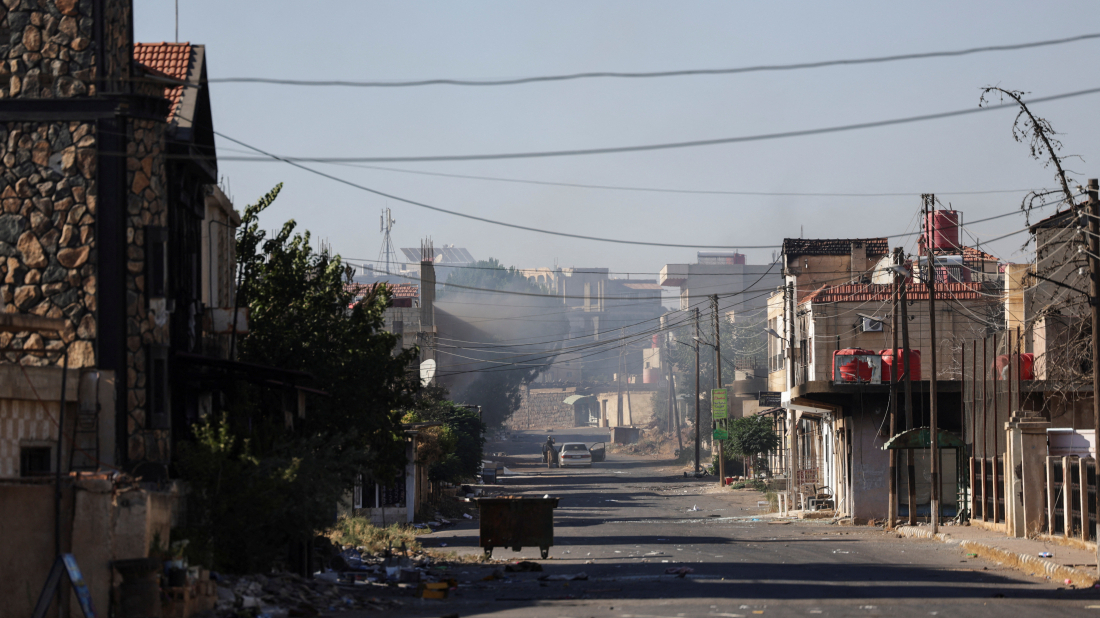
A fragile ceasefire between Israel and Syria, brokered by the U.S. with support from Turkey and Jordan, allows Syrian internal security forces brief access to Sweida for 48 hours to help stabilize the Druze-majority region after over 300 deaths.
Intense violence erupted in southern Sweida after clashes between Sunni Bedouin tribes and local Druze militias spiraled into broader sectarian warfare. Over 300 deaths, including civilians and medical staff have been documented, and reports describe field executions, kidnappings, and widespread human rights abuses.
Israel, citing its commitment to protect Syria’s Druze minority (which includes Druze living in Israel and the Golan Heights), carried out airstrikes on Syrian military positions, including in Damascus and demanded regime forces withdraw from Sweida.
Despite earlier pledges to block any Syrian military presence in the south, Israeli officials agreed to permit Syrian internal security units into Sweida for a limited 48‑hour period, aiming to aid in stabilization, not occupation.
Syrian Interim President Ahmed al‑Sharaa declared the ceasefire immediate and comprehensive, urging all fighting factions Druze, Bedouin, Sunnis to uphold unity and cease hostilities. He pledged that government forces entering the province will focus on quelling violence and restoring vital services.
Nonetheless, skirmishes have continued, particularly in western and northern Sweida, raising doubts about the truce’s durability. Thousands of Bedouin fighters remain active, while humanitarian conditions deteriorate over 80,000 displaced, hospitals inoperable, and residents cut off from food and water.

The U.S.-Israeli war with Iran loomed over U.S. President Donald Trump's visit to China, as signs emerged that the conflict is causing a shift in alliances across the Middle East.
Iran’s Foreign Minister Abbas Araghchi said Tehran has “no trust” in the United States and will only consider negotiations if Washington shows seriousness. His remarks came as talks on Iran’s nuclear programme continued, with Trump and Xi also opposing Iran acquiring nuclear weapons.
British Prime Minister Keir Starmer was fighting for his political survival on Thursday (14 May) after Health Secretary Wes Streeting resigned, saying he had “lost confidence” in Starmer’s leadership.
Türkiye has issued 20,000 work visas to Afghan citizens for jobs in the livestock sector, the Turkish Embassy’s chargé d’affaires in Kabul said during talks with Afghanistan’s refugee minister on Wednesday.
The second semi-final of the 70th Eurovision Song Contest 2026 takes place tonight in a rain-soaked Vienna, with the final 10 places in Saturday’s grand final still up for grabs.
China has launched the world’s first experiment to study how artificial human embryos develop in space, marking a major step in understanding whether humans could one day reproduce beyond Earth.
Every day, an elderly woman in China’s Shandong province looks forward to a video call from her son. He asks about her health, tells her he has been busy with work, and promises he will come home once he has saved enough money. She tells him she misses him. He tells her to take care of herself.
U.S. President Donald Trump said on Friday that Abu-Bilal al-Minuki, second in command of ISIS globally, was killed in an operation conducted by U.S. and Nigerian forces.
Start your day informed with the AnewZ Morning Brief. Here are the top stories for the 16th of May, covering the latest developments you need to know.
Deep in the ancient forests of southern China, researchers have discovered a small, shy snake with an extraordinary survival trick: when threatened, it creates the illusion that it has two heads.
You can download the AnewZ application from Play Store and the App Store.
What is your opinion on this topic?
Leave the first comment