Kazakh voters approve new constitution that could allow Tokayev stay in power beyond 2029
Kazakh voters have overwhelmingly approved a new constitution that could allow President Kassym-Jomart Tokayev a loop...
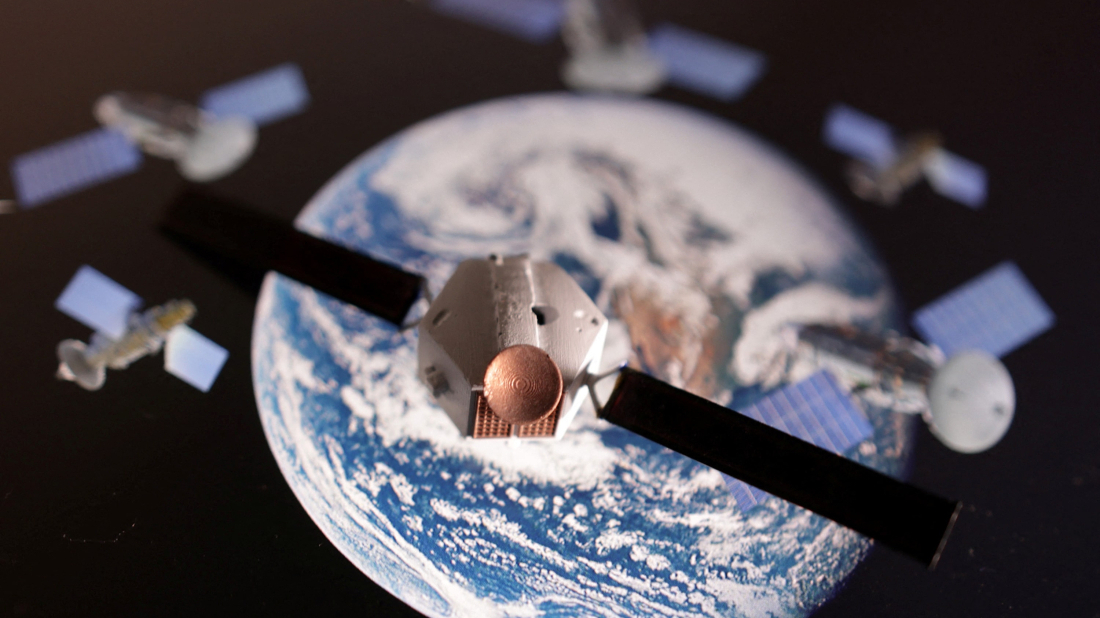
ROME, Feb 19 (Reuters) - Italy is aiming to develop its own low-orbit satellites for government communications, its industry minister said on Wednesday, presenting it as an alternative to systems provided by U.S. billionaire Elon Musk.
Prime Minister Giorgia Meloni's government had previously said it was considering the use of Musk's Starlink satellites to provide encrypted communications between officials operating in risky areas.
The suggestion was sharply criticised by opposition politicians, who questioned the wisdom of handing a national security contract to a foreign entrepreneur who is also part of the U.S. government under President Donald Trump.
"We are in fact working on the creation of a national low-orbit satellite system developed independently, with the involvement of the main national players," Minister Adolfo Urso said in the lower house of parliament.
Urso, a member of Meloni's right-wing Brothers of Italy party, said that would offer a competitive alternative to infrastructure provided by other global operators, including Musk.
Urso did not give a timing for the development of the project and did not specify which companies the government had called in, but said the national space agency would carry out a feasibility study.
Musk has a warm relationship with Meloni and said last month he would be ready to offer his services to Italy. However, Defence Minister Guido Crosetto denied an agreement had been sealed.
Starlink, part of Musk's SpaceX aerospace business, has 6,700 active satellites in low earth orbit. A source told Reuters that Italy was considering a five-year deal with the company worth 1.5 billion euros ($1.57 billion).
($1 = 0.9584 euros)

A long-running investigation has suggested that the street artist known as Banksy may be legally named David Jones. A report indicates that Jones was previously known as Robin Gunningham, a name long associated with Banksy, before legally changing his name several years ago.
Iran says it is open to talks with countries seeking safe passage through the Strait of Hormuz - disrupted by recent attacks - as Israel continues to launch wide‑scale strikes on Iranian infrastructure in the west. This live report tracks the latest developments.
North Korea fired what appeared to be a ballistic missile on Saturday (14 March), Japanese and South Korean officials said. The development comes amid the joint annual U.S.-South Korea "Freedom Shield" military drills and South Korean Prime Minister Kim Min-seok's visit to Washington.
Ukrainian drones struck an oil refinery and a key port in Russia’s southern Krasnodar region overnight (13-14 March), local authorities said, causing injuries and damage. In separate action, Russian air attacks on Ukrainian territory killed and wounded civilians near Kyiv, officials reported.
The Academy Awards nominations have been announced, with the crime drama Sinners leading the race securing a record 16 nominations ahead of the ceremony set for 15 March. The event, which honours the film industry’s top achievements over the past year, will be hosted by comedian Conan O'Brien.
Chinese electric vehicle giant BYD is pushing to make charging an electric car almost as quick and convenient as filling up a traditional petrol vehicle - a move that could help remove one of the biggest barriers to wider electric vehicle adoption.
South Korea will soon cease to be one of the few countries where Google Maps does not function fully, after its security-conscious government reversed a two-decade-old policy and approved the export of high-precision map data to overseas servers.
New research suggests 40,000-year-old carved objects from south-western Germany bear repeated marks arranged in organised sign sequences similar to early proto-cuneiform, although they are not regarded as a form of writing.
The chief executive of Google DeepMind, Demis Hassabis, has called for more urgent research into the risks posed by artificial intelligence, warning that stronger safeguards are needed as systems become more advanced.
NASA successfully completed a critical fueling rehearsal on Thursday (19 February) for its giant moon rocket, Artemis II, after earlier hydrogen leaks disrupted preparations for the next crewed lunar mission. The launch is scheduled for 6 March, according to the latest information from NASA.
You can download the AnewZ application from Play Store and the App Store.
What is your opinion on this topic?
Leave the first comment