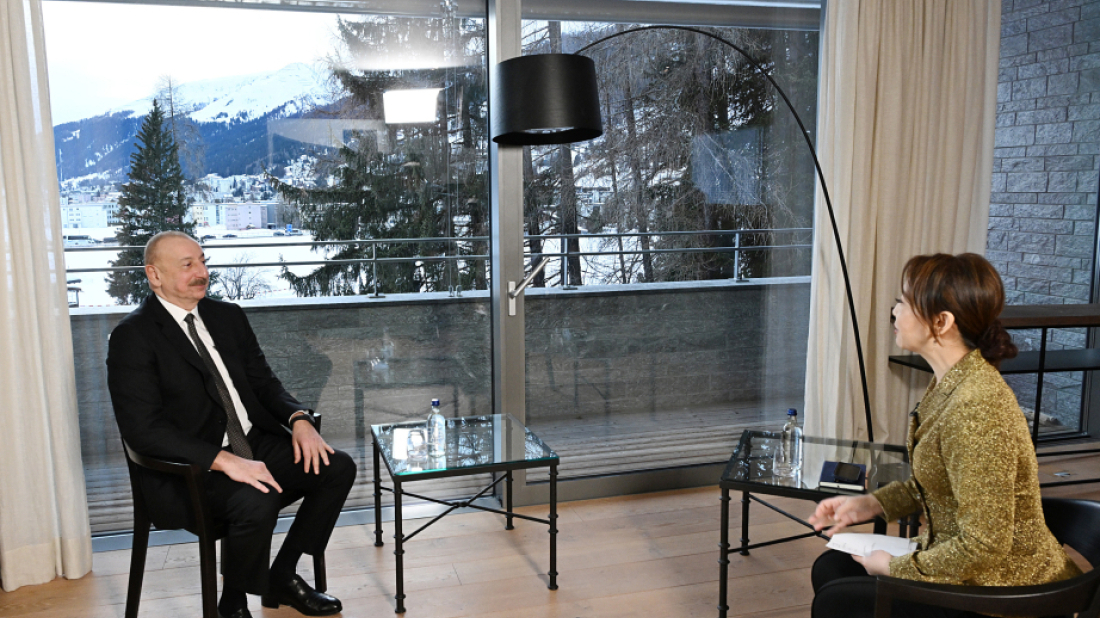
On January 20, President of Azerbaijan Ilham Aliyev sat down for an exclusive interview with China’s CGTN (China Global Television Network) during the World Economic Forum in Davos.
The interview, which covered Azerbaijan’s geopolitical strategy, economic ambitions, and international partnerships, was aired on February 11.
Restoring Sovereignty and Defending National Interests
During the discussion, President Aliyev highlighted Azerbaijan’s most significant achievement in recent years—the full restoration of its territorial integrity and sovereignty. He emphasized that this was accomplished in accordance with international law, the UN Charter, and Security Council resolutions. However, he also criticized the inefficacy of international organizations, noting that key resolutions remained unimplemented for decades.
“For almost 30 years, this was our national goal, and we mobilized all our efforts to achieve it. Unfortunately, the norms of international law did not function, and international organizations were not helpful,” Aliyev stated, adding that Azerbaijan had to take matters into its own hands to ensure justice.
Azerbaijan’s Role in a Multipolar World
Addressing Azerbaijan’s position in an evolving geopolitical landscape, Aliyev pointed to the country’s strong, self-sufficient economy. With a foreign debt-to-GDP ratio of just 6.9%, Azerbaijan has successfully launched large-scale infrastructure projects, reinforcing its influence in the South Caucasus and Caspian regions.
“We have strongly defended our national interests, our independent policy, and our way of life. Azerbaijan, a relatively new player on the global stage, has proven that with stability and unity, a country can safeguard its interests and establish strong international partnerships,” he said.
Expanding Global Influence: Climate Summit and WTO Membership
Azerbaijan’s proactive approach on the world stage was another key focus of the interview. President Aliyev recalled the country’s successful hosting of the global climate summit, which brought together nearly 200 nations. He also noted Azerbaijan’s four-year chairmanship of the Non-Aligned Movement, the second-largest international institution after the UN General Assembly.
“Our policy, based on friendship, cooperation, and non-interference in internal affairs, has gained broad support in the international arena,” Aliyev stated, adding that Azerbaijan’s global engagement continues to expand.
Azerbaijan’s efforts to join the World Trade Organization (WTO) were also discussed. Aliyev acknowledged the complexities of the accession process, especially given the rising trend of protectionism, trade barriers, and disruptions in the global supply chain.
“We have been actively negotiating WTO membership for years, but the growing use of tariffs and protectionist policies contradicts the organization’s core principles,” he explained. He emphasized that Azerbaijan is carefully evaluating the advantages and potential risks of membership, particularly in terms of protecting local industries and exports.
Strengthening Economic Ties with China
The interview also touched on Azerbaijan’s deepening economic ties with China. President Aliyev confirmed ongoing negotiations between the two countries, particularly regarding trade and infrastructure cooperation. He highlighted the Middle Corridor’s growing significance and noted that Azerbaijan is investing heavily in upgrading its transit infrastructure to accommodate increasing trade flows.
Recent discussions between Azerbaijani and Chinese officials suggest positive momentum, with both sides expressing optimism about future cooperation.
Azerbaijan’s Vision for the Future
Concluding the interview, President Aliyev underscored the importance of strong leadership, stability, and long-term vision in achieving national goals.
“Every leader must be fair to their people and always speak the truth,” he remarked.
With Azerbaijan asserting itself as a key player in regional and global affairs, its strategic policies and international collaborations will continue to shape its role in the multipolar world.
In a recent conversation, Azerbaijani President Ilham Aliyev discussed his country’s evolving international relations, particularly with China, and the broader implications for global trade, security, and development.
Reflecting on the strengthening of ties between Azerbaijan and China, President Aliyev noted the establishment of a strategic partnership following a significant meeting with Chinese President Xi Jinping last summer. This partnership, marked by a Declaration on Strategic Cooperation, highlights a mutual commitment to elevating bilateral relations to a higher level of trust and cooperation. Aliyev emphasized the potential for further collaboration, especially within international organizations such as the World Trade Organization.
Azerbaijan's increasing role on the global stage extends beyond its relations with China. As a partner in dialogue with the Shanghai Cooperation Organization and an active participant in BRICS discussions, the country is positioning itself as a key player in the Global South.
President Aliyev spoke to the growing importance of connectivity projects, especially those linking Central Asia, China, and Europe via Azerbaijan. He believes that such initiatives, which leverage Azerbaijan's strategic location, could foster economic growth and regional stability.
On the subject of climate change, President Aliyev expressed concern over the disparities between the Global North and South, particularly regarding financing for climate action. Highlighting Azerbaijan's efforts to bridge this divide, he pointed to the COP29 conference in Baku, where the country led initiatives to support small island developing states facing existential climate threats.
Aliyev also acknowledged the challenges posed by a lack of trust between global leaders, especially as the world grapples with political uncertainty. Drawing comparisons with past U.S. administrations, he expressed optimism for the future of Azerbaijan’s relations with the United States, especially in light of the more favorable relationship under President Trump’s tenure.
As the international community grapples with increasing fragmentation, the Middle Corridor—an ambitious infrastructure project spearheaded by Azerbaijan—emerges as a critical alternative, fostering greater connectivity and trade between East and West. The President noted that the Middle Corridor is not only a transit route but a means of building lasting economic partnerships, with China playing a key role.
Despite Azerbaijan's wealth in fossil fuels, President Aliyev is committed to transitioning toward green energy. He shared details of the country’s green agenda, including ambitious targets for solar and wind power and collaboration with China on renewable technologies. The country’s progress in green energy and its partnership with China serves as a model for the Global South in fostering sustainable development.
As for the future, President Aliyev concluded by emphasizing the importance of truthful leadership. He urged global leaders to prioritize their countries' long-term interests, regardless of international pressures, and to maintain transparency with their people—a philosophy that has guided his leadership in Azerbaijan for over two decades.
Lastly, President Aliyev extended his New Year’s greetings to the people of China, wishing them prosperity and stability as Azerbaijan and China continue to build on their strategic partnership.











What is your opinion on this topic?
Leave the first comment