The proposed Green Energy Corridor could carry renewable electricity from the Caspian to Europe. But a completed feasibility study is only the beginning of a much larger financial challenge.
Azerbaijan has long supplied Europe with oil and gas. Now, it wants to send electricity.
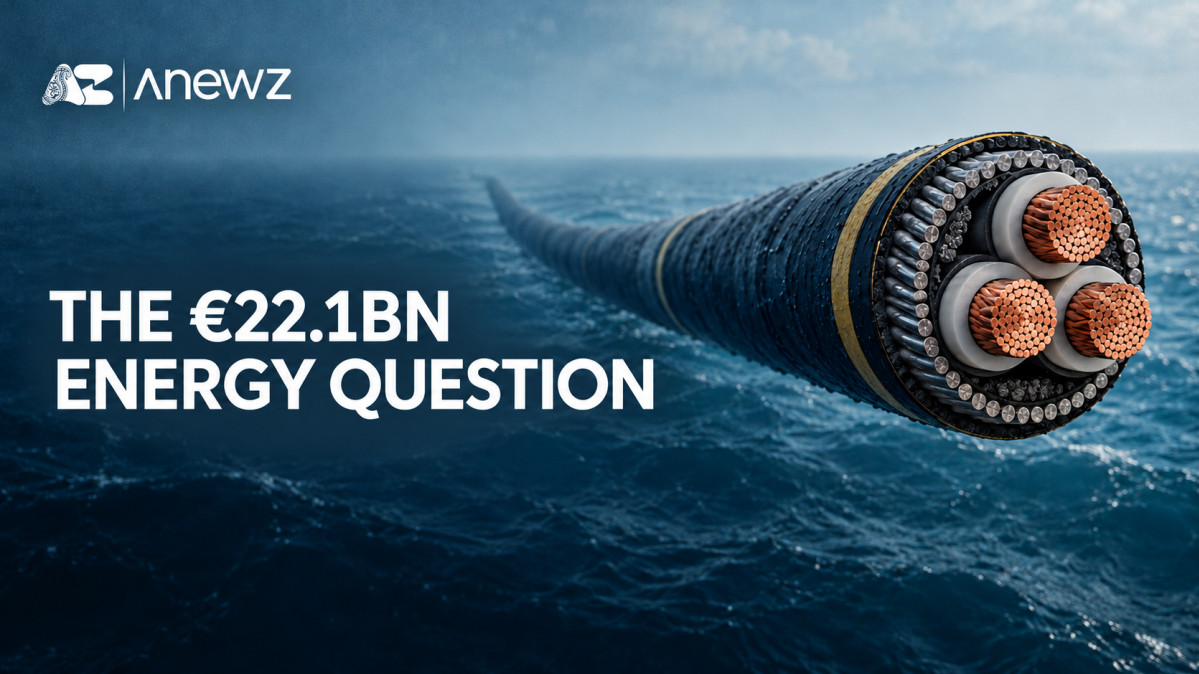
The plan is ambitious: generate renewable power in Azerbaijan and carry it through Georgia, across the Black Sea to Romania, and onwards towards Hungary.
The estimated cost is €22.1 billion.
For Azerbaijan, the proposed Green Energy Corridor could open a new chapter in its energy relationship with Europe. For European buyers, it could provide another source of electricity as demand grows and countries look to diversify supplies.
But between ambition and delivery lies a question: who will finance the corridor, and can it earn enough to justify the investment?
A project in numbers
The cost estimate comes from an investment presentation by the Green Energy Corridor Power Company, or GECO, based on a feasibility study by Italian consultancy CESI.
Of the €22.1 billion total, approximately €14.3 billion is for transmission infrastructure. Another €7.8 billion is intended for renewable electricity generation, according to the presentation reported by Interfax. interfax.com
Those figures are estimates. They do not mean the full amount has been secured.
Azerbaijan’s Energy Ministry says the feasibility study found the project technically feasible and economically attractive. Its findings were presented to international investors and financial institutions at a forum in Baku on 22 October. minenergy.gov.az
The next challenge is to turn that assessment into financing agreements and contracts.
The timeline
The four participating countries — Azerbaijan, Georgia, Romania and Hungary — are working towards a final investment decision in 2029.
Under the current plan, the corridor would begin operating in phases from 2032 and reach full capacity by 2040. Those dates are targets, not guarantees. minenergy.gov.az
By 2040, the project aims to transmit approximately 20 billion kilowatt-hours of electricity a year to Europe, according to the ministry. Its planned transmission capacity is around four gigawatts.
The distinction matters. Gigawatts measure how much power the corridor can carry at a given moment. Kilowatt-hours measure how much electricity it delivers over time.
The feasibility study also projects that the corridor could support the development of at least eight gigawatts of renewable generation capacity in the region. minenergy.gov.az
Who pays?
The project’s scale means its backers will need to bring together substantial financing — potentially from governments, international financial institutions and private investors.
At the Baku forum, representatives of development banks and investment firms discussed financing models, risk-sharing and ways to combine public and private funds, according to the Energy Ministry. Their participation in discussions, however, does not itself amount to a commitment to finance the project. minenergy.gov.az
The division of costs will be consequential. Governments may be willing to support a project for its strategic value. Private investors and lenders will also need confidence that it can generate reliable returns.
There is another detail to watch. Interfax reports that some of the project’s calculations include an assumption of EU grant funding equivalent to 25% of capital expenditure. An assumption in a financial model is not the same as an awarded grant. interfax.com
How much public support will ultimately be available — and on what terms — could shape the project’s economics.
Who buys the electricity?
Building the corridor is one challenge. Finding buyers willing to commit for years is another.
The Energy Ministry says a business model combining regulated and commercial elements is under consideration. Long-term power purchase agreements, private investment and cross-border electricity trade are central to that model. minenergy.gov.az
A long-term purchase agreement gives a buyer and a producer a framework for selling electricity over an extended period. For investors, such contracts can make future income more predictable.
But the price must work for both sides.
Buyers will compare the delivered electricity with alternatives available in Europe. Project backers, meanwhile, must account for the cost of generation, transmission infrastructure, financing, maintenance and electricity lost along the route.
The feasibility study’s positive assessment is an important milestone. Whether the corridor can secure buyers and financing on viable terms remains the next commercial test.
The strategic value
The potential significance goes beyond the balance sheet.
For Azerbaijan, renewable electricity exports could broaden an energy partnership with Europe that has traditionally centred on oil and gas.
For Europe, a new connection could add another source of supply and strengthen links with the South Caucasus. Its contribution to Europe’s overall electricity needs, however, would need to be assessed against the size of the European market and other available sources.
Much will depend on delivery. The corridor crosses several jurisdictions and includes a technically demanding section beneath the Black Sea. It requires renewable power generation as well as the infrastructure to transport it.
The route has been proposed. The feasibility study is complete. Now the project’s supporters must bring together the money, the buyers and the agreements needed to move from a plan to construction.










What is your opinion on this topic?
Leave the first comment