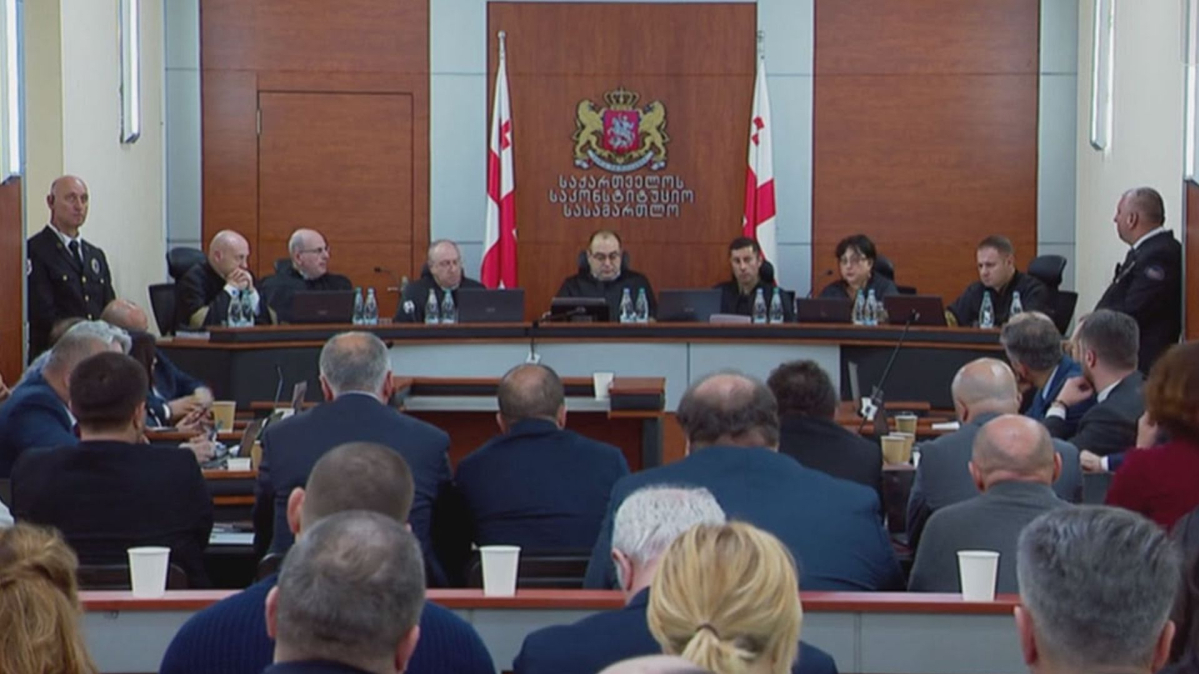
Georgia’s Constitutional Court has rejected an opposition request for witnesses and documents in a case seeking to ban five political parties, as hearings continued on Thursday amid growing criticism from Germany and other international partners.
The decision came on the second day of hearings in Batumi, as tensions deepened between the ruling Georgian Dream party and its opponents over the legal challenge and its implications for democracy.
Germany warned that the proceedings could further damage Georgia’s relations with the European Union, while Georgian Dream accused international officials of interfering in the country’s judicial process.
Constitutional Court chairman Revaz Nadaraia said the seven-judge panel had unanimously rejected the motion, ruling that the requested evidence was unnecessary at this stage. The decision is final and cannot be appealed.
Nika Gvaramia, a leader of the Coalition for Change, had asked the court to obtain documents from government agencies, summon witnesses and allow the opposition to examine the evidence before substantive arguments began. He also requested that evidence unavailable to the defence be excluded from consideration.
Archil Gorduladze, a Georgian Dream MP and chairman of parliament’s Legal Affairs Committee, opposed the motion, accusing the opposition of attempting to delay proceedings and discredit the court. He argued that granting the request would effectively transform the Constitutional Court into an investigative body.
Gvaramia countered that Georgian Dream had itself introduced findings from a parliamentary investigative commission as evidence in the case.
Opposition challenges court over political pressure
Tensions escalated during the hearing when Badri Japaridze, a leader of Lelo – Strong Georgia, challenged Nadaraia over public remarks by Georgian Dream leaders suggesting that the opposition parties would soon be banned.
Japaridze warned that such statements could undermine public confidence in the court by suggesting its decision was already predetermined.
“The greatest insult is when their leader declares that only a few days remain until the parties are abolished,” he said.
Nadaraia dismissed concerns about outside influence, saying the court could not assess political statements made outside the courtroom. He insisted that judges faced no pressure and could not be influenced in their decisions.
Japaridze also urged the court to consider requesting guidance from the European Court of Human Rights, arguing that an attempt to dissolve five separate political organisations through a single case was unprecedented.
Gorduladze acknowledged the unusual nature of the proceedings but maintained that the parties had acted collectively in violation of Article 23 of Georgia’s Constitution, which governs political parties.
Germany warns of further damage to EU relations
Germany has joined mounting international criticism of the lawsuit, warning that it risks pushing Georgia further away from the European Union and eroding democratic standards.
Kathrin Deschauer, a spokesperson for the German Federal Foreign Office, said on Wednesday that Berlin was monitoring the case with concern, describing the use of the judicial system for political purposes as “highly problematic”.
She said Berlin would raise its concerns directly with the Georgian authorities.
Her comments followed a warning from Gudrun Kugler, Vice-President of the Organization for Security and Cooperation in Europe (OSCE) Parliamentary Assembly, who urged Georgia to withdraw the lawsuit.
Kugler stressed that political rivalries should be settled at the ballot box and through democratic debate, not by using the courts to eliminate opponents. She added that banning political parties was an extraordinary measure that demanded the highest legal and democratic standards.
Georgia, a member of both the OSCE and the Council of Europe, was granted EU candidate status in December 2023. However, its accession process has effectively stalled amid growing concerns over democratic backsliding.
Georgian Dream denies claims of judicial interference
Georgian Dream has defended the lawsuit as a legitimate constitutional measure aimed at safeguarding the country’s political system.
The ruling party accuses the five opposition groups of undermining Georgia’s constitutional order, citing findings from a parliamentary investigative commission that examined alleged abuses during the presidency of Mikheil Saakashvili.
Parliament Speaker Shalva Papuashvili condemned criticism from foreign officials, insisting that MPs have a constitutional right to challenge the legality of political parties.
He argued that international statements made before the court had considered the substance of the case amounted to pressure on the judiciary and threatened its independence.
Georgian Dream MP Irakli Cheishvili similarly accused the OSCE of attempting to influence an independent court. He maintained that the ruling party had presented sufficient evidence to justify its lawsuit and accused international partners of double standards.
Opposition warns voters could lose representation
The opposition has rejected the accusations, denouncing the lawsuit as a politically motivated attempt to silence dissent.
Grigol Gegelia, foreign secretary of Lelo – Strong Georgia, warned that banning the parties would have consequences far beyond their membership, potentially depriving voters of their chosen political representatives.
Japaridze also stressed that the five parties have distinct histories, identities and political positions, making a collective ban particularly difficult to justify.
The Federalist Party has refused to take part in the hearings, arguing that its participation could legitimise proceedings it considers politically driven. Representatives of the other four parties have appeared in court.
What happens next?
Hearings are due to resume on Friday, 23 October, in a case targeting five political forces: Unity – National Movement; Coalition for Change; Strong Georgia – Lelo; the Federalist Party; and Gakharia for Georgia.
The lawsuit, backed by the signatures of 88 Georgian Dream MPs, seeks to have all five parties declared unconstitutional and banned.
The court has yet to deliver a final ruling and has until June 2027 to reach a decision.
With Georgia’s relations with Western partners already under strain, the outcome could have far-reaching consequences for political competition, judicial independence and the country’s democratic future.
Read more:
















What is your opinion on this topic?
Leave the first comment