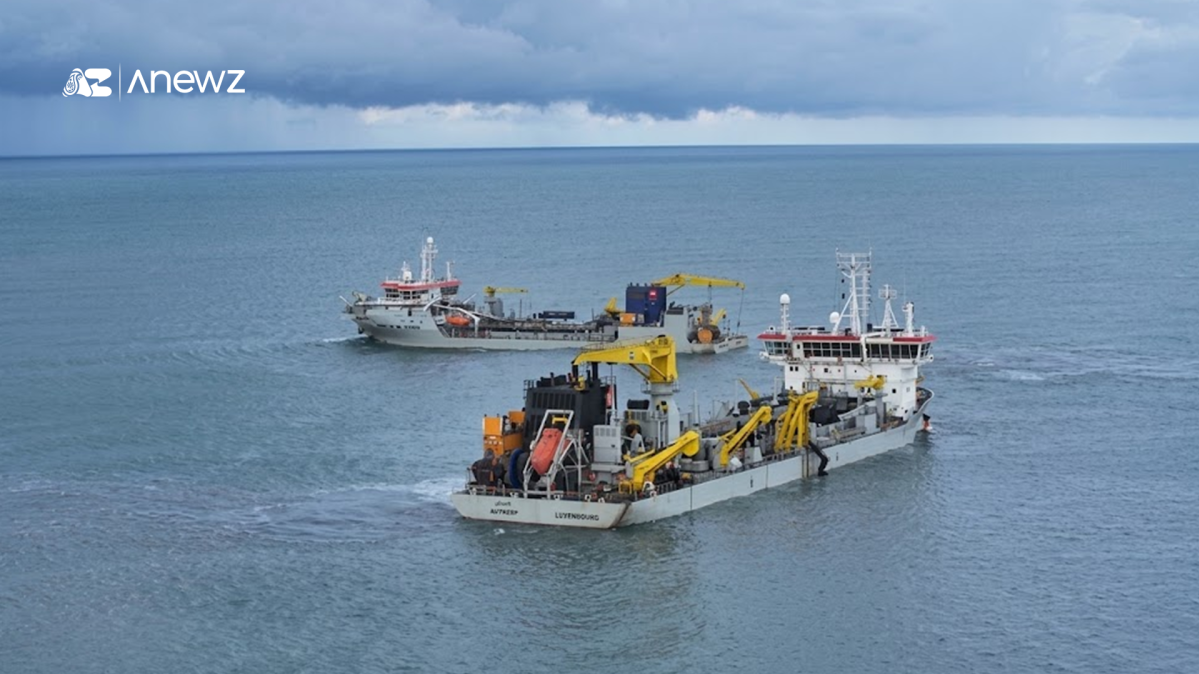
There's a fresh buzz around the Anaklia Deep-Water Port site this week, with the arrival of a second dredging vessel called the Al-Idrisi, which has now entered the waters off the future port to join its sister vessel, the Tristao Da Cunha.
With two vessels - run by Belgian dredging specialists, the Jan De Nul Group - now working the site side by side, the pace of construction has stepped up noticeably, and officials say everything remains firmly on schedule.
Where the work stands right now
The seabed at the base of the breakwater has already been dredged along roughly a kilometre of the site, and crews have now moved on to the trickier task of carving out the entrance channel and turning basin, the route ships will eventually take to reach the port itself.
Back on land, teams are busy laying down the first stretch of stone and gravel that will form the breakwater's initial body, work that needs to happen before construction can push out into open water.
Once dredging wraps up, the seabed at Anaklia will sit at around 17.5 metres deep, enough to welcome the largest vessels sailing the Black Sea. The breakwater will run for 1,376 metres in total, sheltering a water area that has been designed with deepwater container berths in mind, along with space for dry and bulk cargo.
The Anaklia Deep Sea Port Project is being developed under what's known as a "landlord" model. In practice, that means the state takes care of building and owning the core infrastructure, while private companies come in to develop and run the individual terminals.
It's a set-up designed to keep things competitive, draw international partners to the table and make sure cargo keeps flowing efficiently once the port opens.
There's more to the plan than just the port itself, too. The state is also lining up a new road and railway connection to Anaklia, tying the site into the country's wider transport network.
Why this port matters so much
It's worth stepping back for a moment to remember just how much is riding on Anaklia.
A deep-water port capable of handling the Black Sea's largest ships would be a genuine game-changer for Georgia, opening the door to bigger cargo volumes, a stronger foothold as a regional trade hub and a more prominent role along the transit routes that connect Europe and Asia.
Georgia's Deputy Minister of Economy and Sustainable Development Tamar Ioseliani has framed the second dredger's arrival as proof that momentum is building.
"The construction of the Anaklia deep-sea port has entered an active phase," she said, adding that the project is moving to plan and that its success will mean bigger ships, more cargo and a more competitive Georgia in the Black Sea region.
Eric Bates, project director at Jan De Nul, struck a similarly upbeat note. He said the port stands to be a real boost for Georgia's economy, supporting jobs and contributing to growth both at home and further afield.
What to watch for next
With the seabed work well underway and the breakwater beginning to take shape on land, the months ahead look to be a defining stretch for the project as construction moves further out to sea.
If things keep going at this rate, Anaklia's journey towards becoming a fully operational deep-water port, one capable of welcoming the region's biggest ships, looks to be well and truly on course.
Read more from Georgia:














What is your opinion on this topic?
Leave the first comment