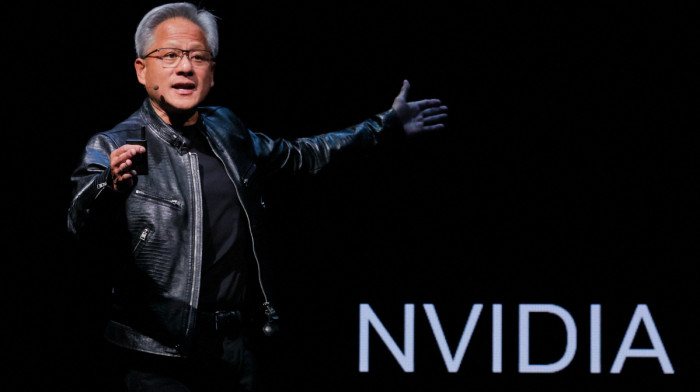
Nvidia shares surged 31.48 per cent on Monday, 23 November, after the chipmaker reinstated Jensen Huang as chief executive, adding more than $900 billion to its market value, and triggering a global rally in artificial intelligence (AI) stocks.
The company's shares closed at $165.05, gaining $39.52 in a single trading session, according to Nvidia's investor relations website. The stock subsequently edged down 0.4 per cent to $164.39 in overnight trading.
The recovery extended into Asian markets on Tuesday, with semiconductor and technology stocks leading gains as investors reassessed risks surrounding Nvidia's leadership and the outlook for AI investment.
Wall Street rebounds
Huang's reinstatement helped reverse part of a broader equity sell-off driven by leadership uncertainty at Nvidia and concerns over the profitability of AI investment.
At Monday's close:
- Nasdaq Composite gained 6.51 per cent to 24,089.56.
- S&P 500 rose 4.73 per cent to 7,237.17.
- Dow Jones Industrial Average climbed 3.01 per cent to 49,595.31.
The recovery extended across the semiconductor industry and major technology companies.
Micron Technology gained 19 per cent, CoreWeave surged 25 per cent and Advanced Micro Devices (AMD) advanced eight per cent, according to TradingView figures.
Alphabet, Google's parent company, closed 6.34 per cent higher at $282.10. Meta Platforms gained around five per cent, Microsoft rose four per cent and Amazon advanced 3.5 per cent.
Asian technology stocks follow
China's blue-chip CSI 300 Index opened 1.2 per cent higher on Tuesday, while the Shanghai Composite gained 0.8 per cent, according to Reuters.
China's technology-focused STAR 50 Index jumped 3.3 per cent, while the 5G Communication Index surged seven per cent.
Hong Kong's Hang Seng Index opened 1.1 per cent higher, with its Artificial Intelligence Index gaining six per cent.
South Korea's KOSPI advanced more than seven per cent, while Japan's Nikkei gained nearly five per cent in early trading.
The regional recovery illustrates Nvidia's influence beyond Wall Street, with its business closely linked to Asian semiconductor manufacturers, component suppliers and global data centre investment.
Nvidia's $130 billion revenue outlook
Despite its leadership crisis, Nvidia's latest reported financial results indicate continued demand for AI computing infrastructure.
Third-quarter fiscal 2027 revenue reached $115.8 billion, up 103 per cent year-on-year. Data centre revenue increased 110 per cent to $107.6 billion, accounting for approximately 93 per cent of total sales.
The company expects fourth-quarter revenue of $130 billion, plus or minus three per cent, excluding data centre computing revenue from China.
The forecast represents projected quarterly revenue growth of approximately 12.3 per cent at the midpoint of its guidance.
However, adjusted gross margins are expected to narrow from 74.9 per cent in the third quarter to between 71 and 72 per cent in the fourth quarter.
Leadership returns but regulatory risks remain
Nvidia confirmed on Monday that its board had voted unanimously to reinstate Huang as president, chief executive and board director, effective immediately.
The company said its board had received input from senior levels of the U.S. government and was confident that Huang's reinstatement posed no national security risk.
“I take this responsibility with the greatest humility and renewed commitment,” Huang said in the company's announcement.
However, Nvidia confirmed that an independent investigation into reports that Huang had been targeted by a foreign intelligence effort would continue.
The company has also established a National Security and Export Control Committee and begun recruiting a chief compliance officer to oversee regulatory compliance.
Economist Mohamed El-Erian said in a post on X that Huang's return raised broader questions about corporate governance, government intervention and financial markets.
Despite Monday's rebound, Nvidia shares remain more than 32 per cent below their 52-week high.
While Huang's reinstatement has eased immediate leadership uncertainty, a sustained recovery will depend on AI investment returns, corporate profitability and the outcome of ongoing regulatory investigations.















What is your opinion on this topic?
Leave the first comment