Syrian President al-Sharaa makes landmark Visa payment as country reconnects with global financial system
A restaurant payment with a Visa card in Damascus has become a symbol of Syria’s reconnection with the global financial system....
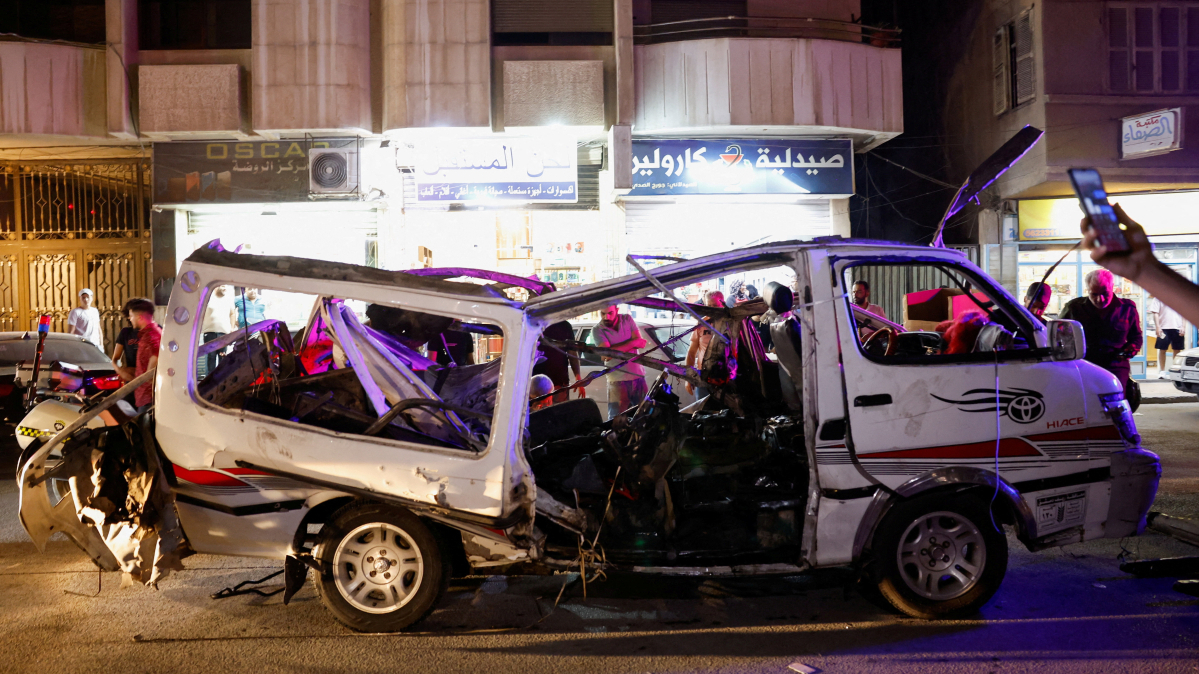
A bomb planted inside a minibus has killed two people and injured 13 others in the Damascus suburb of Jaramana, adding to concerns over security in an area that has seen repeated tensions in recent months.
Syrian officials said the explosion happened on Thursday evening in the predominantly Druze district on the outskirts of the capital. Initial findings indicate that an explosive device had been hidden inside the vehicle.
Television footage from the scene showed the charred remains of the white minibus being removed after the blast.
For those nearby, the explosion came without warning.
Shopkeeper Samer Abbas was working just metres from the blast when shrapnel struck the front of his clothing store.
"It was a strong unnatural sound," he told Reuters.
His immediate concern was for his son, who had been sitting outside moments before the explosion.
"My blood dried up until I checked up on him... until I heard his voice," Abbas said, describing the fear he felt before discovering his son was unharmed.
At Damascus' Mujtahid Hospital, Bassel Imad waited alongside relatives after his cousin, Safouh, who had been driving the minibus, was brought in injured.
"What happened was very wicked," he said, describing the bombing as "sadistic".
No group has claimed responsibility for the attack.
Jaramana is home to a large Druze population and has become increasingly sensitive since the fall of Syria's former government. Relations between factions within the Druze community and the country's new Islamist leadership have remained strained.
The attack follows months of instability in southern Syria. A United Nations investigation published in March found that more than 1,700 people, most of them Druze civilians, were killed during violence in Sweida province in July 2025. The report said Syrian government forces, tribal fighters and Druze armed groups may all have committed war crimes.
Thursday's bombing is likely to deepen fears over security as Syria continues to grapple with political transition and sectarian tensions.
Oil prices fell after the U.S. expanded economic sanctions on Iran, as Tehran vowed to retaliate and warned it had tools to respond, raising concerns over potential disruption to regional oil supplies.
Rescuers in Nepal used helicopters on Thursday to scour for hundreds still missing after a wall of mud and rock collapsed into a river on the Himalayan border with China's Tibet, sending catastrophic floods through towns and valleys, killing 162 people.
Secretary of State Marco Rubio told allied foreign ministers Washington will focus on sanctions and other pressure on Iran “for the time being”, Axios reports. Meanwhile, Iran and Oman have resumed talks on a temporary shipping route through the Strait of Hormuz.
Kyiv has recently received a small number of U.S.-made Patriot interceptors capable of downing Russian ballistic missiles, Ukrainian President Volodymyr Zelenskyy has said. It comes as Britain and France pledged stronger military support for Ukraine.
Iranian President Masoud Pezeshkian has called for greater economic cooperation among Muslim countries, saying their combined economic weight remains disproportionately small compared with their population, strategic location and resources.
The inaugural Silk Road Finance & Technology Forum brought together policymakers, investors and technology companies as Central Asia looks to build a more connected financial system and compete for a bigger share of global fintech investment.
Uzbekistan's region of Karakalpakstan is developing three cryptocurrency mining facilities and three data centers with a combined investment of $5.1 billion, as the region seeks to attract larger and higher-quality investments.
A restaurant payment with a Visa card in Damascus has become a symbol of Syria’s reconnection with the global financial system.
The Silk Road Finance & Technology Forum will bring more than 6,000 policymakers, investors and technology leaders from 74 countries to Tashkent, as Central Asia seeks a bigger role in the global fintech landscape.
Kazakhstan is considering the Baku-Supsa pipeline as an alternative oil export route after Caspian Pipeline Consortium disruptions cost the country an estimated 3.5 million tonnes of oil, Energy Minister Yerlan Akkenzhenov said.
You can download the AnewZ application from Play Store and the App Store.
What is your opinion on this topic?
Leave the first comment