Analysis: U.S. sanctions on Iran have a big impact, but not necessarily in the intended places
Sanctions are a long-used tool designed as an alternative to military force and with the objective of changing governments’ behaviour, but they also...
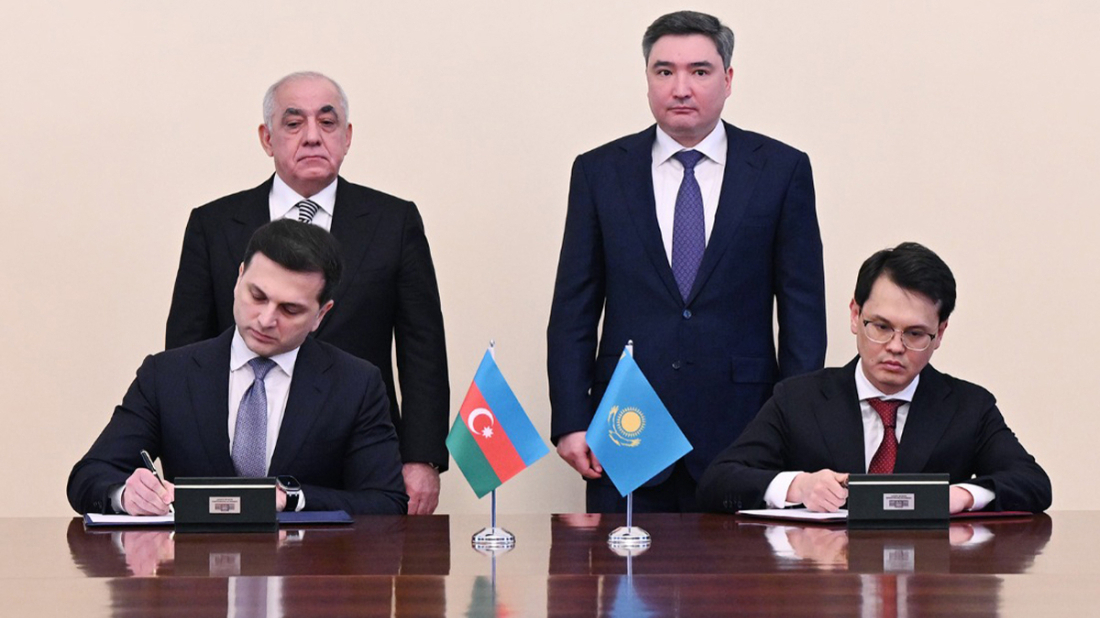
Azerbaijan and Kazakhstan have signed an agreement to design and build the Trans-Caspian Fiber Optic Cable Line, which will connect the two countries as part of the Digital Silk Way project.
The document was signed by Emil Masimov, Chairman of the Board of AzerTelecom, and Bagdat Musin, Chairman of the Board of Kazakhtelecom, in attendance of the Prime Ministers of Azerbaijan and Kazakhstan, Ali Asadov and Olzhas Bektenov.
The Trans-Caspian Cable Project, strategically important for the region, involves the construction of a 380 km backbone fiber-optic cable between Sumgait (Azerbaijan) and Aktau (Kazakhstan) along the seabed of the Caspian Sea. This will enable high-capacity data transmission, supporting speeds of up to 400 terabits per second.
The construction will be executed in multiple phases, starting with the assessment of coastal areas and the seabed, followed by the design and production of durable, high-quality cables, and their subsequent transportation and installation.
AzerTelecom and Kazakhtelecom plan to complete the project by the end of 2026.
The interstate agreement “On organization of activities by communication operators of Azerbaijan and Kazakhstan in relation to the joint construction, ownership and operation of fiber optic transmission lines along the bottom of the Caspian Sea on Azerbaijan-Kazakhstan route” was signed between Azerbaijan and Kazakhstan on March 19, 2019.

Minnesota Governor Tim Walz has activated the state’s National Guard following the fatal shooting of a U.S. citizen in Minneapolis, an incident that has triggered protests and intensified tensions between state and federal authorities.
Venezuela’s interim president Delcy Rodriguez said on Sunday the country should not fear pursuing energy ties with the United States, as Caracas seeks to expand oil and gas production and attract foreign investment.
Iran’s Foreign Ministry has strongly rejected a U.S. magazine report on the death toll during January unrest. Nationwide protests erupted in response to soaring inflation and a national currency crisis.
A mosaic portrait of Pope Leo XIV was illuminated on Sunday at the Basilica of St. Paul Outside the Walls in Rome, continuing a centuries-old Vatican tradition marking the election of a new pope.
The death toll from nationwide protests in Iran has climbed to 6,126, according to the U.S.-based Human Rights Activists News Agency (HRANA).
Residents in Syria’s Kurdish-majority city of Qamishli have stepped up volunteer patrols amid growing pressure from the country’s Islamist-led government, expressing deep mistrust of Damascus despite a fragile U.S.-backed ceasefire.
Sanctions are a long-used tool designed as an alternative to military force and with the objective of changing governments’ behaviour, but they also end up hurting civilian citizens.
Azerbaijan’s participation in the United States-backed Board of Peace reflects a clear calculation of national interest, according to Chingiz Mammadov, Research Alumni of the National Endowment for Democracy (NED) and the Woodrow Wilson International Center.
A clock in a Tel Aviv square that became a rallying point for Israelis demanding the release of hostages taken during the October 2023 Hamas attack was turned off on Tuesday, 844 days after it began counting their captivity.
Turkish defence firm Aselsan announced on Monday that it had signed a deal with the NATO alliance, of which Türkiye is a longstanding member, for the supply of “Identification of Friend or Foe” (IFF) interrogator systems for use with Man-Portable Air Defense Systems, or MANPADS.
You can download the AnewZ application from Play Store and the App Store.
What is your opinion on this topic?
Leave the first comment