Major currencies remained jittery on Friday as markets considered the impact of a politically turbulent week that saw the collapse of France's government and the brief imposition of martial law in South Korea.
Major currencies remained jittery on Friday as markets considered the impact of a politically turbulent week that saw the collapse of France's government and the brief imposition of martial law in South Korea.
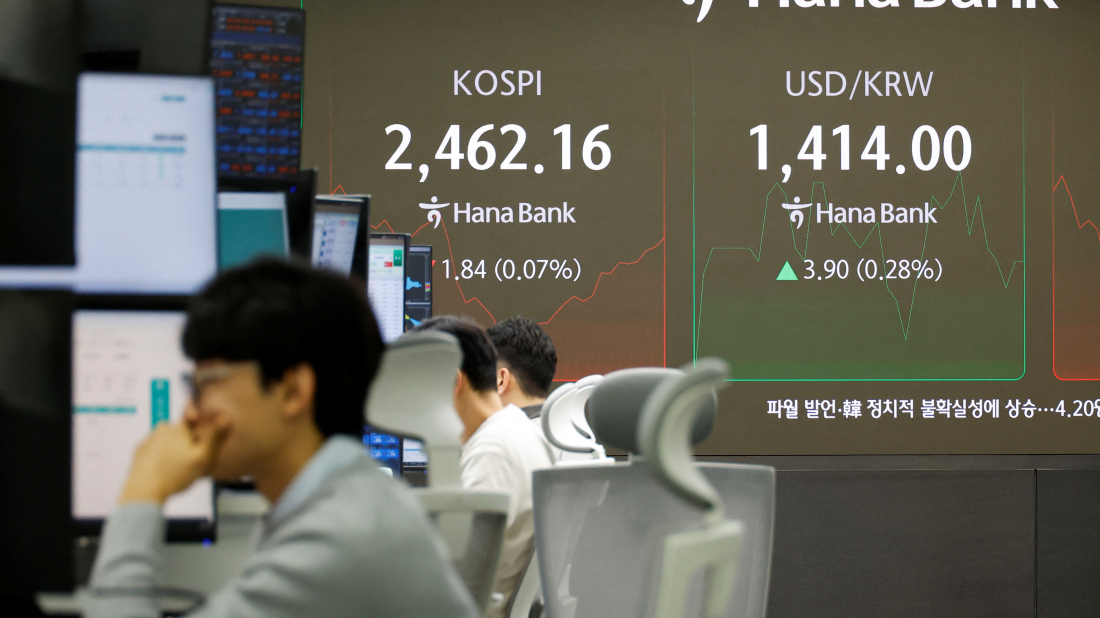
The U.S. dollar spiked against South Korea's won KRW= after local media reported that South Korea's main opposition Democratic Party said lawmakers were on standby after receiving reports of another martial law declaration.
The won was last down 0.43% at 1419.32.
South Korea's President Yoon Suk Yeol shocked the nation and his own ruling People Power Party on Tuesday when he imposed martial law and then rescinded it hours later, spreading turmoil in global financial markets.
The political upheaval has kept Korean markets on edge even as authorities pledged to provide 'unlimited liquidity' to stabilise conditions.
In cryptocurrencies, bitcoin BTC= took a breather after catapulting above $100,000 for the first time a day earlier, and even sceptics now expect a crypto-friendly Trump administration to feed an extended rally.
On the broader economic front, the spotlight will be on the U.S. non-farm payrolls report for November due later in the day as investors look to second guess the pace of future Federal Reserve rate cuts.
Payrolls are expected to have increased by 200,000 jobs last month, according to a Reuters survey, after rising by only 12,000 in October, the lowest number since December 2020.
"The Fed will be wary of placing too much weight on the expected steep rebound in payrolls in November," said Sean Callow, senior FX analyst at InTouch Capital Markets.
"So long as the unemployment rate doesn't fall back to 4.0%, markets should be comfortable about leaning towards a rate cut this month, which should keep a lid on dollar rallies."
Markets currently see about a 72% chance that the Federal Reserve will deliver a 25-basis-point rate cut when it meets on Dec. 17-18, up from 66.5% a week ago, CME FedWatch tool showed.
The dollar index =USD, which measures the greenback against six rivals, rose 0.10% to 105.82 after slipping towards a three-week low in the previous session.
The euro EUR=EBS slid 0.14% to $1.0574 after bouncing on Thursday as French bonds stabilised, pulling further away from a two-year low of $1.03315 hit at the end of November.
French President Emmanuel Macron met allies and parliament leaders on Thursday as he sought to swiftly appoint a new prime minister to replace Michel Barnier, who officially resigned a day after opposition lawmakers voted to oust his government.
For now, the European Central Bank isn't expected to react to heightened political turmoil in Europe when it meets next week.
All but two of 75 economists polled by Reuters believe the ECB will trim 25 basis points from its deposit rate on Dec. 12.
Traders are also all but certain about a rate cute next week.
The euro bloc currency was on track to post a loss this week, the fourth in the last five weeks.
BOJ RATE OUTLOOK IN FOCUS
Traders are pondering the likelihood of a rate hike at the Bank of Japan's meeting on Dec. 18-19 after media reports published on Wednesday suggested the BOJ may stand pat this month, muddling market expectations.
But comments from typically dovish policymaker Toyoaki Nakamura that he's not opposed to rate hikes helped push the currency higher on Thursday.
The dollar was down 0.06% against the yen at 149.98. Government data showed Japanese household spending dropped 1.3% in October from a year earlier, coming in better than expected.
Sterling GBP=D3 traded at $1.2746, down 0.11% on the day.
In cryptocurrencies, bitcoin BTC= hovered lower as traders locked in profit after Thursday's break above the $100,000 milestone.
The world's best known cryptocurrency has been on a tear since November on bets that Donald Trump's U.S. presidential election win will usher in a friendly regulatory environment for cryptocurrencies.
Trump on Thursday said he was appointing former PayPal PYPL.O Chief Operating Officer David Sacks as his artificial intelligence and cryptocurrency czar.
Bitcoin briefly slid to a one-week low and was last down 1.11% at $97,911, well off its all-time-high of $103,649 hit the previous day.

















What is your opinion on this topic?
Leave the first comment