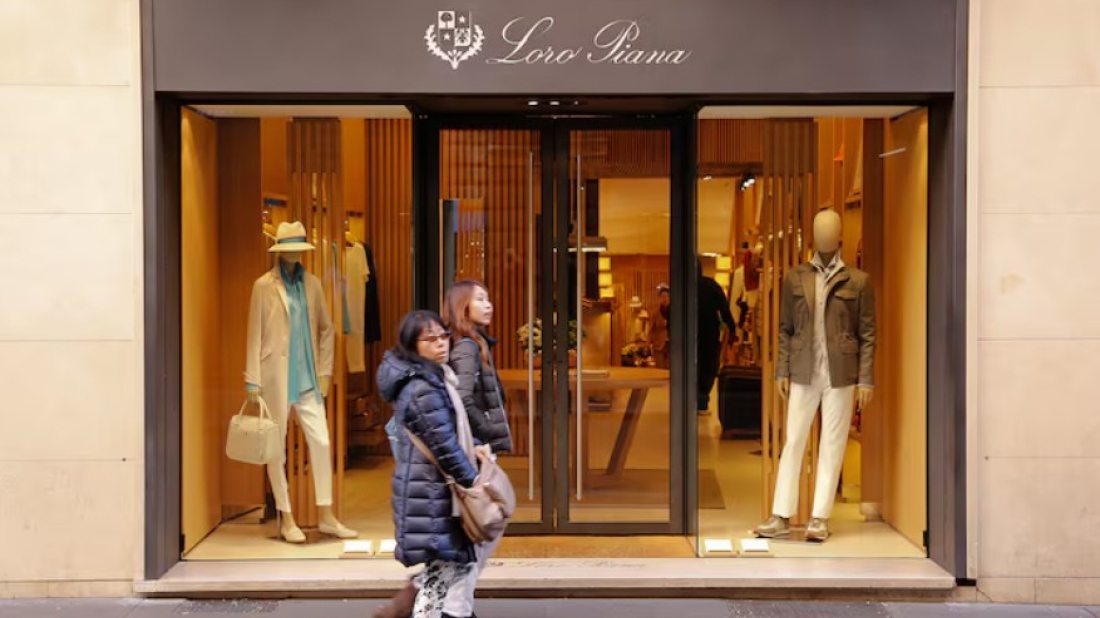
An Italian court has placed LVMH group's high-end Italian cashmere firm Loro Piana under judicial administration for a year after allegedly uncovering worker abuse inside its supply chain, in the latest in a string of cases that have tainted the image of Italy's luxury brand.
Loro Piana Spa is the fifth fashion company to be targeted by the same Milan court for similar labour issues since 2023, according to the 26-page ruling reviewed by Reuters on Monday.
Units of fashion brands Valentino, LVMH's Dior, Italy's Armani, and Italian handbag company Alviero Martini were also placed under administration.
The court found that Loro Piana, which makes cashmere clothing, subcontracted its production through two front firms with no actual manufacturing capacity to Chinese-owned workshops in Italy that it said exploited workers.
The Milan court found Loro Piana "culpably failed" to adequately oversee its suppliers in order to pursue higher profits, according to the ruling.
The court in its ruling also appointed an external administrator to verify the company meets all the judges' demands on control of its supply chain.
Loro Piana declined to comment. LVMH was not immediately available for comment.
The company, Loro Piana said in its statement it "has been constantly reviewing and will continue to strengthen its control and audit activities" to ensure compliance with its own quality and ethical standards across the supply chain.
The administration will be lifted earlier if the unit brings its practices into line with legal requirements, as was the case with Dior, Armani and Alviero Martini previously targeted by the court.
LVMH, the world's biggest luxury group, acquired 80% of Loro Piana in July 2013, leaving 20% in the hands of the Italian family that founded the company.
ITALIAN FASHION FIRMS VIOLATE RULES
In their ruling, the Milan judges wrote that despite the previous cases being widely reported "this production chain, headed by Loro Piana, has continued to operate until now".
In its ruling, the court also emphasises that this kept going even after representatives of Italy's fashion brands signed an accord in May with legal and political authorities to fight worker exploitation.
The owners of the contracting and subcontracting companies are under investigation by Milan prosecutors for exploiting workers and employing people off the books. Loro Piana Spa itself faces no criminal probe.
The prosecutors in the case said the violation of rules among fashion companies in Italy was "a generalised and consolidated manufacturing method".
Italy is home to thousands of small manufacturers that make up 50%-55% of global luxury goods production, consultancy Bain has calculated.
WORKER BEATEN AFTER ASKING FOR BACK PAY
The case involving Loro Piana Spa originated after Carabinieri police from the Milan labour protection unit in May arrested a Chinese workshop owner and closed his factory in the northwestern suburbs of Milan.
The employer was reported by one of his workers for beating him, causing injuries that required 45 days of treatment, after the worker demanded €10,000 ($11,692.00) in unpaid wages.
Carabinieri police found that the workshop produced Loro Piana-branded cashmere jackets and that its 10 Chinese labourers, including five illegal immigrants, were forced to work up to 90 hours a week, seven days a week, were paid €4 an hour, and slept in rooms illegally set up inside the factory.
Carabinieri said in a statement they inspected two intermediary companies and three Chinese workshops, all in the Milan area, and identified 21 workers, 10 of whom were working off the books without proper registration, including seven illegal immigrants.
According to the court ruling, the owner of an intermediary company stated that in recent years she had been producing around 6,000-7,000 jackets per year for Loro Piana at an agreed price of €118 per jacket if the order was for more than 100 items and €128 if the order was under 100 items.
Based on the Loro Piana website, for example, men's cashmere jackets range from a minimum of more than €3,000 to a maximum of over €5,000.
In their statement, Carabinieri concluded they had closed two Chinese-owned factories, the third being a ‘paper’ company with no production capacity, and imposed a joint fine of more than €240,000.

















What is your opinion on this topic?
Leave the first comment