Billionaire Jeff Bezos’s Blue Origin has launched NASA’s twin ESCAPADE satellites to Mars on Sunday, marking the second flight of its New Glenn rocket, a mission seen as a crucial test of the company’s reusability ambitions and a fresh challenge to Elon Musk’s SpaceX.
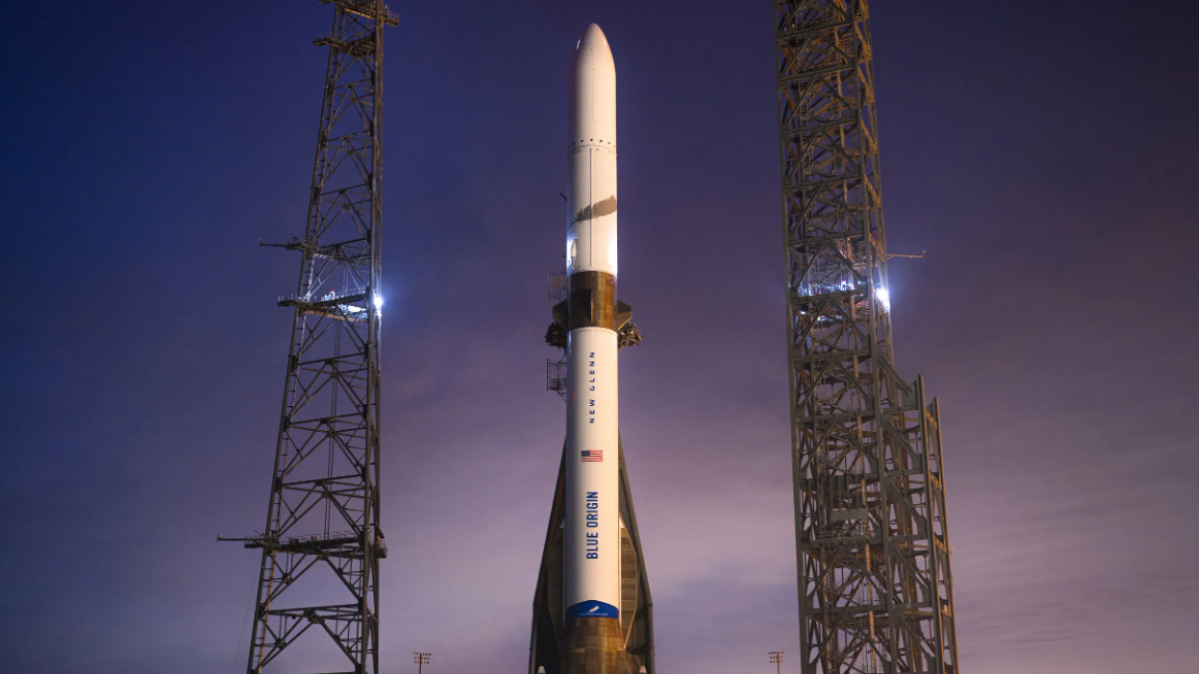
The 322-foot (98-metre) Escape and Plasma Acceleration and Dynamics Explorers (ESCAPADE) rocket blasted off during an 88-minute launch window beginning at 2:45 p.m. (1945 GMT), in what could prove a defining moment for Jeff Bezos’s space venture.
The mission aims to study Mars’s magnetosphere and climate history, laying groundwork for future human exploration of the Red Planet. If all goes according to plan, the twin satellites will reach Martian orbit in 2027.
Beyond the scientific payload, the launch serves as a pivotal test for Blue Origin’s ability to recover its first-stage booster — a feat that, if successful, would mark a major milestone in reusability for the company. Blue Origin’s first New Glenn flight in January achieved orbit but failed to land its booster, which was lost during descent.
This time, engineers hope to replicate what only SpaceX has managed so far: safely returning and reusing a booster stage.
A race beyond Earth
The launch comes amid intensifying competition between Bezos’s Blue Origin and Elon Musk’s SpaceX, whose dominance in orbital launches has long gone unchallenged. The rivalry deepened after the U.S. space agency opened new bidding rounds for upcoming lunar missions, following concerns that SpaceX’s development timeline had slipped.
George Nield, a senior aerospace executive and former FAA official who has flown with Blue Origin, told AFP that Sunday’s launch would be an important signal of the company’s readiness to compete.
“How the launch plays out will be an indicator of how well they’re doing and how much progress they’ve made,” Nield said.
If successful, the mission will not only advance NASA’s Martian research but also position Blue Origin as a credible alternative in commercial spaceflight — an area long dominated by Musk’s company.
Pressure from Washington
U.S. President Donald Trump’s administration has continued to push NASA to speed up its lunar ambitions under the renewed Artemis programme, as Washington seeks to stay ahead of China’s growing space capabilities.
Mason Peck, an aeronautics professor at Cornell University and former NASA chief technologist, said competition between SpaceX and Blue Origin would ultimately benefit the industry.
“More launches mean more ideas in space,” Peck said. “It can’t be a bad thing to have Blue Origin even trailling behind.”
If weather or technical issues delay the mission, rescheduling could prove difficult as the U.S. government shutdown has forced the Federal Aviation Administration to limit commercial rocket launches starting Monday.
With the ESCAPADE mission now en route, Blue Origin will seek to demonstrate that New Glenn can one day rival SpaceX’s Falcon Heavy and Starship — and that Bezos’s vision for reusable, cost-efficient spaceflight is taking off.






















What is your opinion on this topic?
Leave the first comment