Scientists have discovered thriving animal communities living off chemicals, not sunlight, at record depths in the Pacific Ocean’s Kuril-Kamchatka and Aleutian trenches.
In a groundbreaking discovery, Chinese scientists have uncovered abundant and diverse ecosystems of chemosynthetic animals living deep beneath the Pacific Ocean, at depths surpassing 9,500 metres — nearly 25% deeper than such communities have ever been documented.
The expedition, led by the Institute of Deep-sea Science and Engineering (IDSSE) under the Chinese Academy of Sciences, deployed the crewed submersible Fendouzhe into the hadal zone of the Kuril-Kamchatka and Aleutian trenches — regions known for their cold, dark, and geologically active environments.
"What makes our discovery groundbreaking is not just its greater depth – it's the astonishing abundance and diversity of chemosynthetic life we observed," said marine geochemist Mengran Du, the study’s lead author.
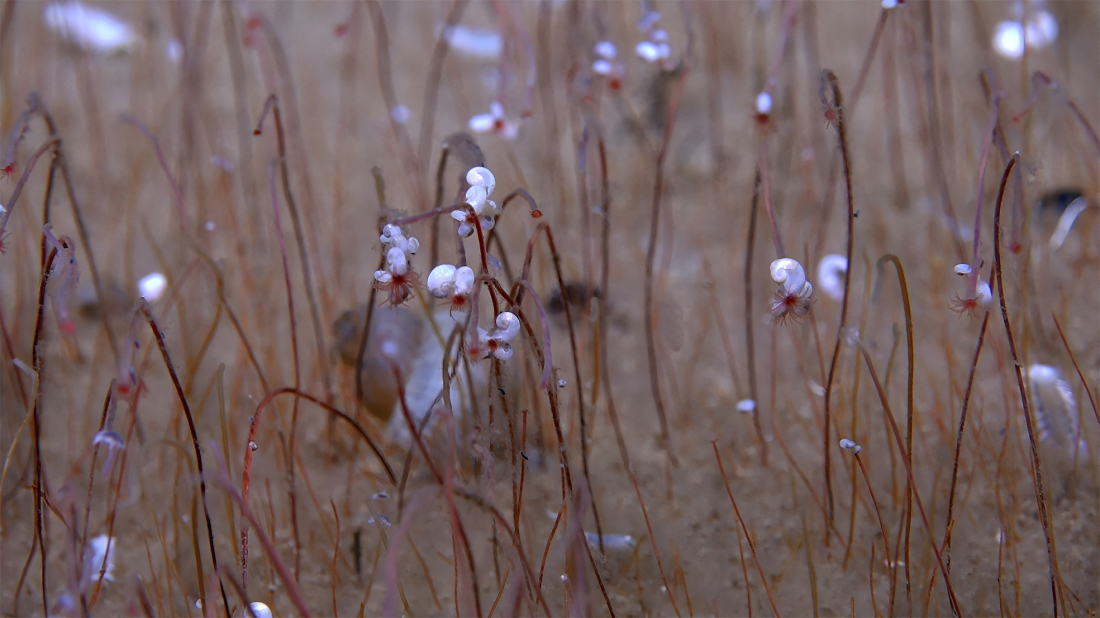
These ecosystems, located more than 9,500 metres below sea level, are sustained by hydrogen sulfide and methane seeping from the ocean floor, rather than sunlight. Tube worms and clams dominate the scene, with several appearing to be previously unidentified species.
The creatures convert these chemicals into energy through chemosynthesis, a biological process previously recorded at shallower depths. According to the researchers, this newly identified habitat represents "the deepest and most extensive chemosynthetic communities known to exist on our planet."
The Kuril-Kamchatka Trench spans 2,900 kilometres off the southeastern Russian coast, while the Aleutian Trench stretches about 3,400 kilometres along the southern edge of Alaska and the Aleutian Islands.
Despite the harsh conditions, including crushing pressure and total darkness, life thrives. "Even though living in the harshest environment, these life forms found their way to survive and thrive," Du said.
Non-chemosynthetic animals such as sea cucumbers and anemones, which feed on organic debris drifting down from above, were also spotted living nearby.
Marine geologist and study co-author Xiaotong Peng noted that this work pushes the known limits of life in extreme conditions and opens the door to further discoveries.
“These findings extend the depth limit of chemosynthetic communities on Earth,” Peng said. “We suggest that similar communities may also exist in extraterrestrial oceans, as chemical species like methane and hydrogen are common there.”





















What is your opinion on this topic?
Leave the first comment