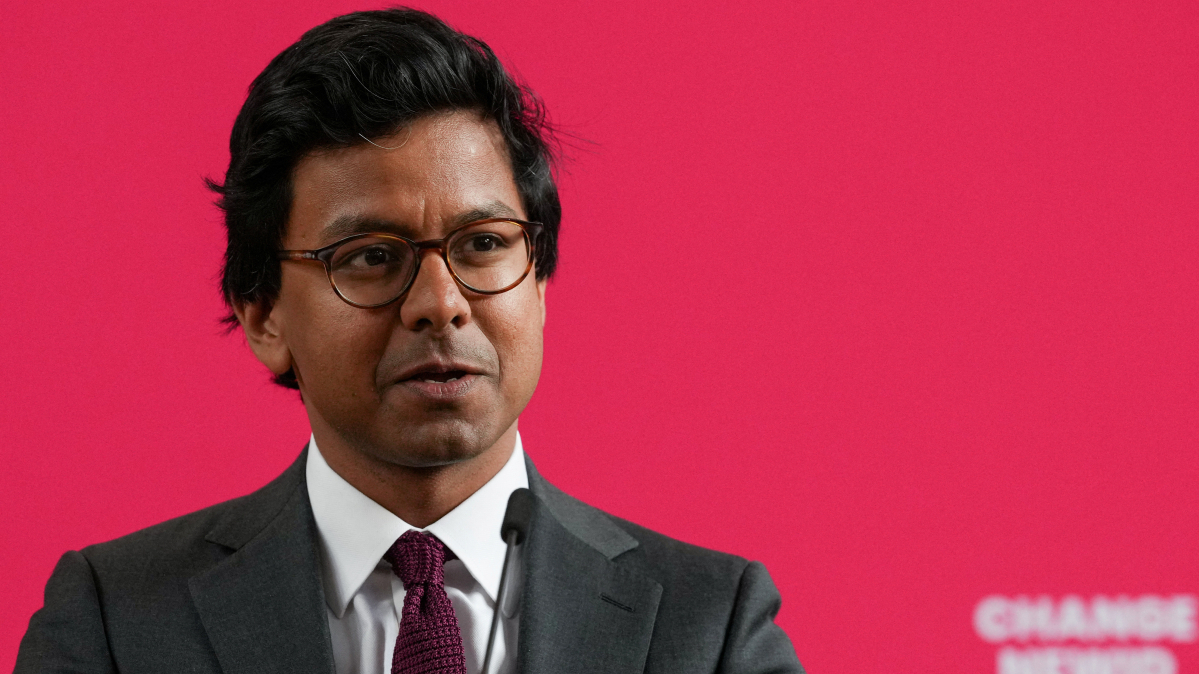
Britain's new Prime Minister Andy Burnham has appointed Kanishka Narayan as Minister for Artificial Intelligence, making it the first time the role has held cabinet-level status. The move signals a stronger government focus on AI as the UK seeks to strengthen its position in the sector.
Born in India, Kanishka Narayan spent his early childhood in Bihar before moving to Delhi and later relocating to Cardiff, Wales, at the age of 12. He studied Philosophy, Politics and Economics at the University of Oxford before completing an MBA at Stanford University.
In 2024, Narayan made history by becoming Wales' first ethnic minority MP after winning the Vale of Glamorgan constituency, according to the BBC.
In September 2025, Narayan was appointed Minister for Online Safety and Artificial Intelligence under Prime Minister Keir Starmer. During his tenure, he oversaw the UK's AI Security Institute and announced millions of pounds of investment for UK semiconductor and AI start-ups.
In July 2026, Burnham appointed Narayan as the UK's first minister dedicated exclusively to artificial intelligence and granted him a seat at Cabinet meetings.
Following the announcement, Narayan shared his thoughts on the future of AI in the UK on X: "Nations have a narrow window to decide whether they shape AI or get shaped by it. Britain is in that window right now. While that window is still open, I will act with pace, I will act with ambition, and I will focus relentlessly on securing British influence in shaping AI."
Changes in the UK tech sector
Britain is home to leading AI companies and research institutions, including Google DeepMind, Wayve and ElevenLabs, and has a strong engineering talent pool. The UK is not the first country to appoint a cabinet-level AI minister. France and Canada established similar roles over the past two years.
Following Brexit, the UK sought to position itself as a hub for overseas technology investment by offering a lighter regulatory framework than the European Union. However, the government has faced criticism for inconsistent technology policies and underinvestment in computing infrastructure.
As part of his agenda, Burnham abolished the Department for Science, Innovation and Technology (DSIT) and merged it with the Department for Business and Trade. He appointed Jonathan Reynolds as Secretary of State to oversee the newly created Department for Business, Innovation, Science and Trade.
The Department for Culture, Media and Sport, led by Lisa Nandy, will also expand its responsibilities, taking on some of the government's digital work and technology regulation previously managed by DSIT.
DSIT was established in 2023 by Rishi Sunak. The department supported research programmes in quantum computing and clean energy, as well as creating AI Growth Zones, designated areas for building data centres with streamlined planning approval and improved access to power.
Industry concerns over department merger
The merger has raised concerns across the UK's technology sector. Dom Hallas, executive director of Startup Coalition, warned that the closure of DSIT would shut the "single front door" the technology sector had to government, calling its abolition "clearly a bad thing".
However, he expressed confidence in the newly appointed AI minister, adding: "But if anyone could make up for it in cabinet, it would be Kanishka [Narayan], who knows startups and the ecosystem better than anyone in government."
Read more





















What is your opinion on this topic?
Leave the first comment