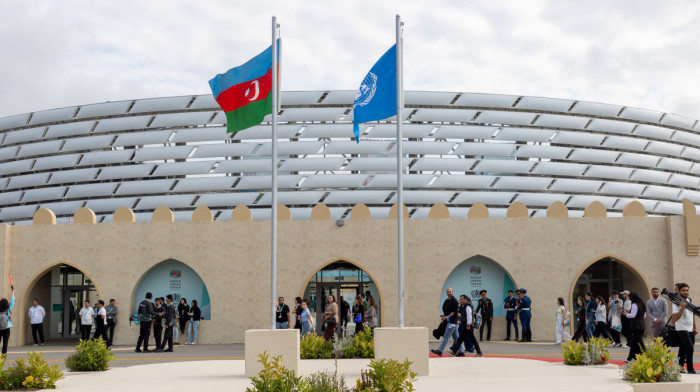
A documentary produced by AnewZ highlighting the Azerbaijani city of Shaki and its living heritage was screened on 21 May during the 13th Session of the United Nations World Urban Forum (WUF13).
The film, titled Shaki: Where Shebeke, History and Craftsmanship Weave Azerbaijan’s Living Heritage, presents Shaki as a living heritage site through a poetic and visually rich narrative exploring its architecture, craftsmanship, history and cultural identity.
Produced by Fred Naccache, the documentary centres on the traditional art of shebeke, using it as a metaphor for the spirit and identity of the city.
Shebeke is a centuries-old craft created by assembling wooden latticework and coloured glass without the use of nails or glue. The film portrays it as a fusion of geometry, craftsmanship and imagination that reflects the character of Shaki itself.
The documentary also traces the city’s deep historical roots as a major crossroads along the Silk Road dating back more than 2,500 years. Following the devastating flood of 1772, Shaki was rebuilt while preserving its architectural character. Today, its medieval-style streets and cobbled lanes form part of a UNESCO World Heritage Site.
Palace, faith and trade
One of the central highlights of the film is the Shaki Khan's Palace, regarded as one of the masterpieces of 18th-century architecture.
The palace is renowned for its intricate frescoes and shebeke windows, while decorative motifs such as pomegranates and dragons symbolise the spiritual and political philosophy of the period. Located within the historic Shaki Fortress complex, the site now houses museums and art galleries connecting the city’s past with its present.
The film also explores Shaki’s religious and commercial heritage. The Khan Mosque is highlighted for its two mihrabs, designed to allow different Islamic communities to worship together harmoniously.
Meanwhile, the ancient Kish Temple reflects the region’s Caucasian Albanian heritage and stands among the oldest churches in the Caucasus.
The city’s historic caravanserais are presented as reminders of Shaki’s former role as an important centre of global trade where goods, cultures and ideas once converged.
Culinary traditions and living heritage
The documentary concludes by focusing on Shaki’s culinary traditions, particularly its famous halva, whose decorative patterns echo the geometric designs of shebeke windows.
Through these interconnected elements, the film presents Shaki not simply as a city of monuments, but as a living cultural space where history remains closely tied to everyday life.
The film closes with the message that in Shaki, “everything created by hand is always created with the heart.”
The documentary is also notable for being the only Azerbaijani film selected for screening as part of WUF13.













What is your opinion on this topic?
Leave the first comment