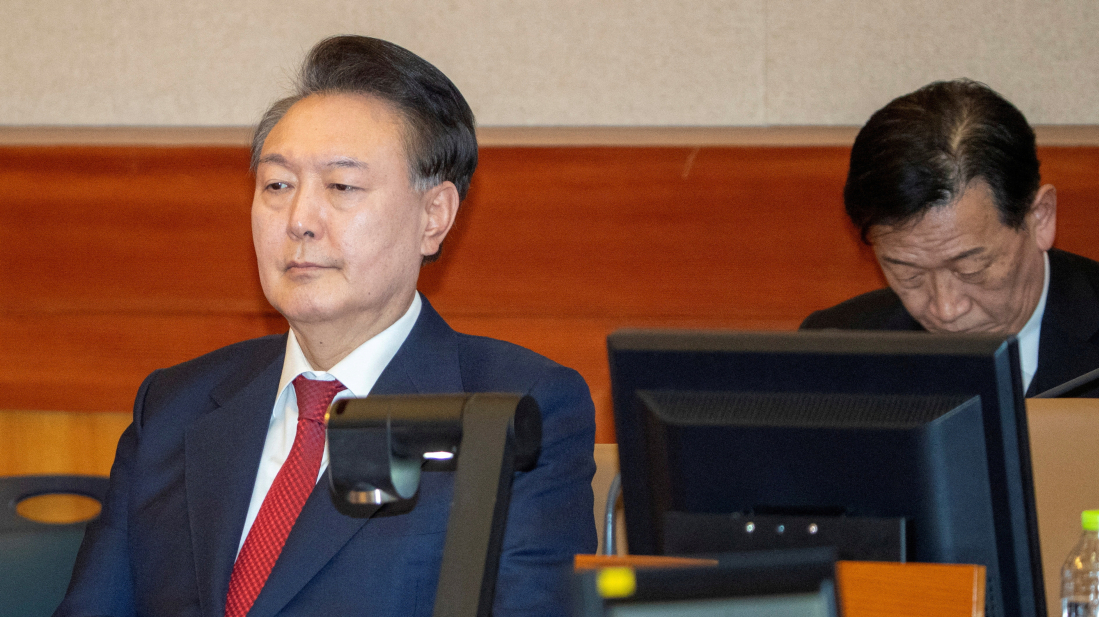
South Korean President Yoon Suk Yeol will give a closing statement on Tuesday in a Constitutional Court trial reviewing his impeachment for declaring martial law. If upheld, he could be removed from office less than three years into his term, with a new election required within 60 days.
South Korean President Yoon Suk Yeol is anticipated to deliver a closing statement on Tuesday in a Constitutional Court trial assessing his impeachment, as public hearings conclude and his political future is placed in the hands of eight judges.
Yoon risks being ousted from office less than three years into his five-year presidency if the court upholds parliament's impeachment, which accused him of declaring martial law on December 3 without valid constitutional justification.
The president has stated in his trial that he had the authority to declare martial law but never intended to enforce full military rule, instead asserting that he sought to issue a warning regarding the opposition Democratic Party's misuse of its parliamentary majority.
Yoon and the chairman of parliament's judiciary committee, Jung Chung-rae, will present their final statements on Tuesday at a hearing scheduled to commence at 2 p.m. (0500 GMT). The justices are expected to deliberate for several days before deciding whether to remove him from office or reinstate him.
Yoon has stated during the trial that martial law, which was in place for merely six hours before he revoked the decree, was not a failure but rather ended sooner than he had anticipated.
He also argued that it was futile to debate allegations that he instructed military commanders to storm parliament to expel lawmakers assembling to overturn the martial law decree, as "nothing actually happened" and no one was harmed.
Yoon’s reasoning prompted a rebuke from parliament, which asserted that the president is unfit to determine what constitutes a national emergency warranting such an extreme measure and that he could attempt to impose martial law again if reinstated.
His unexpected martial law declaration, which enforced a prohibition on political and parliamentary activity, sparked a constitutional crisis that also resulted in the impeachment of the prime minister, who was serving as acting president. The finance minister is currently leading the country.
Yoon is being held at the Seoul Detention Centre after being arrested in connection with a separate criminal case, in which he is accused of orchestrating an insurrection. The former prosecutor is the first sitting president to stand trial on criminal charges.
The Constitutional Court has not specified when it will issue its ruling on Yoon but has up to six months from December 14, when it registered the case following parliament's impeachment vote.
Former President Park Geun-hye was removed from office in 2017 by the Constitutional Court 11 days after the final arguments in her impeachment trial.
If Yoon is removed, a new presidential election must be conducted within 60 days.
















What is your opinion on this topic?
Leave the first comment