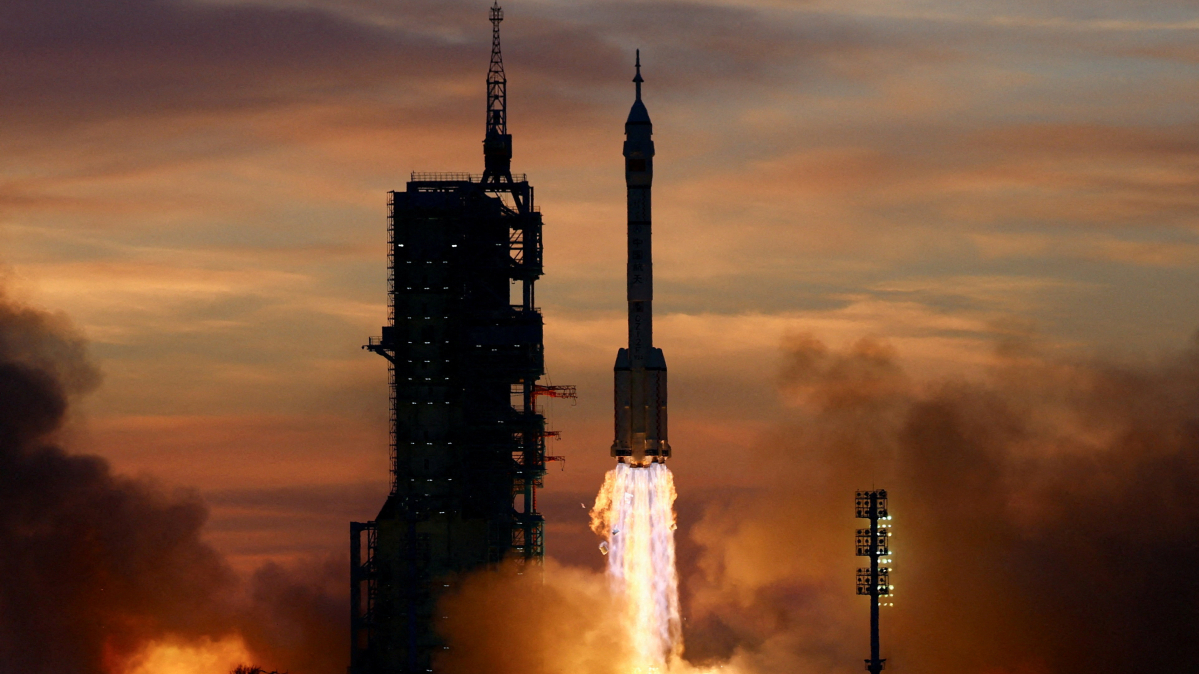
China's Shenzhou-24 spacecraft successfully docked at the Tiangong space station on Wednesday, carrying Pakistani astronaut Muhammad Zeeshan Ali, who has become the first Pakistani in orbit and is set to become the first foreign astronaut to board China's orbital station.
The spacecraft docked at 11:56 a.m. Beijing time (03:56 GMT), approximately three and a half hours after launching aboard a Long March-2F rocket from the Jiuquan Satellite Launch Centre in north-western China.
Ali, a 40-year-old pilot, will serve as a payload specialist and spend between five and ten days aboard the station, alongside Chinese commander Tang Hongbo and flight engineer Wu Yi.
The Pakistani astronaut completed seven months of training in Beijing, including intensive Chinese-language lessons.
“I'm not flying for myself. I carry the name of Pakistan on my shoulder,” Ali told reporters ahead of the launch.
Strengthening China-Pakistan space cooperation
Pakistani Prime Minister Shehbaz Sharif welcomed the historic mission, describing it as a testament to the longstanding friendship between Islamabad and Beijing.
The mission builds on decades of space cooperation between the two countries, which began in the early 1990s.
China has previously launched Pakistani satellites, while a Pakistani-built rover is expected to participate in a Chinese lunar mission around 2028.
During his stay aboard Tiangong, Ali will conduct scientific experiments, including research into self-healing carbon fibre composites capable of repairing small cracks in spacecraft.
Pakistan's Development Minister Ahsan Iqbal expressed hope that the mission would pave the way for deeper cooperation, potentially including a joint lunar mission.
Chinese astronaut to spend a year in orbit
The mission will also feature an unusual crew handover, with Shenzhou-23 commander Zhu Yangzhu remaining aboard Tiangong for an extended stay.
Zhu will spend a year in orbit, supporting research into the effects of prolonged spaceflight on the human body. He is expected to set a new record for the longest continuous stay in space by a Chinese astronaut.
Ali will return to Earth alongside the remaining members of the Shenzhou-23 crew.
China's growing space ambitions
China is positioning Tiangong, which has been fully operational since late 2022, as a centre for international scientific cooperation as the International Space Station faces possible retirement by 2030.
Beijing remains committed to landing astronauts on the Moon by 2030, despite delays to its Chang'e-7 lunar mission.
China also plans to establish a lunar research base with Russia by 2035, while the U.S. aims to return astronauts to the Moon by 2028.
The competing programmes highlight growing international competition in lunar exploration, although Beijing maintains that it supports the peaceful use of outer space.
Read more:














What is your opinion on this topic?
Leave the first comment