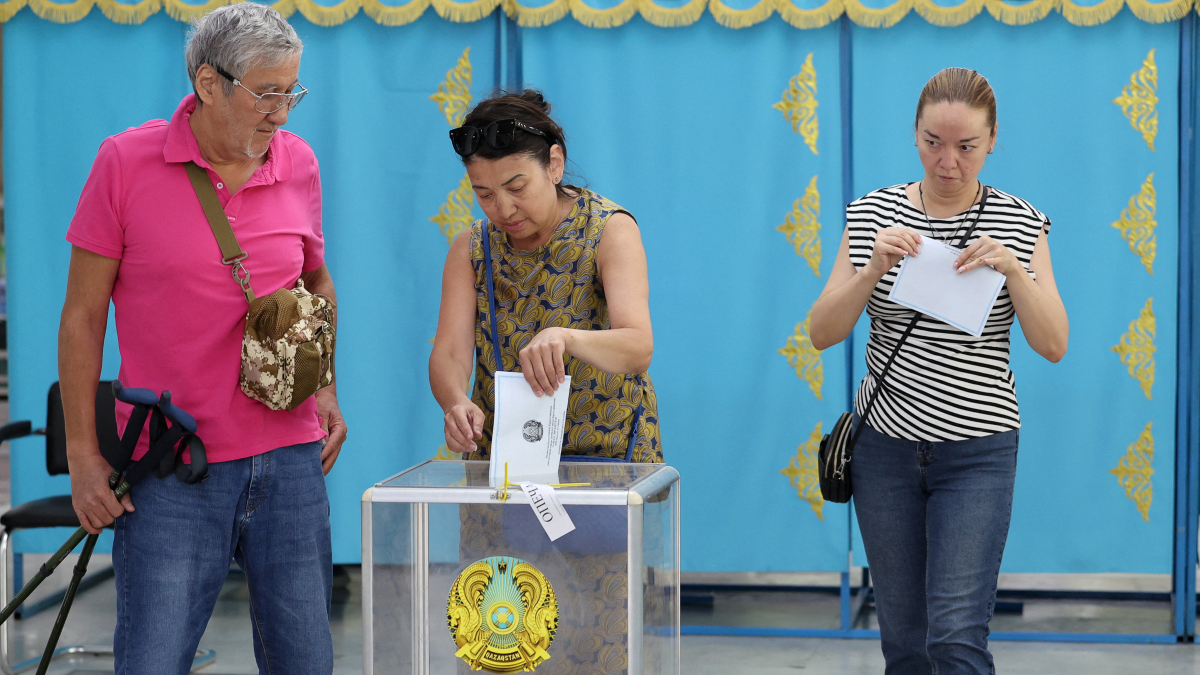
Kazakhstanis went to the polls on Sunday in a snap parliamentary election held under the country’s new constitutional system, which replaces the former two-chamber parliament with a single 145-seat legislature known as the Kurultai.
The election is widely expected to strengthen President Kassym-Jomart Tokayev’s political influence, with opinion polls showing strong support for the pro-government Adilet party.
First election under new Constitution
The vote follows the adoption of Kazakhstan’s new Constitution earlier this year. It took effect on 1 July, ending the powers of the Senate and the Mazhilis and creating the unicameral Kurultai.
The name Kurultai was chosen as a reference to the historical political traditions of the nomadic peoples of the Eurasian steppe. Kazakh authorities say the return of the term to modern constitutional practice is intended to connect the country’s contemporary political system with its historical traditions and national statehood, while combining them with modern democratic mechanisms.
All 145 deputies will be elected through proportional representation from party lists in a single nationwide constituency, meaning voters choose a political party rather than an individual candidate. A total of 545 candidates from seven political parties are competing for five-year terms.
Tokayev described the transition to the new system as “a major stage in Kazakhstan’s political development” and said the election would provide an opportunity to demonstrate “open, honest and competitive politics.”
Pro-Tokayev party leads field
Opinion polls indicate a large lead for Adilet, a pro-Tokayev party established only months ago. The previous ruling party, Amanat, which had dominated Kazakh politics since the 1990s, dissolved itself and was absorbed into the new political landscape. Several opposition parties are also contesting the election, although they are broadly viewed as loyal to Tokayev.
Voting in Astana, Tokayev told journalists that it was too early to say whether he would seek another term. Kazakhstan’s Supreme Court said last month that the new Constitution allows Tokayev, who became president in 2019, to run for another seven-year term.
The new parliamentary system is expected to further reshape Kazakhstan’s political structure, while the possibility of Tokayev seeking another term remains a key question.
Seven parties contest election
The seven parties taking part are Adilet, Ak Zhol, Auyl, Respublica, People's Party of Kazakhstan, Baitaq and the Nationwide Social Democratic Party. Their campaigns have focused on a range of domestic issues:
Adilet - state reform, economic development, digitalisation, education, regional development and social protection.
Ak Zhol - private business, competition and parliamentary accountability.
Auyl - rural development, agriculture and food security.
Respublica - entrepreneurship, digital government, infrastructure and economic competitiveness.
People’s Party of Kazakhstan - social protection, wages, healthcare, education and support for families and pensioners.
Baitaq - environmental protection and the transition to a green economy.
Nationwide Social Democratic Party - social justice, reducing inequality and strengthening political competition.
Adilet has the largest number of candidates, with 186, followed by Respublica with 76, the People’s Party with 72, Auyl with 69, Ak Zhol with 63, Baitaq with 47 and the Nationwide Social Democratic Party with 33. All seven parties complied with statutory requirements concerning the representation of women, young people and people with disabilities.
The first session of the newly elected Kurultai is expected to be convened by the president within 30 days of the publication of the election results.
Read more:













What is your opinion on this topic?
Leave the first comment