Peace. Prosperity. New political forces. A technology-driven economy. Following Armenia’s parliamentary election, AnewZ took to the streets of Yerevan to ask people how they imagine their country five years from now.
An election decides who governs.
It does not decide what success means.
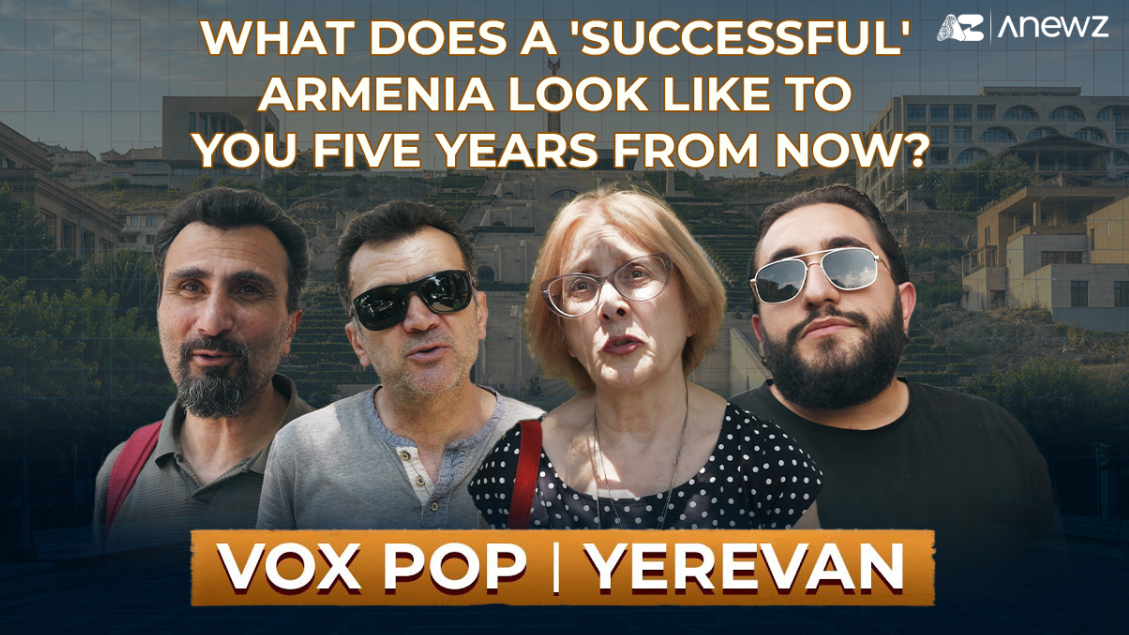
Following Armenia’s parliamentary election, AnewZ asked people on the streets of Yerevan one question:
What would a successful Armenia look like five years from now?
Their answers revealed hope, frustration and uncertainty.
Some imagined a richer and more technologically advanced country.
Others placed peace and security above everything else.
And some argued that Armenia could not move forward without an entirely new political generation.
A demand for new political forces
For several people, Armenia’s central problem was not simply which party had won the election.
It was the absence of a convincing alternative.
“Our pain is that we have to choose between the bad and the worst,” one person said.
They argued that Armenia needed a political representative with no connection to either the current government or the former authorities.
Another person also called for political renewal.
“New forces should come. These ones are outdated already,” they said, pointing towards the younger generation as a possible source of change.
Another described the desired future as “a more European Armenia, but with Christian values”.
The words differed.
The frustration did not.
For these people, changing the government would not be enough. Armenia needed a change in its political class.
Peace before ambition
For others, success began with something more fundamental: security.
They spoke of a more peaceful Armenia. A safer Armenia. A country able to plan for the future without constantly fearing another crisis.
“It would be good if we do not lose what we have,” one person said, while expressing hope for greater peace and security.
Another argued that Armenia should pursue peaceful relations and solidarity with other states.
Several people connected peace directly to economic development.
They wanted transport routes opened, regional trade expanded and Armenia transformed into a stronger transit country.
“The roads must all be unblocked. Trade must develop,” one person said.
In this vision, peace is not only the absence of conflict.
It is movement.
It is trade.
It is opportunity.
Prosperity that can be felt
Economic development appeared repeatedly in the responses.
Some predicted that Armenia could become a highly developed and industrial country within five years.
Others focused on something more immediate: the daily financial security of ordinary people.
“People should go to work happy and return home happy,” one person said.
For them, success would not be measured only through national statistics.
It would be measured at home.
A stable income.
A secure job.
A life with less anxiety.
People also called for development beyond Yerevan.
They wanted stronger villages and regional cities, fewer people forced to move to the capital and less pressure on Yerevan’s roads and services.
Success, they suggested, should not stop at the borders of the capital.
A technological and democratic Armenia
Technology was another recurring theme.
People spoke about electronics, computer businesses, chip production and cooperation with major international technology companies.
One person described the Armenia of the future in four words:
“Democratic, technological, developed, modern.”
Another offered a more ambitious comparison:
“Like Singapore. Rich, independent.”
Others imagined a country recognised internationally for its culture, history and ability to attract the world’s attention.
There were also calls for greater freedom of speech, stronger democracy and closer access to Europe, including visa-free travel.
Yet modernisation was not presented as the rejection of Armenian identity.
The country they imagined was modern, but still distinctly Armenian.
Hope — but not certainty
Not everyone offered a detailed vision.
Some admitted that five years was too far ahead to predict.
“Time will tell,” one person said.
Others expressed confidence that Armenia would continue moving forward, even if progress remained slow.
“Little by little, slowly, slowly it will move forward,” another said.
The interviews do not constitute a scientific survey and cannot represent every political or social group in Armenia.
But they reveal the debate beneath the ballot.
Some want political renewal.
Some want continuity.
Some look towards Europe.
Others emphasise national leadership, traditional values and independence.
Yet several demands repeatedly return.
Peace.
Security.
Better living standards.
And a government capable of delivering more than promises.
The election answered one question: who will govern Armenia?
The harder question remains.
What kind of Armenia will they build?











What is your opinion on this topic?
Leave the first comment