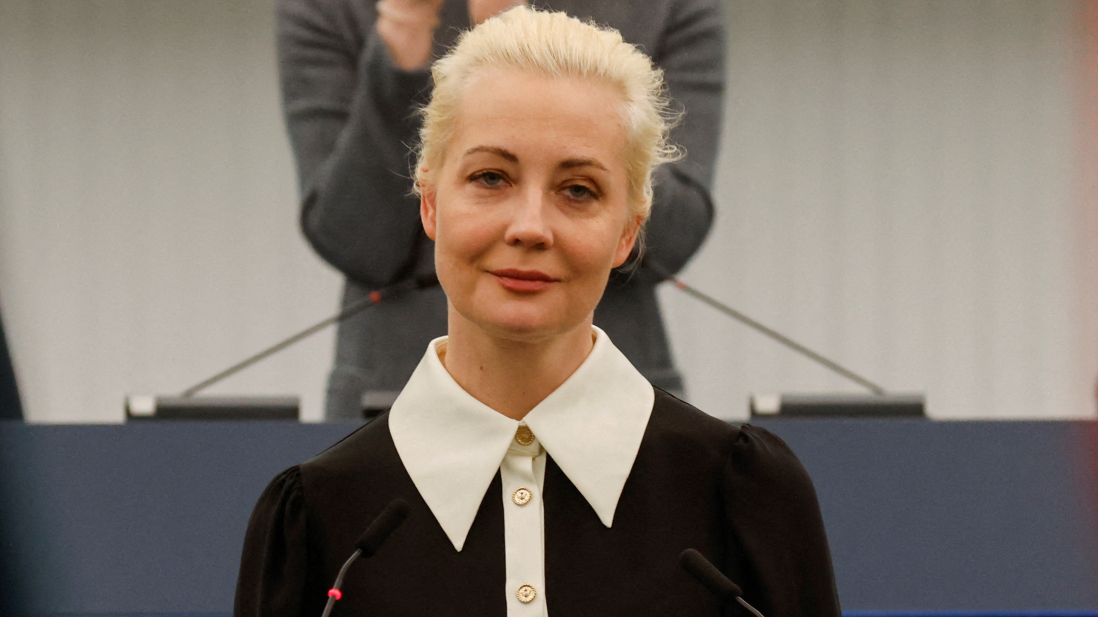
Yulia Navalnaya, the wife of late Russian opposition leader Alexei Navalny, has revealed that her husband has been poisoned.
In a video released on 17 September, Navalnaya said that Western laboratory tests on biological samples obtained from her husband confirmed the poisoning.
“I will not be silent. I affirm that Vladimir Putin is guilty of killing my husband, Alexei Navalny,” Navalnaya said.
However, the Kremlin has denied any knowledge of this.
When asked about Navalnaya's remarks, Kremlin spokesman Dmitry Peskov said, "I don't know anything about these statements of hers, and I can't say anything."
Navalny died suddenly at the age of 47 on 16 February, 2024, in a Russian prison in the Arctic Circle, depriving the Russian opposition of its most popular leader.
Navalnaya has repeatedly accused Russia of killing him, an allegation the Kremlin dismisses as nonsense.
President Vladimir Putin has said that before Navalny died, there had been plans to swap Navalny in a prisoner exchange with the West.
In her video posted on X, Navalnaya said that biological material from Navalny was smuggled abroad in 2024 and that two laborotories examined the material.
"These labs in two different countries reached the same conclusion: Alexei was killed. More specifically, he was poisoned," Navalnaya said.
Navalny had earned admiration around the world for voluntarily returning to Russia in 2021 from Germany, where he underwent treatment for what Western laboratory tests showed was an attempt to poison him with a nerve agent in Siberia.
He was arrested on arrival and was serving sentences on fraud, extremism and other charges that he said were trumped up to silence him.
In her video, Navalnaya described her husband's last moments. He felt ill in a small exercise cell and was crouched on the ground in pain, she said. But he was then put in a punishment cell.
Last year, Navalnaya dismissed information from Russian investigators that Navalny had died from "a combination of diseases".
"Alexei lay on the floor and pulled his knees up to his stomach and moaned in pain," she said. "He said his chest and stomach were burning. Then he began to vomit."
She showed a picture of what she said was the cell. It showed a pile of vomit on the floor.
The Kremlin casts Navalny's political allies as dangerous extremists out to destabilise Russia on behalf of the West. It says Putin enjoys overwhelming support among ordinary Russians.
U.S. intelligence agencies have determined that Putin did not order Navalny killed, according to the Associated Press and the Wall Street Journal.
Navalnaya said that the truth about her husband's death was inconvenient for some unidentified politicians in the West, but gave no specifics.











What is your opinion on this topic?
Leave the first comment