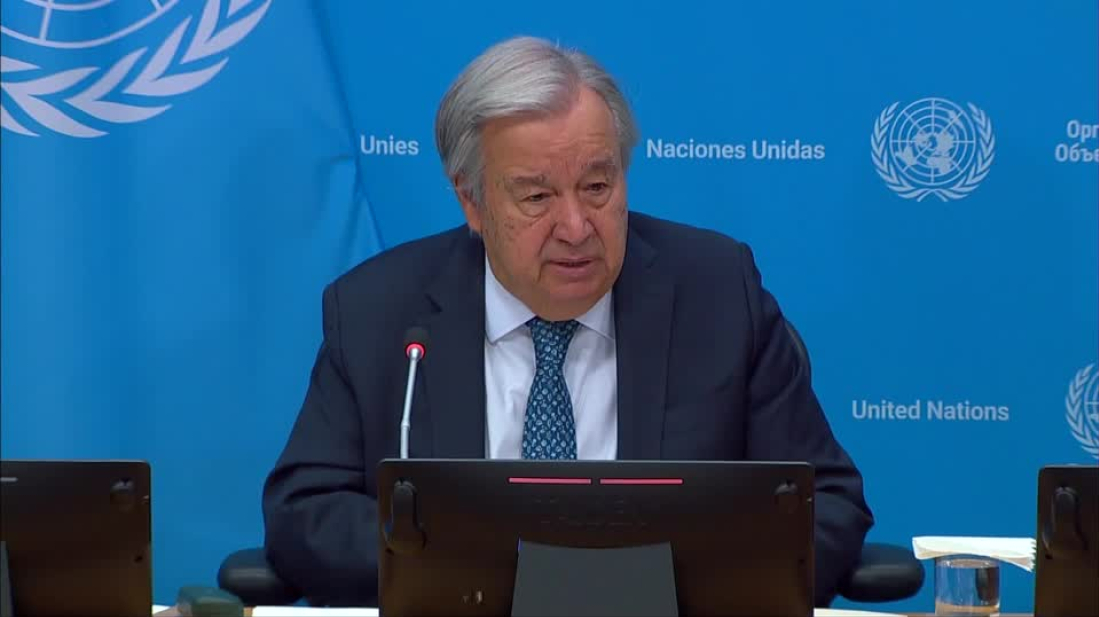
United Nations Secretary-General Antonio Guterres reaffirmed on Tuesday that a two-state solution is the only viable path to settle the Israel-Palestine conflict.
While addressing the latest developments in the Israel-Palestine conflict at a press conference, Guterres reiterated his strong support for the two-state solution, calling it the only realistic framework to resolve the crisis.
"I think we absolutely must do everything and mobilize as much as we can the international community to make sure that the two-state solution prevails. And the question is simple, what is the alternative? It's a one state in which when people is deprived of basic rights? One state in which, when people is moved out of their lands? Is this possible in the 21st century? Is this acceptable in the 21st century?," he said.
"I think that Israel must understand that the one-state solution with the subjugation of the Palestinian people without rights is absolutely intolerable. And so the two-state solution remains the only viable alternative to preserve peace. Without a two-state solution, there will be no peace in the Middle East, and extremism will expand everywhere in the world, with consequences that I consider extremely, extremely negative," said Guterres.
He also pushed back against the claims by U.S. and Israeli officials that recognising a Palestinian state would reward Hamas or undermine peace.
"First of all, it's not a gift to Hamas. It is a gift to the Palestinian people that has suffered also a lot because of Hamas," said Guterres.
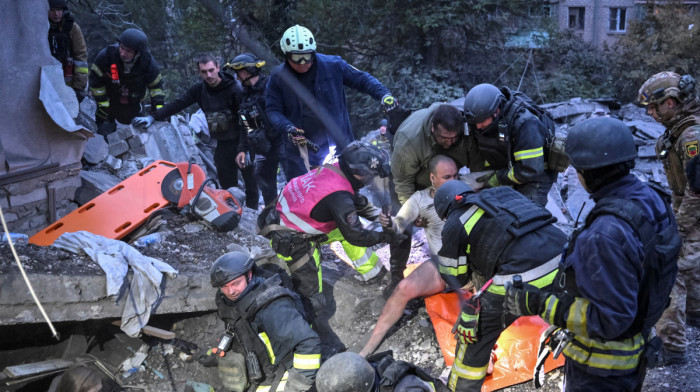
Guterres also expressed deep concern over Israel's military operations in Gaza and the resulting destruction, saying that the large-scale civilian casualties and urban devastation are morally, politically, and legally intolerable.
He also said that what is happening in Gaza is "horrendous" and that the war in the Palestinian territory is morally, politically and legally intolerable.
"What happened in Gaza today is horrendous. We are seeing massive destruction of neighborhoods, now the systematic destruction of Gaza City. We are seeing massive killing of civilians in a way that I do not remember in any conflict since I am Secretary-General. And we are seeing dramatic obstacles to the distribution of humanitarian aid - at a certain moment, it completely stopped."
"With the consequences that the Palestinian people is suffering an horrendous situation with famine, with no access to any kind of health support and with continued displacement and the imminent risk of losing their lives at any moment. So this is something we cannot forget. Independently of the names that are given, the truth is that this is something that is morally, politically and legally intolerable," Guterres added.
He also said he would be willing to meet with Israeli Prime Minster Benjamin Netanyahu and U.S. President Donald Trump at the UN next week.













What is your opinion on this topic?
Leave the first comment