Spanish police have arrested 10 people after three nights of violent unrest in Torre Pacheco, where tensions flared between far-right groups and North African migrants.
Spanish authorities have detained 10 individuals following three consecutive nights of violent clashes between far-right groups and North African migrants in the southeastern town of Torre Pacheco.
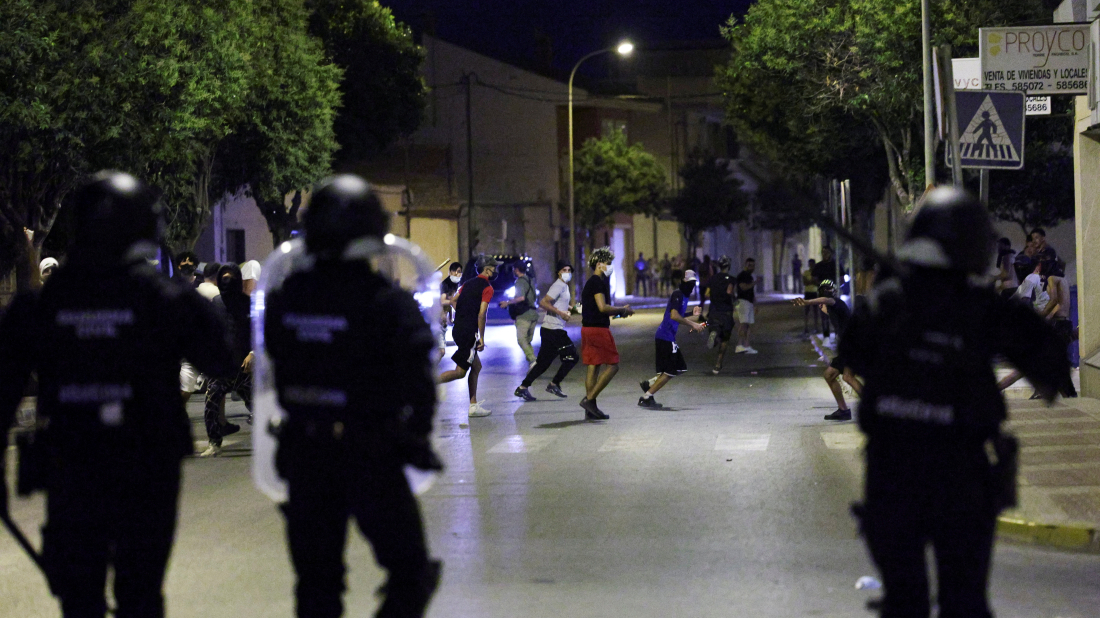
The unrest, one of Spain’s most serious episodes of anti-migrant violence in recent years, escalated on Sunday night as dozens of masked youths hurled bottles and other projectiles at riot police. Officers responded with rubber bullets to disperse the crowd.
The conflict originated from an alleged attack last week (9 July) on a man in his late 60s. Identified in Spanish media as Domingo Tomas, the man said he was assaulted during a walk in a local cemetery garden by two men speaking an unfamiliar language. He was injured but has since returned home.
The Interior Ministry confirmed on Monday that the main suspect in the assault had been arrested in the northern Basque Country. Two foreign nationals were previously detained in connection with the incident.
Among the 10 arrested over the recent violence are six Spaniards and one individual of North African origin. They face charges including assault, hate crimes, and public disorder.
Torre Pacheco, a municipality of about 40,000 residents, is home to a large migrant population, many employed as agricultural day labourers in the Murcia region. Migrants and local officials alike have urged calm amid growing fears of reprisal attacks.
"I ask the migrant community not to leave their homes and not to confront rioters," said local mayor Pedro Angel Roca. "Confrontation achieves nothing and ultimately makes us all afraid."
Interior Minister Fernando Grande-Marlaska blamed far-right groups and political rhetoric for fuelling the unrest, saying the violence was coordinated through social media.
The far-right party Vox, which has led recent opposition to the government’s migration policies, denied any involvement. Vox leader Santiago Abascal instead blamed the government for what he described as “failed migration strategies.”
In recent weeks, the national debate over immigration has intensified amid plans to relocate unaccompanied migrant minors from the Canary Islands to mainland Spain.
"Spain is not a country that hunts down immigrants," said Migration Minister Elma Saiz, condemning the anti-migrant sentiment. "If we have to take to the streets, it is to defend the rights of those trapped and distressed by this hunt."
Abdelali, a North African resident of Torre Pacheco, expressed concern for his safety. "We want peace. That’s what we want, we don’t want anything else," he said.
The latest unrest has drawn comparisons to the 2000 anti-immigration riots in El Ejido, a town in southern Spain where similar violence erupted after the killing of Spanish citizens by Moroccan migrants.
Spanish authorities continue to monitor the situation, urging restraint and unity as the investigation into the initial assault and subsequent riots progresses.


















What is your opinion on this topic?
Leave the first comment