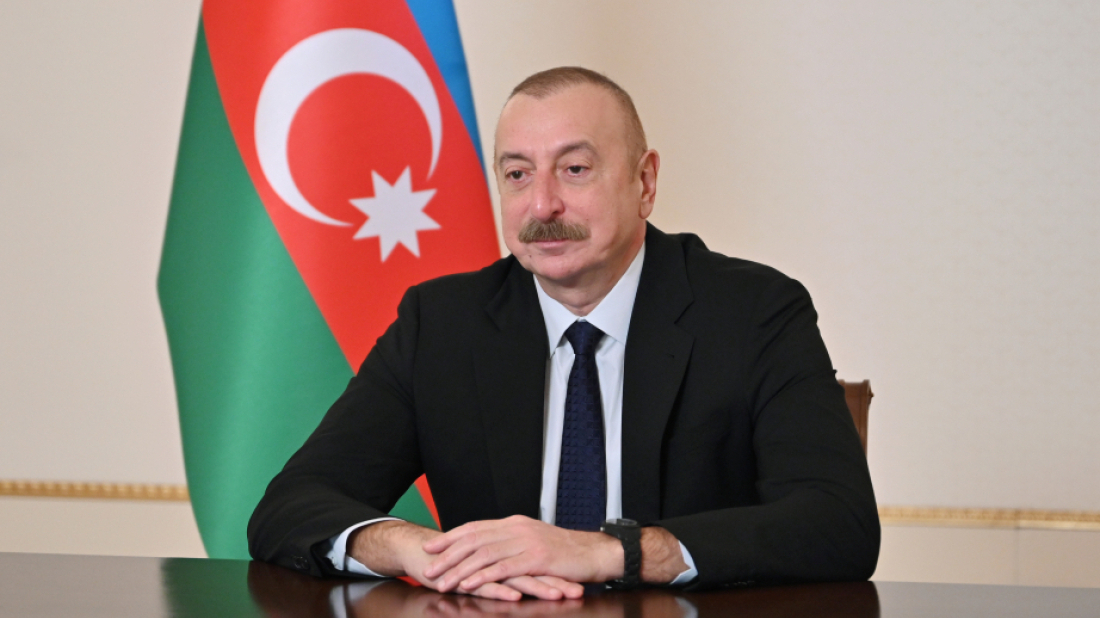
Azerbaijani President Ilham Aliyev, in a letter to the international conference on “Return to Western Azerbaijan as an Important Condition for the Supremacy of Human Rights” in Ankara, stressed peace, justice, and urged Armenia to support a safe return and abandon territorial claims.
Dear conference participants,
I sincerely welcome you, the participants of the international conference on “Return to Western Azerbaijan as an Important Condition for the Supremacy of Human Rights” being held in Ankara, and express my gratitude to the friendly and brotherly Republic of Türkiye for hosting this important event.
The conference, which brings together representatives of Azerbaijan and Türkiye, is a very significant event on the path to establishing peace, justice, and human rights in our region. The alliance and brotherly relations between Azerbaijan and Türkiye, and the commitment of both countries to the principles of international law, provide a solid foundation for ensuring stability in the region.
Unfortunately, due to armed conflicts and racial discrimination, millions of people are displaced from their homelands and live as refugees. In particular, during and after the First World War, Armenian radicalism and extremism subjected the Azerbaijani people to unprecedented hardships; hundreds of thousands of our compatriots were forcibly removed from their ancestral lands and faced mass murder and massacres.
In Western Azerbaijan - the territory of Armenia - systematic and total ethnic cleansing occurred in 1918–1921, 1948–1953, and 1987–1991, resulting in not a single Azerbaijani remaining in Armenia. In addition to being a great humanitarian tragedy, this ethnic cleansing also served the heinous geopolitical goal of cutting off the overland connection of the main part of Azerbaijan with its integral part, Nakhchivan, by severing Western Zangezur from the rest of Azerbaijan and transferring it to Armenia in 1920.
Armenia destroyed the rich cultural heritage, ancient settlements, mosques, shrines and cemeteries of Azerbaijanis who had lived in Western Azerbaijan for millennia. These destructive steps by Armenia were aimed at erasing the traces of the Azerbaijani people from those territories and rewriting the history of the region.
The glorious Victory gained in the Patriotic War of 2020, the full restoration of our sovereignty in 2023, the current reconstruction of Karabakh and East Zangezur, and the return of former internally displaced persons to their homes have also created great enthusiasm among Western Azerbaijanis, enabling them to work in a more organized manner. The issue of Western Azerbaijan has already been included in the international agenda.
The peaceful initiatives of the Western Azerbaijan Community in accordance with international law are commendable and enjoy the support of the world community. Ensuring the safe, dignified and peaceful return of Western Azerbaijanis to their ancestral lands in Armenia is an essential condition for the establishment of peace, human rights, and reconciliation in the region.
Unfortunately, the deep-rooted hatred for Turkic peoples in Armenian society, the fantasy of a “great Armenia”, the inclusion of territorial claims against Azerbaijan and Türkiye in the constitution of this country, and the denial of the opportunity for the return of Western Azerbaijanis represent obstacles to peace. Armenia should give up its territorial claims against neighboring states, take steps to restore and protect the cultural heritage of Azerbaijanis, allow access to the UNESCO monitoring mission, and start a dialogue with the Community on the issue of return. Armenia should express an unequivocal position on when and under what conditions Western Azerbaijanis can return to their ancestral lands. We expect the Armenian leadership to receive representatives of the Community on this issue.
I would like to emphasize in particular that the desire of Western Azerbaijanis to return does not mean a territorial claim against Armenia, and Armenia should abandon attempts to portray this desire in this manner. This issue will not leave Azerbaijan’s agenda until the return is realized. Of course, Western Azerbaijanis who will return to their homeland should also be provided with security guarantees.
We believe that this international conference, which serves the goal of increasing the awareness of the world community about Western Azerbaijan, will make a significant contribution to the return of our compatriots to their native lands.
We believe that Western Azerbaijanis will return to their native lands safely and with dignity, and that lasting peace will be established in the region.
I convey my best wishes to you and wish the conference every success.
Ilham Aliyev
President of the Republic of Azerbaijan













What is your opinion on this topic?
Leave the first comment