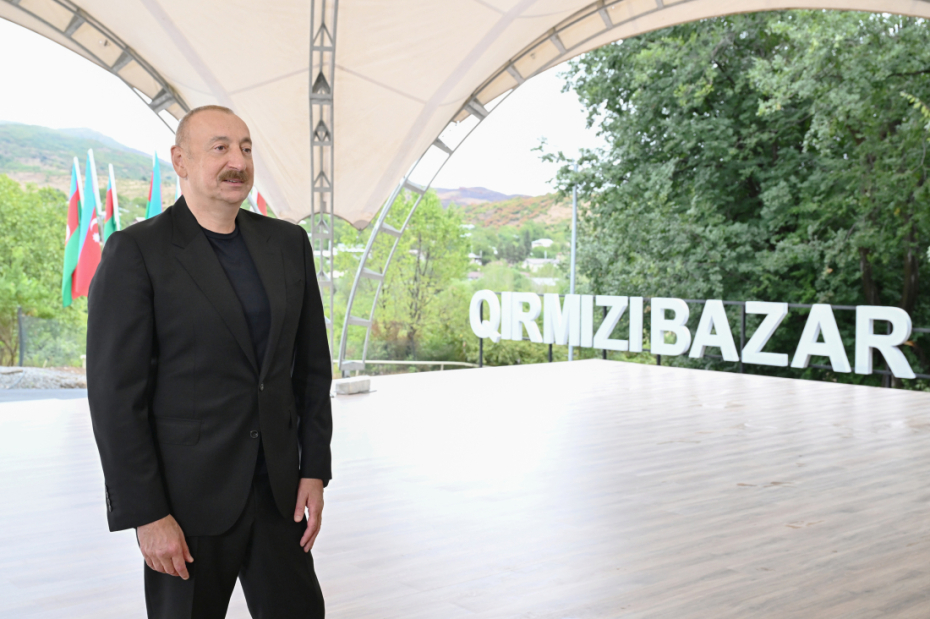
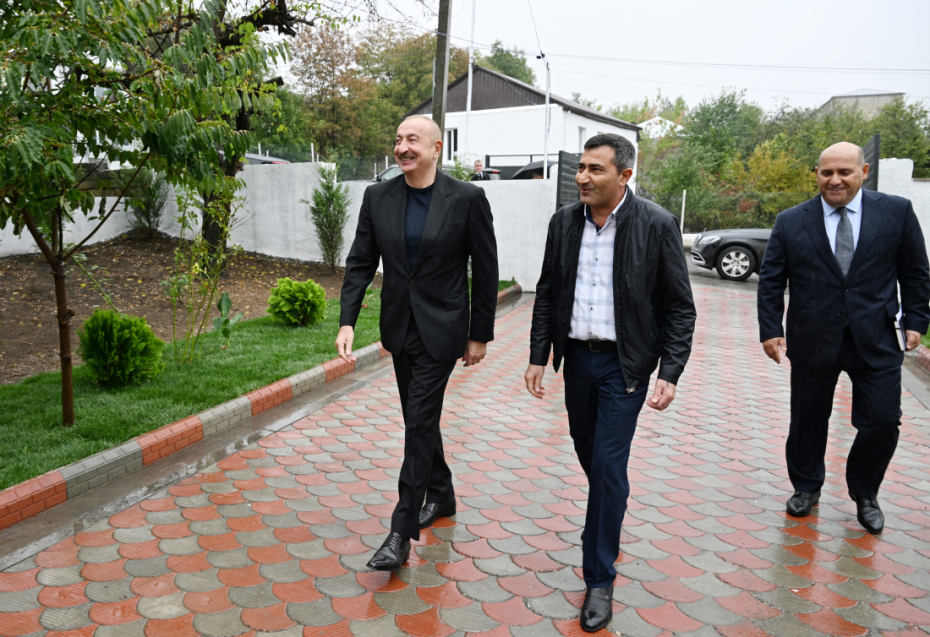
On September 14, President of the Republic of Azerbaijan Ilham Aliyev visited the Hadrut settlement in the Khojavend district.
The head of state was briefed on the developments in the settlement.
Following its liberation from Armenian occupation during the 44-day Patriotic War in 2020, extensive restoration and development projects have been implemented in Hadrut, with work still ongoing.
The “Hadrut” junction substation and Digital Control Center, a new military unit, and the 12.5-kilometer Fuzuli-Hadrut highway have been commissioned. A transformer substation has been built, existing power lines restored, eight water reservoirs repaired, and new water, sewage, and gas lines laid. Internal roads have also been renovated. Essential social infrastructure, including a hotel, commercial facilities, and public catering establishments, has been created in the settlement.
Hadrut has a total of 541 houses, of which 462 are considered uninhabitable and 79 partially habitable. Ten of these houses are already ready for use, while all partially habitable houses are scheduled for restoration by the end of the year.
At present, 10 families, comprising 41 individuals, have returned to their ancestral homeland in Hadrut.
President Ilham Aliyev also visited the home of Hadrut resident Zahid Mustafayev and spoke with his family members.
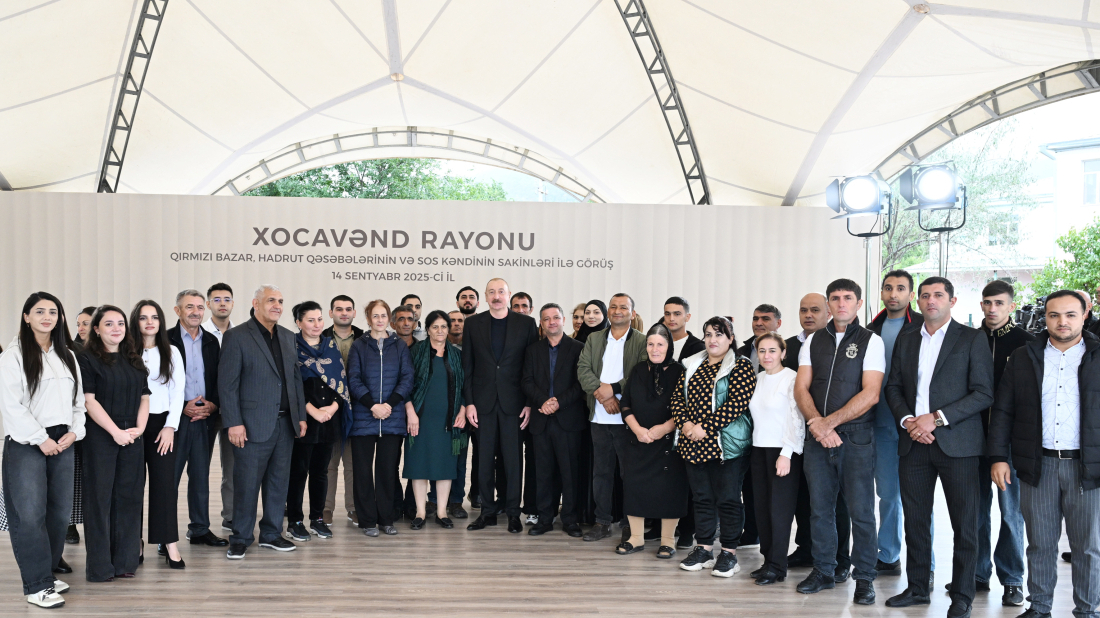
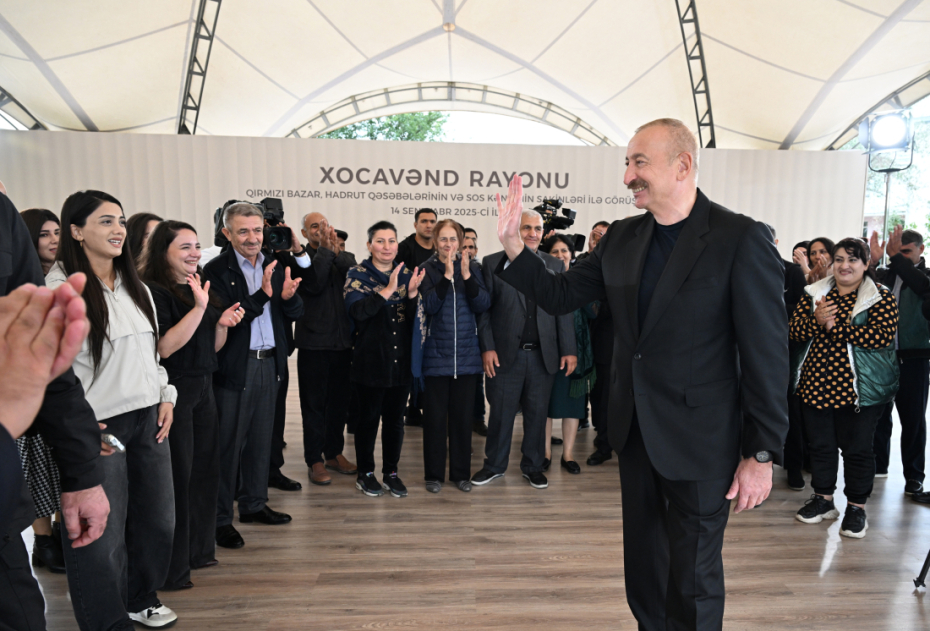
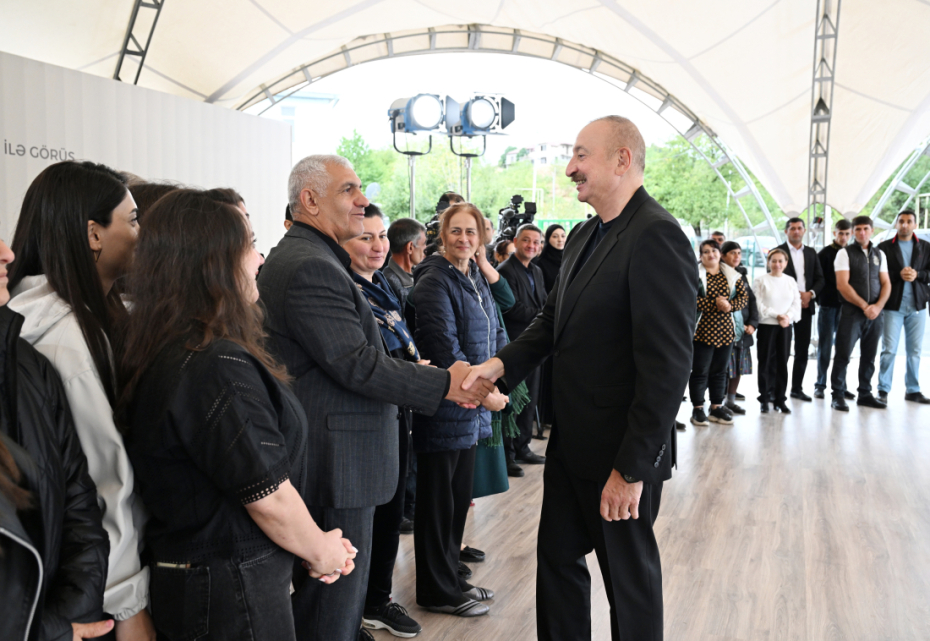
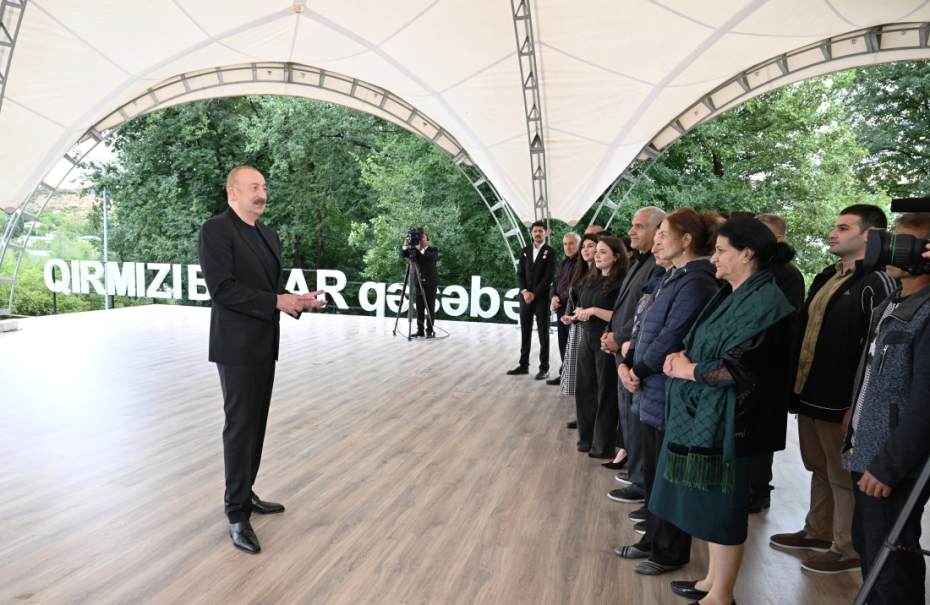
On September 14, President of the Republic of Azerbaijan Ilham Aliyev also met with residents of Girmizi Bazar, Hadrut settlements, and Sos village in the Khojavend district.
The head of state spoke with the residents.
President Ilham Aliyev: We are truly living through historic days. I wholeheartedly congratulate you. You have already settled in your native Karabakh land. Residents from several villages have gathered here today. I visited several villages today, and this will continue tomorrow. All of Karabakh is now fully under our control, and, as you know, this territory was liberated from the occupiers two years ago. During these very days—September 19–20—our glorious Army put an end to separatism. With that, the chapter of separatism was closed, and Azerbaijan fully restored its sovereignty. The “Great Return” Program is also being successfully implemented. In about two months, we will celebrate the fifth anniversary of our historic Victory.
The past five years have been a history of triumph—our glorious history—and I am delighted that you have returned and settled in your ancestral homeland. Conditions have been created for you here; houses have been built and repaired. All necessary amenities are available—water, gas, electricity, heating, schools, medical facilities, and roads. Most importantly, this is our native Karabakh land. These are places with beautiful landscapes, surrounded by mountains, forests, springs, and abundant water. In short, all conditions are in place here to live comfortably, to build and create, to raise children, and to provide them with a good upbringing. From now on, the Azerbaijani people will live in peace. However, to live in peace, strength was, of course, necessary.
May Allah have mercy on all our martyrs. You know that for many years we worked to resolve the Karabakh conflict peacefully. But the Armenian side and those backing them had other intentions. They had no intention of returning our lands. They, along with their supporters—the leaders of major powers—encouraged them, as if they wanted to make this occupation permanent. But they failed to account for one thing: the will, strength, and devotion of the Azerbaijani people to their homeland, the bravery and heroism of the Azerbaijani soldier, and the unity of our people. They could not account for that. If the Armenian leadership had heeded my words in time and left our lands voluntarily, there would have been no need for the Second Karabakh War or the anti-terrorist operation, and we would not have lost more than three thousand martyrs.
May Allah grant them eternal peace. Sacrificing one’s life for the homeland is undoubtedly a great act of heroism, and we will forever cherish their memory and pay eternal respect to it.
Today, we are gathered in this beautiful land of Karabakh. The main reason for this is the unity of our people and the patriotic upbringing of our younger generation. We have proven to the entire world that we are a strong and determined nation. We achieved victory on the battlefield, and we were always ready for peace. However, peace had to be just, based on international law and historical justice. The history of the past five years has shown that no external force could influence our will. The events of September 2023 and the anti-terror operation once again demonstrated that no one can stand in our way. Because our cause is just, we fought for our own land. We have no claims on the territories of other countries, but we have never compromised even an inch of our own land—and we have proven this.
Today, the entire world rightfully recognizes the Azerbaijani people as a victorious nation. In 44 days and one day, no country in the last 80 years has achieved such a complete, absolute, and just victory. We take pride in this. Just as we fought and triumphed in war, we are now building and creating in times of peace. The Armenians left our lands in ruins. They razed the villages and cities where you lived to the ground. The conditions in which they themselves lived were such that, as they say, no self-respecting person would ever live there. But look at what we have accomplished in just five years—cities, villages, bridges, tunnels, water reservoirs, and power stations have been built. The scale of construction happening here in Karabakh and Zangezur is unmatched anywhere in the world. The most important thing is that the Azerbaijani people live comfortably, happily, and in peace.
From battlefield victory to peaceful return
The 44-day Patriotic War in 2020 was the turning point that made this homecoming possible. It was in those battles that Azerbaijan regained Hadrut, Shusha, and dozens of other settlements, breaking through decades of occupation.
Every liberated village carried the cost of sacrifice, but also the promise of return. Today, as families settle once more in Hadrut, the memory of those days shapes the present.
What was achieved on the battlefield is now being carried forward in reconstruction, in the “Great Return” programme, and in the determination to ensure that Karabakh will never again be torn away.












What is your opinion on this topic?
Leave the first comment