Turkic states are considering the creation of a new law enforcement agency, TURKPOL, as members of the Organization of Turkic States (OTS) step up security cooperation.
The proposal was discussed at a meeting of OTS interior ministers in Astana. Türkiye’s Interior Minister Mustafa Çiftçi said a planned Council for Combating Crime could eventually evolve into TURKPOL, an agency modelled on Europol and Aseanapol.
Türkiye proposed the council, with the first technical talks on its founding agreement held in July. Çiftçi said the sides aim to sign the document at their next meeting once negotiations are completed.
Ahead of the Astana talks, Kazakh President Kassym-Jomart Tokayev also called for closer cooperation between law enforcement agencies, describing the global situation as “unstable and unpredictable”.
What is the OTS?
The Organization of Turkic States was established in 2009 by Azerbaijan, Kazakhstan, Kyrgyzstan and Türkiye as the Turkic Council. Uzbekistan joined in 2019, and the group adopted its current name in 2021. Hungary, Turkmenistan and Cyprus are observers.
The organisation has moved beyond its initial focus on historical, linguistic and cultural ties, with security, regional connectivity and technology now playing an increasingly prominent role in talks among its leaders.
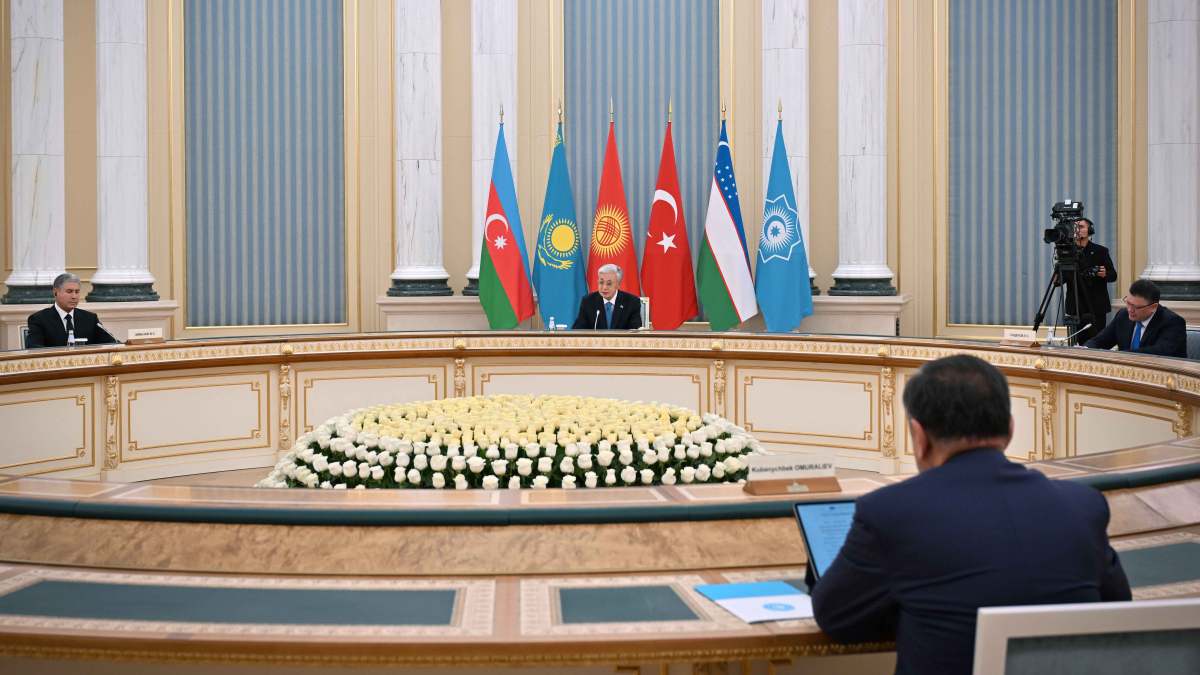
Different views on its future role were on display at an informal OTS summit in Turkistan, Kazakhstan, on 15 May 2026. Azerbaijani President Ilham Aliyev said the Turkic world should become “one of the influential geopolitical centres of the 21st century”.
Tokayev, however, said the OTS was “not a geopolitical project” or a military organisation. Türkiye’s President Recep Tayyip Erdoğan called for closer coordination over regional conflicts and stronger defence industry cooperation.
What else is being planned?
TURKPOL is not the only security proposal under discussion. Kazakhstan has proposed an OTS Cybersecurity Council to enable national agencies to exchange information on cyber threats and coordinate responses to risks affecting critical infrastructure.
The organisation is also considering new forms of cooperation beyond its current membership. At the May summit, Kazakhstan backed Türkiye’s proposal for an “OTS Plus” format aimed at developing ties with countries outside the group.
Joint technology and infrastructure projects are also under way. Kazakhstan, Azerbaijan, Türkiye and Uzbekistan are working on a CubeSat satellite planned for launch in 2027.
Azerbaijan and Kazakhstan are also developing a Trans-Caspian fibre-optic cable, which Azerbaijani officials say will improve digital links across the Caspian.
What happens next?
OTS Security Council secretaries are due to meet in Baku from 16 to 18 September, followed by a meeting of defence industry bodies in Astana from 30 September to 2 October.
The next OTS summit is scheduled for 30 October 2026 in Türkiye, following a meeting of foreign ministers in Ankara a day earlier.
The next meeting of OTS interior ministers will be held in Türkiye in 2027, when the sides aim to sign the agreement establishing the proposed Council for Combating Crime.
Read more:















What is your opinion on this topic?
Leave the first comment