More than 8,300 participants from 100 countries have gathered in Uzbekistan's capital for the fifth Tashkent International Investment Forum (TIIF-2026), bringing together investors, policymakers and business leaders from around the world.
Organisers say the forum has attracted more than 3,400 foreign delegates, including representatives of companies managing a combined $42 trillion in assets.
Held under the theme “Investment Resilience: New Horizons, New Partnerships”, the three-day forum brings together heads of state, executives from global corporations, sovereign wealth funds, development banks and international financial institutions to discuss investment opportunities in sectors ranging from critical minerals and renewable energy to artificial intelligence, logistics and financial services.
The forum has become one of the region's most significant investment platforms since its launch in 2022. Last year's edition concluded with a record $30.5 billion in investment and trade agreements, highlighting Uzbekistan's efforts to position itself as a gateway for international investors seeking access to Central Asia's rapidly expanding markets.
Growing U.S.-Uzbekistan economic ties
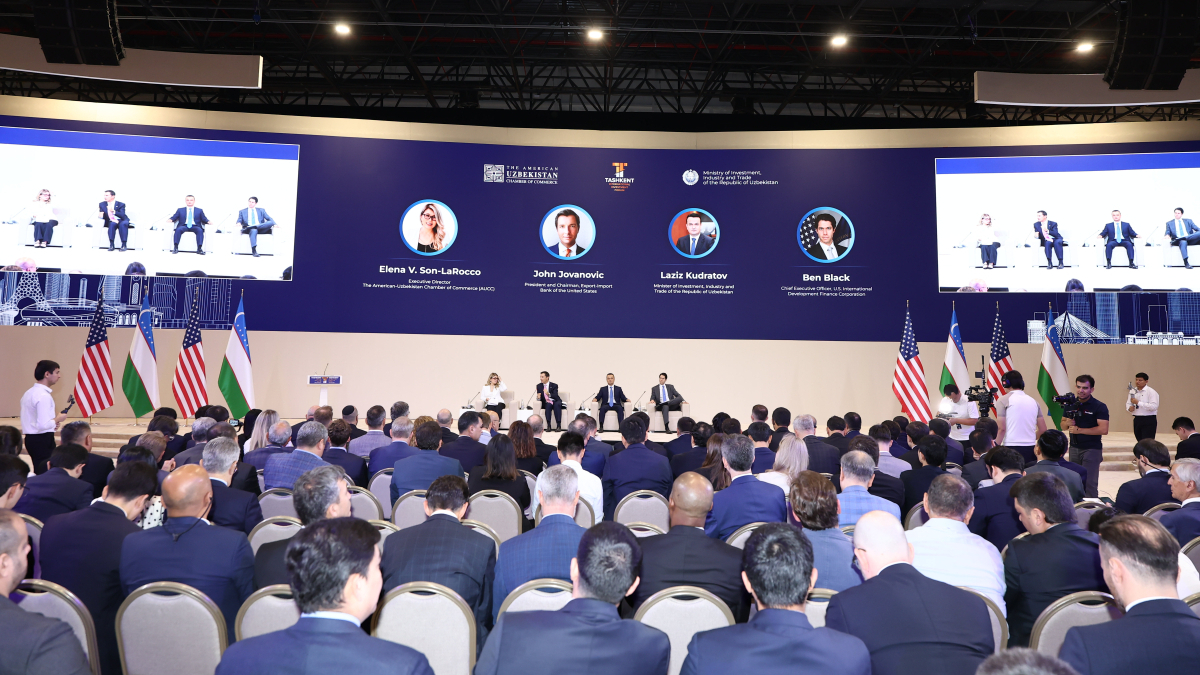
One of the key events on the sidelines of TIIF-2026 was the Uzbekistan–U.S. Business Forum, which focused on expanding co-operation in investment, innovation and job creation.
According to Uzbekistan's Ministry of Investments, Industry and Trade, a record 193 American companies participated in this year's investment forum, representing the largest U.S. business delegation in the history of bilateral economic relations between the two countries.
Addressing participants, Investment Minister Laziz Kudratov said the scale of U.S. participation demonstrates growing confidence in Uzbekistan's economic reforms and long-term investment potential.
Economic ties between the two countries have expanded significantly in recent years. Trade turnover between Uzbekistan and the United States reached approximately $1 billion in 2025, nearly five times higher than in 2017. U.S. exports to Uzbekistan totalled nearly $474 million last year, while imports from Uzbekistan exceeded $574 million.
Forum participants also discussed opportunities for co-operation in advanced manufacturing, technology, infrastructure, critical minerals, financial services and energy projects - sectors increasingly viewed as strategic priorities by both governments.
Islamic finance gains momentum
Another major discussion at TIIF-2026 focused on Islamic finance and the role of Gulf capital in supporting emerging economies.
The panel session, titled “Islamic Finance and Sukuk Markets: Channelling Gulf Capital into Emerging Economies”, examined how Sharia-compliant financial instruments such as sukuk, takaful and Islamic banking products can help finance infrastructure, business development and sustainable growth.
The discussion comes at a pivotal moment for Uzbekistan. Earlier this year, President Shavkat Mirziyoyev signed landmark legislation creating a comprehensive legal framework for Islamic banking and finance.
The reforms allow banks to offer Sharia-compliant products, including Murabaha, Mudaraba and Ijarah financing, through dedicated Islamic banks and Islamic windows within conventional financial institutions. The legislation also introduced tax incentives designed to place Islamic finance on an equal footing with traditional banking.
Officials estimate the reforms could attract more than $1 billion in new investments and deposits while helping to mobilise domestic savings that have traditionally remained outside the formal banking system. More than 10 Uzbek financial institutions are already preparing to launch Islamic finance products.
The government aims to establish at least one operational Islamic banking window by the end of 2026 and two fully fledged Islamic banks by 2030.
Experts at the forum noted that the global Islamic finance industry is now valued at more than $3 trillion, creating significant opportunities for Uzbekistan to attract capital from Gulf countries and strengthen its position as a financial bridge between the Middle East, Central Asia and wider Eurasia.
Looking beyond the forum
Alongside high-level discussions, TIIF-2026 features dozens of investment presentations, bilateral business forums and meetings between investors and government officials.
With global investors, multinational corporations and major development institutions gathered in Tashkent, this year's forum is expected to generate new investment commitments and reinforce Uzbekistan's position as one of Central Asia's fastest-growing and most dynamic economies.














What is your opinion on this topic?
Leave the first comment