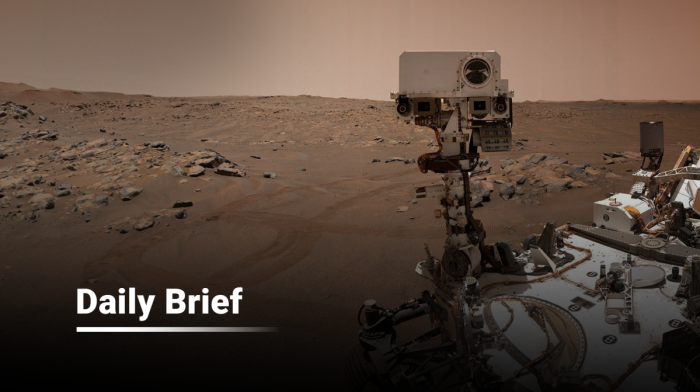
NASA's Perseverance rover has set a new driving record on Mars, travelling 45.2 kilometres since landing in 2021 and surpassing every other robotic vehicle to explore a world beyond Earth, the U.S. space agency said on Tuesday.
The car-sized, six-wheeled rover achieved the feat more than five years into its mission to investigate whether Mars once had conditions suitable for microbial life.
Its journey has taken it across some of the oldest terrain explored in the solar system.
“Perseverance's engineering hardware and instruments are in excellent shape with all redundant systems still available,” Steven Lee of NASA's Jet Propulsion Laboratory in California, told Reuters.
“A recent assessment of all systems concluded that they are capable of operating well into the 2030s, likely beyond,” added Lee, who manages NASA's Perseverance and Curiosity rover projects.
Perseverance surpassed the previous record of 45 kilometres, set by NASA's Opportunity rover during its mission from 2004 to 2018. Both rovers have travelled farther than any vehicle deployed on the Moon.
Exploring Mars' ancient terrain
Equipped with a range of scientific instruments, Perseverance has been exploring Jezero Crater in Mars' northern hemisphere, where scientists believe a lake existed billions of years ago.
The rover broke the record while travelling towards an area known as Idubi, passing through a region beyond the crater's western rim nicknamed Lac de Charmes.
Meanwhile, NASA's Curiosity rover continues exploring Gale Crater near the Martian equator.
Self-driving technology powers record journey
A key factor behind Perseverance's success is its ability to navigate the Martian surface without constant human guidance.
NASA credits the rover's autonomous navigation system, known as AutoNav, with helping it cover greater distances. According to Lee, 90 per cent of its driving is carried out autonomously, without human intervention.
Another major advantage is the Vision Compute Element, a high-speed co-processor that allows the rover to process images and run its navigation software almost continuously while moving.
Earlier rovers, by contrast, had to stop and “think” before beginning each new driving segment, Lee explained.
“Perseverance builds on the 29-year legacy of our past Mars rovers - Sojourner, Spirit, Opportunity and Curiosity - each incorporating prior lessons and improving our ability to drive on another world,” Lee said.
Mission could continue into the 2030s
Perseverance was originally expected to travel just 20 kilometres, but it has now covered more than twice that distance and remains in excellent condition.
NASA has recently approved an extension allowing the rover to continue exploring the crater rim until approximately the end of 2028.
Its plutonium-powered energy system is also operating as expected, with Lee saying it has “many years of useful energy still available.”
With its systems still performing strongly, Perseverance could continue exploring Mars well into the next decade, extending both its scientific discoveries and its record-breaking journey.


















What is your opinion on this topic?
Leave the first comment