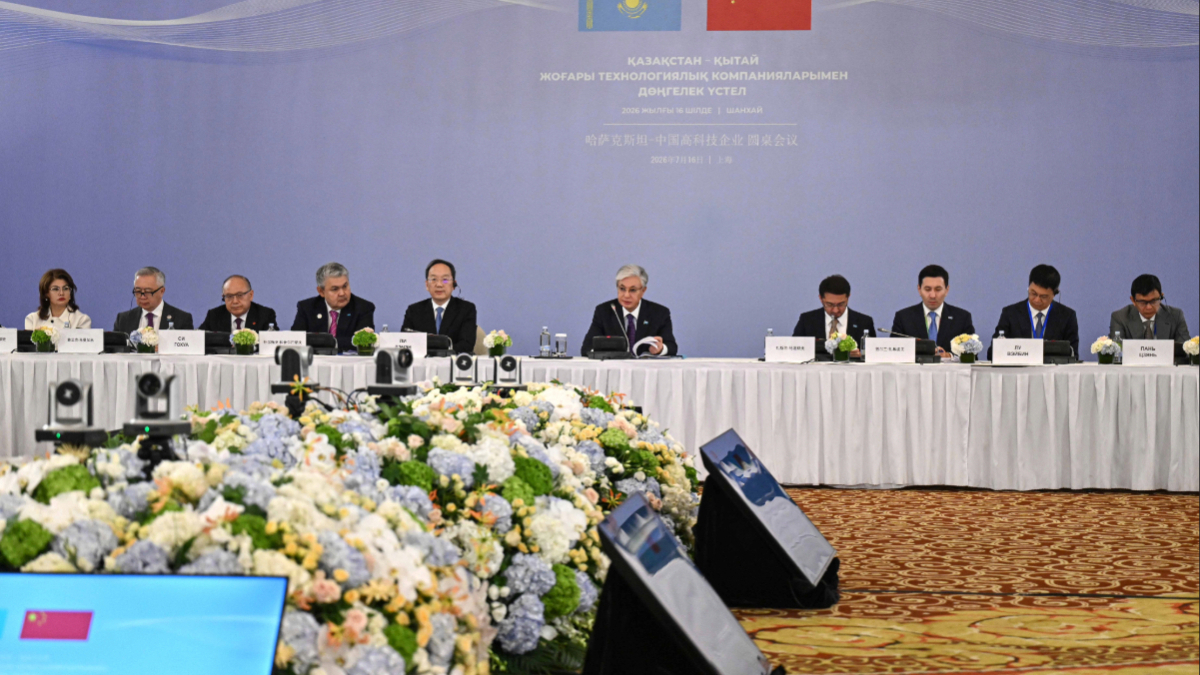
Kazakh President Kassym-Jomart Tokayev invited Chinese technology companies to expand investment in Kazakhstan during a business roundtable in Shanghai on 16 July, promoting the country as a regional hub for artificial intelligence and digital infrastructure.
Speaking ahead of the World Artificial Intelligence Conference (WAIC), Tokayev said Kazakhstan aims to build long-term partnerships that go beyond capital investment to include technology transfer, research and innovation.
Highlighting AI as a key pillar of future economic growth, Tokayev unveiled several flagship projects designed to attract global technology companies. Among them is the Data Centre Valley initiative in Ekibastuz, which is expected to become a regional hub for hyperscale data centres, cloud computing and AI infrastructure.
He also highlighted the development of Alatau, a new smart city being built under a Digital by Default concept. The project will feature intelligent transport systems, digital payments, energy-efficient infrastructure and a regulatory framework supporting blockchain and digital assets.
"I am confident that Alatau will become a new centre of talent, technology, and investment in Eurasia in the future," Tokayev said.
Trade, transport and industrial cooperation
Tokayev said bilateral trade between Kazakhstan and China reached a record $49 billion last year, while cumulative Chinese investment in Kazakhstan has exceeded $30 billion.
He noted that more than 8,500 companies with Chinese participation operate in Kazakhstan and highlighted ongoing joint projects in petrochemicals, automotive manufacturing, textiles and food processing.
The president also called for deeper cooperation in transport and logistics, saying Kazakhstan aims to strengthen its role as a key land bridge linking China with Central Asia, the Caucasus, the Middle East and Europe.
He added that the country is developing the Smart Cargo digital platform to integrate customs, logistics and commercial services into a single transport ecosystem.
More than $15 billion in agreements signed
Agriculture also featured prominently in Tokayev's address, with the president highlighting the growing use of artificial intelligence, drones, satellite monitoring and precision farming technologies to boost agricultural productivity.
He said Kazakhstan is developing a national digital traceability system for agricultural products as part of its ambition to become Central Asia's leading agri-industrial hub.
During the working visit to Shanghai, Kazakhstan and China signed more than 70 commercial agreements worth over $15 billion, covering artificial intelligence, digitalisation, transport infrastructure, finance, the agro-industrial sector, mechanical engineering and other high-tech industries.



















What is your opinion on this topic?
Leave the first comment