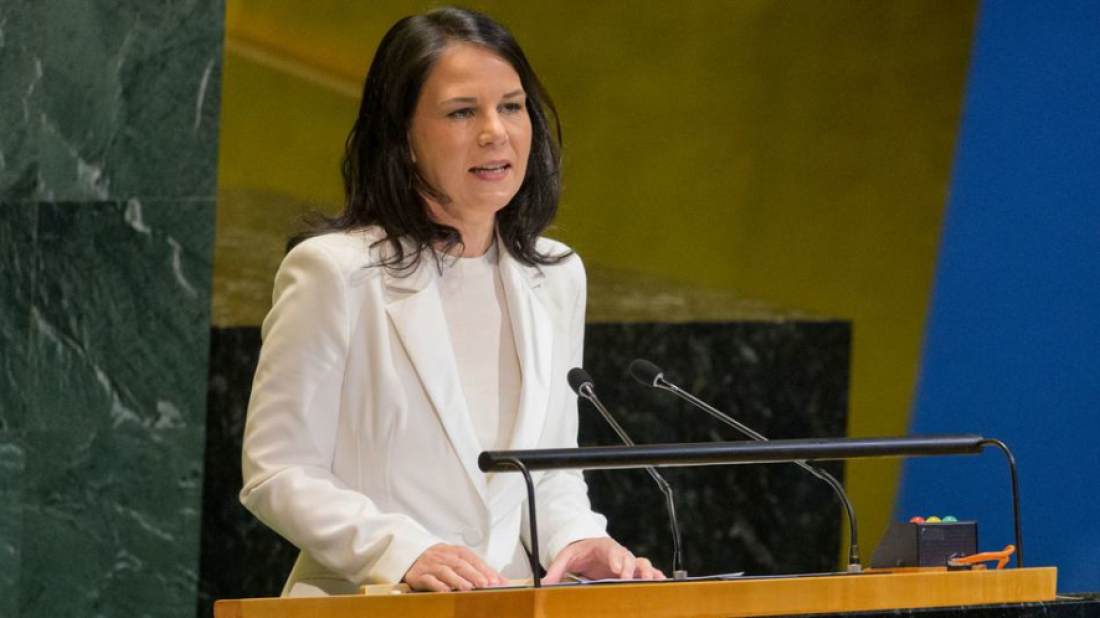
Annalena Baerbock, former German Foreign Minister, was elected President of the UN General Assembly’s 80th session despite strong opposition from Russia.
According to the United Nations statement, Ms. Baerbock received 167 votes following the secret ballot. Write-in candidate Helga Schmid, a former OSCE Secretary-General and career diplomat, also from Germany received seven. Fourteen delegations abstained.
She becomes the first woman from the Western European group to hold the post and the fifth woman overall to lead the General Assembly. The presidency rotates among the world body’s five regional groups.
At 44 years, Ms. Baerbock is also one of the youngest leaders to secure the top job.
The vote for the presidency of the UN General Assembly is typically conducted by acclamation. However, this year Russia, which opposed Annalena Baerbock’s candidacy, requested a secret ballot, according to diplomatic sources cited by AFP.
Baerbock emerged as a candidate only in March, shortly before stepping down as Germany’s foreign minister following the country’s parliamentary elections in February. She replaced diplomat Helga Schmid, whose candidacy for the UN post had been announced the previous year.
Russia objected to the switch, criticizing Baerbock for what it described as “repeated incompetence, extreme bias, and a lack of understanding of basic diplomatic principles.”
“The decision by the authorities in Berlin to push through her candidacy is nothing less than a slap in the face to the world organization and a blatant show of disrespect,” Russian Deputy Ambassador Dmitry Polyanskiy said in May.
Pledge to be an honest broker
In her acceptance speech, President-elect Baerbock acknowledged the current global challenges and pledged to serve as “an honest broker and a unifier” for all 193 Member States, emphasising her theme of “Better Together.”
She outlined three priorities for her presidency: making the Organization more efficient and effective; advancing the 2030 Agenda for Sustainable Development; and making the Assembly a “truly inclusive forum”.
She called for a UN “that embraces everyone. I see the diversity of the General Assembly as our strength. This is the place where all nations come together and where every country has a seat and a voice.”
She also highlighted the importance of promoting gender equality, multilingualism, and engagement with civil society and youth.
UN80 initiative
Ms. Baerbock also touched on the UN80 initiative, which was launched by Secretary-General António Guterres in March.
“The UN80 Initiative should not be a mere cost-cutting exercise,” she said, stressing the need for bold ambition and readiness to take difficult decisions.
“Our common goal is a strong, focused, nimble and fit-for-purpose organization. One that is capable of realising its core objectives – we need a United Nations that delivers on peace, development and justice.”










What is your opinion on this topic?
Leave the first comment