Zelenskyy visits Poland after EU summit in Brussels
Ukrainian President Volodymyr Zelenskyy arrived in Poland on Thursday following a summit of the European Council in Brussels....
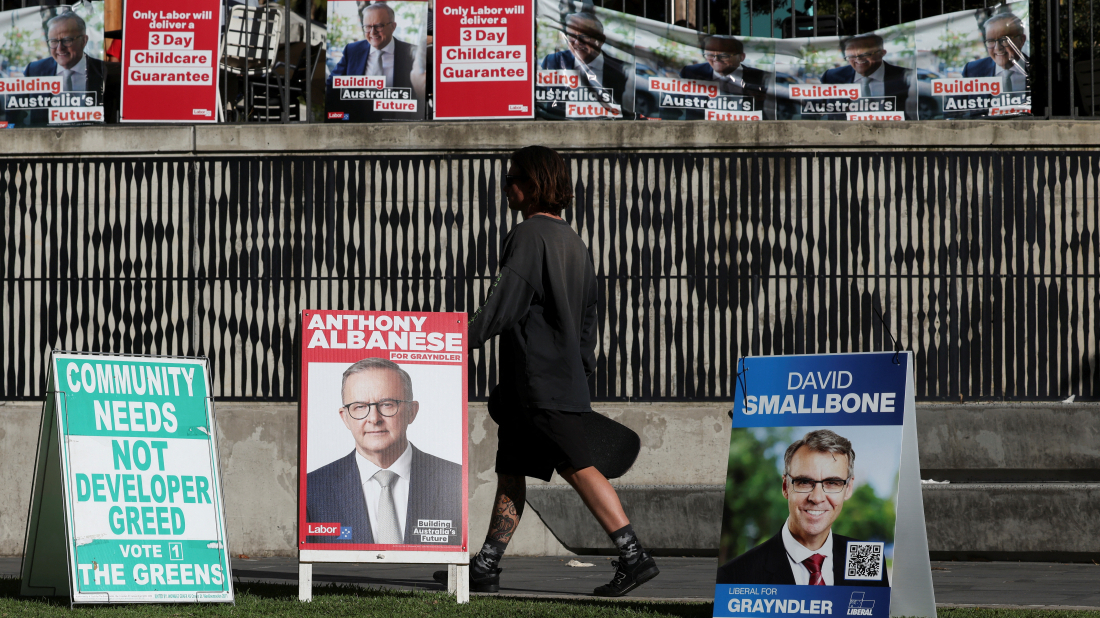
Voting has concluded in Australia’s eastern states, including Sydney and Melbourne, in a general election marked by economic concerns and foreign policy anxieties. With two hours of voting still remaining in Western Australia, early indications point to a close race.
General election voting has closed in Australia's populous eastern states, including the cities of Sydney and Melbourne, with two more hours of voting left on Saturday in Western Australia in what has been a closely fought race.
Opinion polls showed Prime Minister Anthony Albanese's Labor Party with a narrow lead over the conservative opposition after a campaign dominated by concerns over the high cost of living and the policies of U.S. President Donald Trump.
Labor had trailed in the polls as recently as February.
Polls closed at 6 p.m. (0800 GMT) in Australia's most populous eastern time zone, which also includes Brisbane and the capital, Canberra.
The state of South Australia and the Northern Territory will close at 0830 GMT, followed by Western Australia, home to the city of Perth, at 1000 GMT.
Results could start coming in for individual constituencies within a few hours after polls close, although it could take several more hours or even days for a final result, depending on how close the vote is.
Analysts say Albanese has run a solid campaign while opposition leader Peter Dutton has suffered from policy missteps and a perceived ideological closeness to Trump, which has become a top concern for voters.
The bounce in the centre-left Labor Party's fortunes mirrors those of Canada's Liberal Party, which returned to power this week in a come-from-behind victory after Trump's tariffs and remarks on Canadian sovereignty sparked a backlash from voters.

The latest clashes between Thailand and Cambodia mark a dangerous escalation in one of Southeast Asia’s oldest and most sensitive disputes.
In the complex world of international diplomacy, the ongoing tensions between India and Pakistan have raised significant questions about the role of third-party mediation.
Petroleum products are being transported by rail from Azerbaijan to Armenia for the first time in decades. The move is hailed as a tangible breakthrough in efforts to normalise relations between the long-time rivals.
FIFA has introduced a new “more affordable” ticket category for the 2026 World Cup, priced at $60 (£45) for all 104 matches in the U.S., Canada, and Mexico, according to agencies.
In a ground-breaking development, artificial intelligence (AI) is taking on new forms in Japan, where it has extended to a more personal and intimate domain being romantic relationships.
Brazilian President Luiz Inácio Lula da Silva has offered to mediate between the U.S. and Venezuela, warning that urgent diplomatic intervention is needed to prevent a “fratricidal war” in Latin America.
Türkiye has enhanced its environmental and cultural conservation efforts, registering 10,503 monumental trees and 319 caves nationwide, the Ministry of Environment, Urbanisation and Climate Change confirmed.
Former Iraqi President Barham Ahmed Salih has been elected by the UN General Assembly as the next High Commissioner for Refugees, beginning a five-year term on 1 January 2026.
Ukrainian President Volodymyr Zelenskyy arrived in Poland on Thursday following a summit of the European Council in Brussels.
Russian Foreign Minister Sergey Lavrov arrived in Cairo on Thursday ahead of a two-day ministerial conference of the Russia-Africa Partnership Forum.
You can download the AnewZ application from Play Store and the App Store.
What is your opinion on this topic?
Leave the first comment