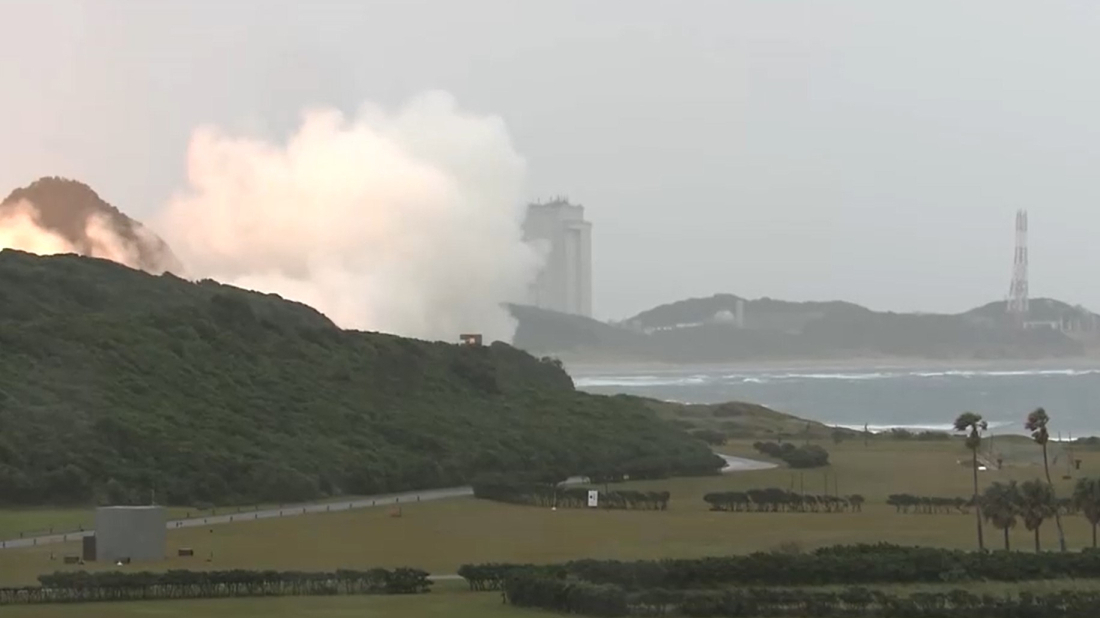
Japan's space agency aborted an engine test for the Epsilon S rocket on Tuesday following a fire at the test site, a failure that could push the rocket's debut launch beyond the March-end target and cause further delays in the national space programme.
Japan's space agency aborted an engine test for the Epsilon S rocket on Tuesday following a fire at the test site, a failure that could push the rocket's debut launch beyond the March-end target and cause further delays in the national space programme.
An explosion could be heard and a blaze could be seen shortly after the ground combustion test started at the Tanegashima Space Center in southwestern Japan, according to footage from public broadcaster NHK.
The Japan Aerospace Exploration Agency (JAXA) said the engine test encountered a "combustion abnormality" 49 seconds after the ignition. It said there was no indication of injury or damage to the outside facility.
"JAXA will conduct a thorough investigation into the cause of the problem and consider countermeasures," Chief Cabinet Secretary Yoshimasa Hayashi said at a regular press briefing.
Hayashi, the top government spokesperson, said rocket development is "extremely important" to ensure the autonomy of Japan's space programme.
JAXA partnered with the aerospace unit of heavy machinery maker IHI 7013.T to develop Epsilon S, the next generation in the Epsilon solid-fuel small rocket series.
Shares in IHI were down as much as 6% in Tokyo trade. An IHI Aerospace spokesperson said the company is investigating the cause.
Epsilon S's debut flight was slated by the end of the fiscal year through March 31 depending on the success of Tuesday's engine test.
The test was conducted after previous failures triggered months of investigation that have delayed space missions and satellite launch plans.
In July last year, an Epsilon S engine test failed due to thermal damage to its ignition systems. That followed a launch failure in 2022.
JAXA's larger flagship rocket H3, built by Mitsubishi Heavy Industries 7011.T, failed at its first launch last year but has succeeded in three flights this year, launching Japanese satellites and winning orders including from French satellite operator Eutelsat ETL.PA.
The H3 and Epsilon S are central to JAXA's ambition to build cost-competitive rockets amid the rise of American commercial launch providers such as market leader SpaceX and small rocket maker Rocket Lab RKLB.O.
In the private sector, IHI-backed Space One is set to attempt the second launch of its Kairos small rocket on Dec. 14 after the first flight exploded in March. It aims to become the first Japanese business to put a satellite in orbit.


















What is your opinion on this topic?
Leave the first comment