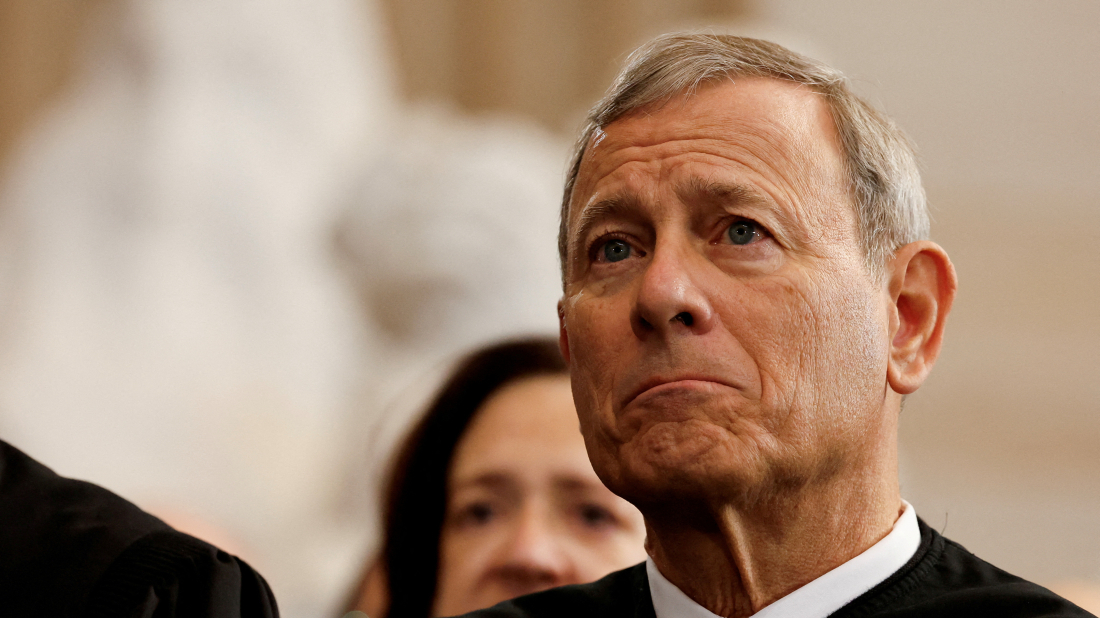
U.S. Chief Justice John Roberts has publicly rejected President Donald Trump’s demand to impeach a federal judge, delivering a rare rebuke that highlights growing tensions between the White House and the judiciary.
“For more than two centuries, it has been established that impeachment is not an appropriate response to disagreement concerning a judicial decision,” Roberts wrote on Tuesday. “The normal appellate review process exists for that purpose.”
His statement came after Trump lashed out at U.S. District Judge James Boasberg, who blocked the administration’s attempt to deport alleged Venezuelan gang members under a controversial 18th-century wartime law.
“I’m just doing what the VOTERS wanted me to do. This judge, like many of the Crooked Judges I am forced to appear before, should be IMPEACHED!!!” Trump posted on social media.
Roberts, a conservative appointed by former President George W. Bush, has rarely intervened in political disputes but previously pushed back against Trump’s attacks on the judiciary. In 2018, he rejected Trump’s claim that judges appointed by different presidents serve partisan agendas, stating: “We do not have Obama judges or Trump judges, Bush judges or Clinton judges. What we have is an extraordinary group of dedicated judges doing their level best to do equal right to those appearing before them.”
Deportation standoff
The clash stems from Trump’s use of the Alien Enemies Act of 1798, an obscure law historically invoked only during wartime, allowing the president to deport non-citizens tied to foreign adversaries. It was last used in World War Two to justify mass internment.
Trump invoked the law on March 15 to fast-track the deportation of Tren de Aragua, a Venezuelan gang he claims is closely linked to President Nicolás Maduro.
A group of Venezuelan detainees sued to block the removals, arguing that the law only applies during a declared war or an invasion by a foreign nation. Judge Boasberg sided with them, issuing an immediate suspension of the deportations. The ruling forced the administration to recall flights carrying hundreds of alleged gang members to El Salvador.
However, two flights were not turned back, sparking accusations that Trump’s administration had defied the court order. The Justice Department defended its actions, arguing that the ruling was issued in writing after the planes had already taken off and that verbal instructions given in court were not legally binding.
The episode adds to Trump’s history of clashing with the judiciary, with Roberts’ intervention serving as a rare warning from the nation’s highest court. The White House has not yet signaled whether it will appeal the ruling.




















What is your opinion on this topic?
Leave the first comment