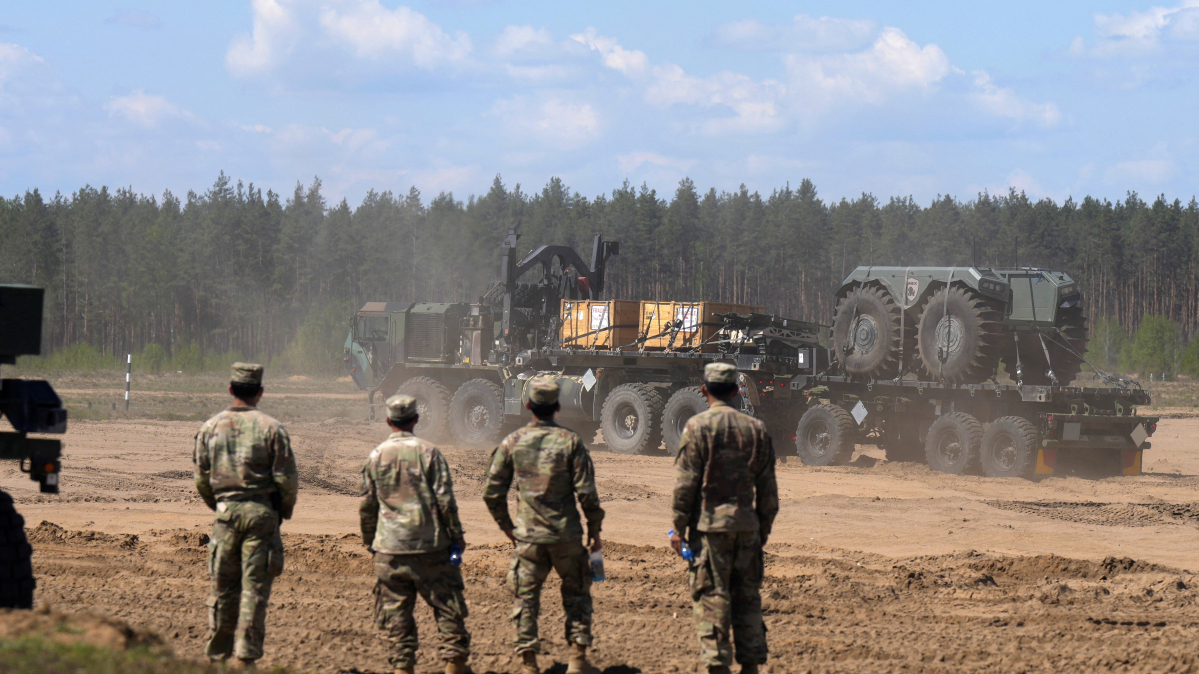
Germany is deploying around 1,800 troops and more than 750 vehicles to Lithuania for a major military exercise aimed at testing its ability to rapidly reinforce NATO’s eastern flank amid security concerns over Russia’s war in Ukraine.
Germany’s Panzergrenadier Brigade 37, a rapid-response unit known as the “Free State of Saxony,” will demonstrate its readiness to defend Lithuania alongside NATO allies during the Grand Eagle 26 exercise.
“We want to prove that we are capable of deploying troops and combat vehicles from Germany to NATO’s eastern flank by air and land within just a few days,” said Colonel Hagen Ruppelt, the brigade commander based in Frankenberg, Saxony.
The exercise will test the full operational cycle, from initial alert and deployment to combat training and the troops’ return to their home bases.
Most of the troops will come from Panzergrenadier Battalion 391 in Bad Salzungen, supported by logistics personnel, combat engineers, artillery units and command staff from several German military bases.
One of the main events will be a live-fire drill at Lithuania’s Pabradė training area, where troops will practise combined-arms operations against a simulated enemy.
NATO forces strengthen multinational coordination
The deployment is part of wider German and NATO efforts to strengthen military readiness, including the Quadriga 2026 exercise series and NATO’s Steadfast Dart 2026.
From January, Allied Reaction Force personnel and equipment were moved across Europe by road, air and sea in a test of NATO’s ability to mobilise multinational forces at speed.
Troops from Italy, Spain, Türkiye and other NATO countries arrived in Germany, where they completed procedures for receiving, assembling, moving and integrating forces.
The operation aimed to bring national units together under coordinated command structures, communications networks and logistics systems, enabling them to operate as a single force.
Allied troops practised battlefield reinforcement
At Germany’s Bergen Training Area, NATO allies and German troops carried out complex battlefield manoeuvres, including a forward passage of lines, which involves units moving through positions held by friendly forces.
After drone and counter-drone training, Allied Reaction Force troops trained alongside Germany’s 413 Light Infantry Battalion.
The exercise simulated German infantry advancing through positions held by allied troops to provide reinforcements and maintain combat operations.
Germany increases focus on collective defence
Germany’s armed forces, the Bundeswehr, have made national and collective defence a priority amid the continuing war in Ukraine.
German military authorities regard Russia as the biggest threat to European peace and security for the foreseeable future.
Against this backdrop, Quadriga 2026 was designed to simulate the pressures of a real military operation, going beyond conventional training exercises.
The programme tested the ability of combat-ready forces to deploy at short notice, coordinate under pressure and carry out missions with minimal preparation.
Germany’s Bundeswehr Joint Force Command oversaw the drills, coordinating the participation of forces from several NATO countries.
According to the German military, the exercises aimed to showcase Germany’s growing defence capabilities and NATO’s ability to deter potential aggression through collective action.
During the Grand Quadriga exercise in February, German Army units practised deploying medium forces under realistic operational conditions.
The training emphasised rapid troop movements towards NATO’s eastern flank and the ability to sustain military operations in challenging battlefield conditions.
Read more:














What is your opinion on this topic?
Leave the first comment