Beijing says it deployed naval forces to monitor a U.S. warship near Sabina Shoal, while Taiwan reports a separate confrontation with a Chinese coast guard vessel near the Pratas Islands.
China and the United States faced renewed maritime friction on Tuesday after Beijing accused an American warship of entering disputed waters in the South China Sea, as a separate encounter near Taiwan brought competing sovereignty claims into focus.
China's Southern Theatre Command said it sent naval forces to track the USS Charleston after the ship entered waters adjacent to Sabina Shoal in the Spratly Islands without Beijing's approval.
The command described the passage as illegal and accused Washington of undermining maritime security. It called on the United States to halt such operations.
A Philippine military spokesperson rejected China's position, saying the American vessel had not entered Chinese territory and that lawful passage through international waters did not require Beijing's permission.
Why Sabina Shoal is a flashpoint?
Sabina Shoal has become a recurring point of confrontation between China and the Philippines, whose competing claims form part of a wider dispute over the Spratly Islands.
Beijing claims almost the entire South China Sea, despite overlapping claims by the Philippines, Vietnam, Malaysia, Brunei and Taiwan.
The dispute extends beyond territorial control to questions of maritime access and the authority to regulate foreign vessels.
The U.S. Navy has previously conducted freedom of navigation operations to challenge maritime restrictions it considers excessive. However, Washington had not confirmed whether the USS Charleston's latest passage was part of such an operation.
The encounter comes a month after the Philippine Coast Guard accused a Chinese vessel of ramming a Philippine boat during a refuelling mission near Sabina Shoal. Chinese authorities blamed the Philippine side for the collision.
Manila's mutual defence treaty with Washington gives the dispute wider significance, although Tuesday's encounter involved no reported clash between the American and Chinese vessels.
Taiwan reports separate confrontation near Pratas
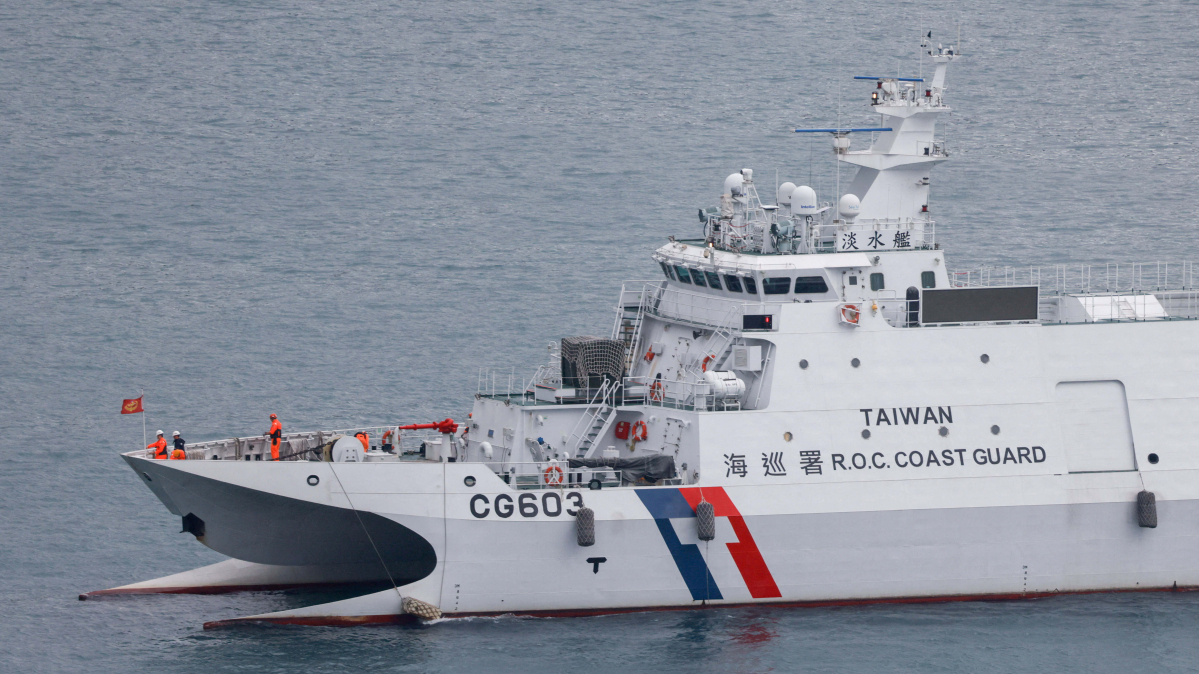
Farther north, Taiwan's Coast Guard said a Chinese coast guard ship entered restricted waters near the Pratas Islands, prompting Taipei to dispatch its vessel Taichung.
The two ships exchanged radio warnings during the encounter.
According to Taiwan's Coast Guard, the Chinese vessel challenged Taiwan's political legitimacy, broadcasting that the Republic of China, the island's official name, did not exist.
Taiwan's patrol vessel responded by asserting the island's sovereignty.
The confrontation was continuing when Taiwanese authorities issued their statement. China's Taiwan Affairs Office had not immediately responded to a request for comment.
The incident followed a warning from Beijing last week after Taiwan's Coast Guard used a water cannon against a Chinese fishing vessel near Pratas.
The islands, located between southern Taiwan and Hong Kong, are administered by Taipei and guarded primarily by its Coast Guard.
Why the two encounters matter?
The incidents occurred in different parts of the South China Sea and involved separate disputes. There is no indication that they were coordinated.
Both, however, demonstrate how disagreements over maritime jurisdiction can bring military and coast guard vessels into direct contact.
Around Sabina Shoal, the immediate dispute concerns China's claims and the ability of foreign vessels to navigate contested waters. Near Pratas, maritime enforcement is closely tied to Beijing's broader sovereignty dispute with Taiwan.
China considers Taiwan part of its territory, a claim rejected by Taipei's government.
Beijing's expanding coast guard activity around Taiwan has also drawn criticism from U.S. and Taiwanese officials.
Speaking at a forum in Taipei on Tuesday, the chair of a review commission appointed by the U.S. Congress described Chinese coast guard patrols east of Taiwan as highly destabilising.
Taiwan's National Security Council Secretary-General Joseph Wu told the same gathering that Beijing had no legal claim to waters east of the island.
Neither incident was reported to have involved an armed clash. Chinese and Taiwanese authorities, however, described an ongoing confrontation near Pratas, while Beijing demanded an end to U.S. naval activity near Sabina Shoal.
Read more:












What is your opinion on this topic?
Leave the first comment