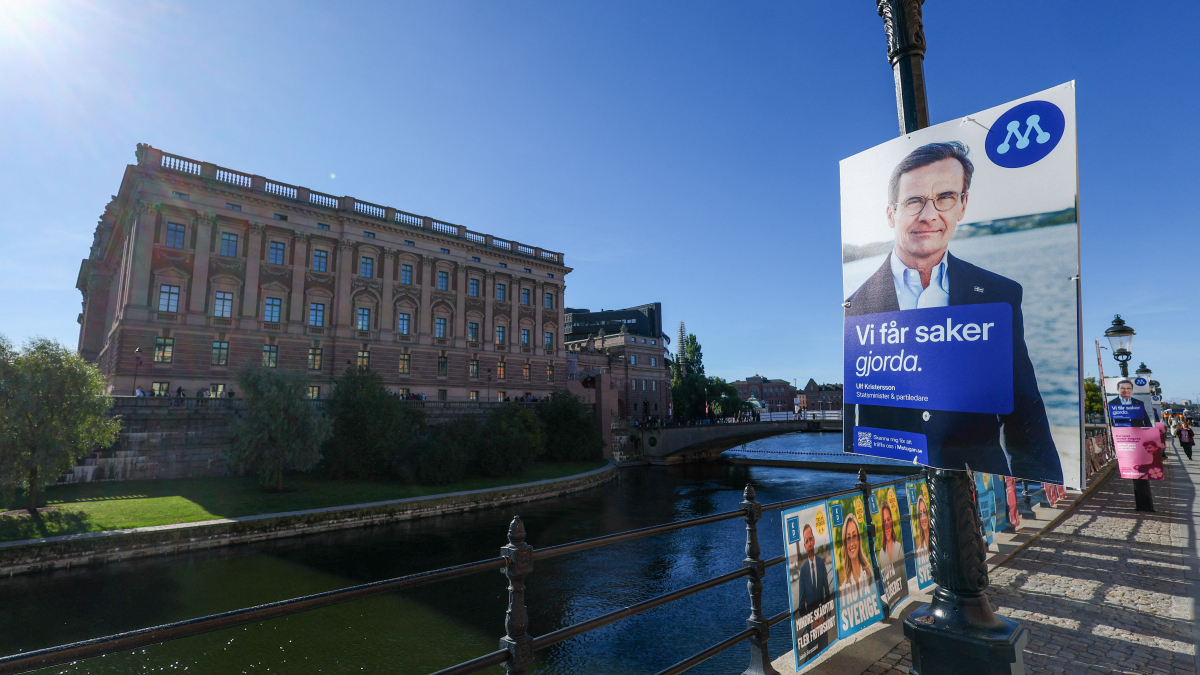
Sweden's centre-left opposition holds a narrow lead over the ruling right-wing bloc ahead of Sunday's parliamentary election, leaving Social Democrat leader Magdalena Andersson well placed for a return as prime minister.
Andersson, who has spent four years in opposition, is the favourite to replace centre-right Moderate Party leader Ulf Kristersson, according to a poll conducted between 2 and 10 September and published on Friday.
The four left-leaning parties had combined support of 50.8 per cent, enough for an estimated 180 seats. The governing coalition and its far-right support party, the Sweden Democrats, had 47.6 per cent support, equivalent to 169 seats,according to the Indikator Opinion survey of 5,642 voters.
Andersson's bloc has led every poll this year, although the gap has narrowed in recent weeks. The three latest surveys putthe opposition ahead by around 10 seats.
Tougher immigration policies
Kristersson has overseen a shift towards tougher immigration policies in Sweden, moving the country away from the liberal approach for which it was once known.
He has said the Sweden Democrats would join the government for the first time if his bloc wins. The party has previously apologised for its links to neo-Nazism.
The election comes as far-right parties continue to gain ground elsewhere in Europe. Alternative for Germany, which opposes immigration and supports closer ties with Russia, recently won a state election, while Marine Le Pen remains ahead in polls for next year's presidential election in France.
Divided left
A win for the centre-left would not necessarily mean a straightforward return to power.
The opposition parties remain divided over how a government led by the Social Democrats should be formed. The Centre Party and the Left Party have both ruled out joining a government if the other is included.
They also disagree on issues including a tax on billionaires and whether Sweden should build new nuclear reactors.
The divisions could trigger lengthy negotiations and result in a minority government involving some, but not all, of the opposition parties.
The two blocs broadly agree on support for Ukraine in its war against Russia, increased military spending and measures to help households cope with higher living costs.
But the campaign has focused on several issues, including welfare, immigration and crime, with none clearly dominating, according to experts.
“Nothing has really stuck, it's been sort of unsatisfactory in that sense,” said Nicholas Aylott, an associate professor at Södertörn University.
Aylott said the centre-left was still likely to win, although its advantage had narrowed since earlier in the summer.
“It would be somewhat sensational if the governing parties were to make up the gap... So I probably don't think it's going to happen, but you never know,” he said.
Social Democrats remain largest party
The Social Democrats remain Sweden's largest party, with 28.6 per cent support, down 1.7 percentage points from the 2022 election, according to the poll conducted for public broadcaster SR.
The Sweden Democrats remain the largest party in the governing bloc, with 18.3 per cent support, down 2.2 percentage points from 2022.
The party has supported the ruling coalition without formally joining the government and holds no cabinet positions.
Read more:










What is your opinion on this topic?
Leave the first comment