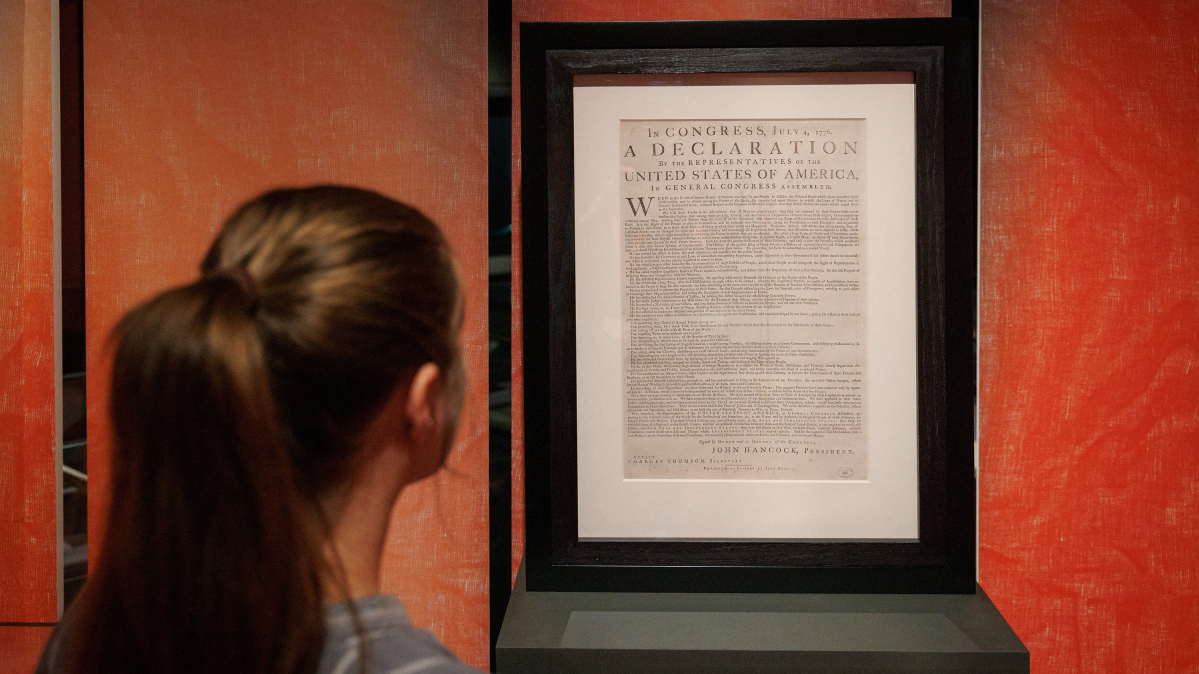
A “vanishingly rare” copy of the Declaration of Independence has been discovered in London, found in British archives holding records linked to the capture of an American privateer vessel in 1776.
The document, which contains the founding text of the United States and its famous phrase “life, liberty and the pursuit of happiness”, had long been catalogued as an unremarkable item described simply as “another document”.
Accidental discovery in British archives
The copy was identified in May by a volunteer working at the UK’s National Archives during a cataloguing project.
Michael Scurr, who made the discovery, said handling the document was a significant historical moment.
“Unearthing and handling such a significant historical document has been thrilling, particularly in this important anniversary year,” he said.
The find was announced on the eve of US Independence Day celebrations marking 250 years since the Declaration was adopted in 1776.
First known copy found outside the United States
Researchers confirmed the document is one of the so-called “Exeter Declarations”, printed in Exeter, New Hampshire, in mid-July 1776.
It is the 11th surviving copy of this group and the first ever discovered outside the United States.
Historians say the Exeter printings were among the earliest reproductions of the Declaration, produced rapidly as news of independence spread across the American colonies.
Wartime journey across the Atlantic
The copy is believed to have been taken by Eleazer Johnson, captain of the ship Dalton, who carried it during voyages aimed at capturing British vessels during the American Revolutionary War.
In December 1776, the Dalton was captured by the British Royal Navy off the coast of Portugal and taken to Plymouth, along with its cargo and documents.
The National Archives said it is the only known copy of the Declaration of Independence seized as a result of military action.
Rich historical context in British records
British naval prize procedures required captured ships to submit all onboard documents to authorities, creating extensive archival records that now provide historians with valuable historical material.
Graham Moore, curator at the National Archives, said the bureaucratic nature of wartime documentation helped preserve rare historical artefacts.
“Thanks to the bureaucratic processes of war … we can present an unusually rich backstory that most surviving declarations do not have,” he said.
The discovery adds a rare international dimension to one of the United States’ most important founding documents, just as the country prepares to mark its semiquincentennial anniversary.



















What is your opinion on this topic?
Leave the first comment