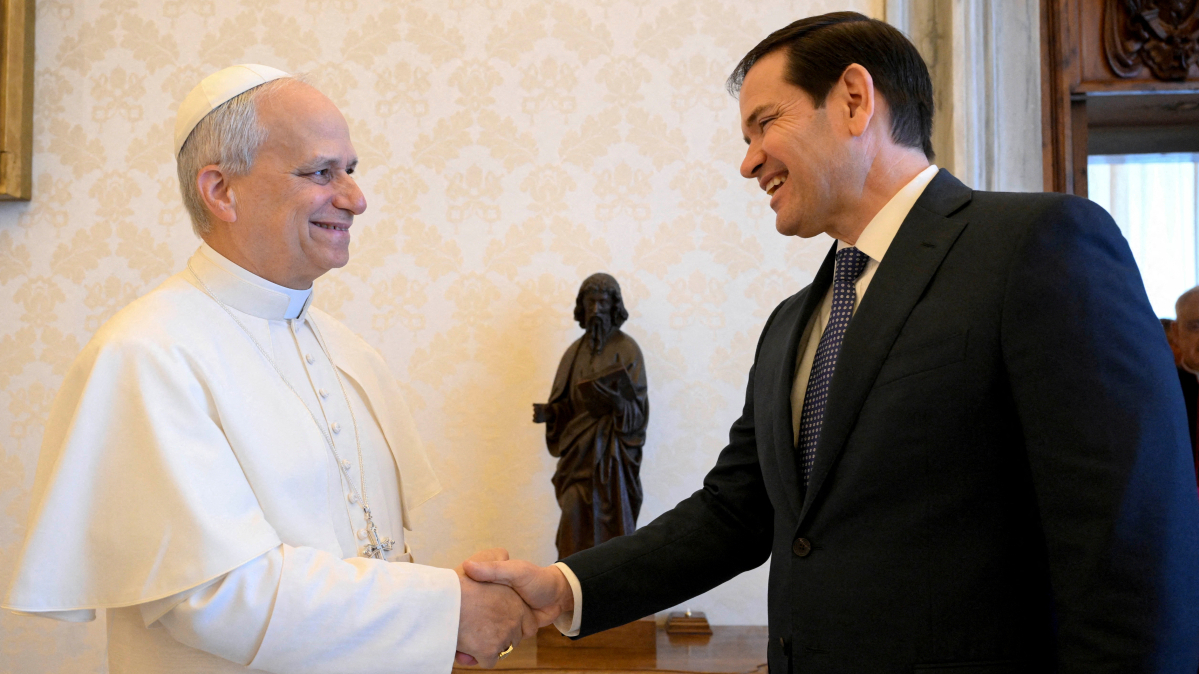
U.S. Secretary of State Marco Rubio is expected to discuss Cuba and global religious freedom with Pope Leo during a visit to the Vatican on Thursday (7 May), following recent criticism from President Donald Trump over the pope’s comments on the U.S.-Israeli war against Iran.
Earlier on Tuesday (5 May), U.S. ambassador to the Holy See Brian Burch said Rubio and the Pope would “have a frank conversation about U.S. policy, to engage in dialogue”.
“Nations have disagreements, and I think one of the ways that you work through those is ... through fraternity and authentic dialogue,” Burch said at an event hosted by the U.S. embassy at Rome’s Gregorian University.
Rubio highlights religious freedom concerns
Speaking at the White House, Rubio said discussions with the Vatican would focus on religious freedom, particularly in Africa, as well as humanitarian assistance in Cuba.
“There’s a lot to talk about with the Vatican,” Rubio said. “The pope is obviously the vicar of Christ, is a Roman Catholic, but he’s also the head of a nation state.”
Rubio said the United States continued to cooperate with the Catholic Church on humanitarian aid distribution in Cuba and shared concerns about “the destruction of religious liberty, the persecution of Christian minorities”, and challenges facing Christians in Africa.
Trump renews criticism of pope over Iran
Trump has criticised the first U.S.-born Pope several times in recent weeks. Rubio said his Vatican trip had been arranged before the latest disagreement.
“No, I mean it’s a trip we had planned from before, and obviously we had some stuff that happened,” Rubio said when asked whether the visit was intended “to smooth things over with the Pope”.
On Monday, Trump told conservative radio host Hugh Hewitt, “The Pope would rather talk about the fact that it’s okay for Iran to have a nuclear weapon, and I don’t think that’s very good.”
Pope Leo has not said Iran should possess nuclear weapons, but he has opposed the conflict, which Trump says is aimed at ending Iran’s nuclear programme.
Iran denies seeking nuclear weapons and says its nuclear activities are for peaceful purposes, including uranium enrichment permitted under the Nuclear Non-Proliferation Treaty (NPT). The United States possesses nuclear weapons.
Pope says Church stands against nuclear weapons
Responding to Trump’s remarks, the Pope said criticism would not affect his message.
“The mission of the Church is to preach the Gospel, to preach peace,” Leo said. “If someone wants to criticise me for preaching the Gospel ... I hope simply to be listened to because of the value of God’s words.”
He also rejected suggestions that he supported nuclear weapons.
“The Church has spoken out for years against all nuclear arms, on that there is no doubt,” he said.
Rubio, who is Catholic, and Vice President JD Vance met Pope Leo last year after attending his inaugural Mass.
Burch dismissed suggestions of a major divide between Trump and the Vatican, saying the purpose of Rubio’s visit was for both sides to “better understand each other, and to work through, if there are differences, certainly to talk through that”.
Rubio to meet Meloni after Vatican visit
Rubio is also scheduled to meet Italian Prime Minister Giorgia Meloni on Friday (8 May). Meloni has defended the Pope, while Italy’s defence minister has said the Iran conflict could weaken U.S. leadership internationally.
Leo, who marks his first anniversary as Head of the Catholic Church on Friday, has recently become more vocal on international issues, including the Iran conflict, U.S. immigration policy, and relations between Washington and Cuba.










What is your opinion on this topic?
Leave the first comment