China has released a military propaganda video hinting at a possible fourth aircraft carrier - its first to be nuclear-powered.
The video was accompanied by a renewed pledge from Beijing to expand and militarise its network of islands, signalling a push to strengthen maritime power, secure deep-sea resources, and reinforce territorial claims across the Indo-Pacific.
Issued on Wednesday ahead of the 77th anniversary of the Chinese People’s Liberation Army Navy (PLAN), the video features fictional officers whose names are homophones of China’s three existing aircraft carriers: Liaoning, Shandong and Fujian.
Titled Into the Deep, it introduces a 19-year-old recruit named “He Jian”. This has sparked speculation that the video is hinting at a nuclear-powered carrier, as the name closely resembles the Mandarin term for “nuclear vessel”. China’s current carriers are conventionally powered and bear the pennant numbers 16, 17 and 18. The recruit’s age - 19 - has been interpreted as a reference to a potential fourth carrier following this sequence.
China’s defence ministry did not immediately respond to Reuters’ request for comment.
Building a blue-water navy and warning Taiwan
For more than a decade, Beijing has invested heavily in developing a “blue-water navy” capable of operating far beyond its shores. The strategy dates to 2012, when President Xi Jinping took power, and remains central to China’s ambition to become a leading global power by mid-century.
The anniversary video features simulated military drills and strike operations in the Pacific. It also carries a clear political message aimed at Taiwan, which Beijing claims as its territory despite strong opposition from Taipei.
In one scene, a naval officer speaks with his young son, “Xiao Wan” - a name that phonetically echoes Taiwan. “I don’t want to go home just yet. I want to play out a little longer,” the boy says. His father replies: “Xiao Wan, don’t be difficult. Mum is waiting for you at home. Let’s go home.” The exchange reflects Beijing’s framing of unification as inevitable.
Fortifying the South China Sea
The messaging comes alongside renewed efforts to strengthen China’s territorial claims. The natural resources ministry recently published an article in the People’s Daily calling for greater efforts to “protect” and develop more than 11,000 claimed islands.
Official data from 2018 shows most of these islands lie within 100 km (62 miles) of the mainland, with nearly 60% in the East China Sea. However, around 30% are in the disputed South China Sea, where tensions remain high.
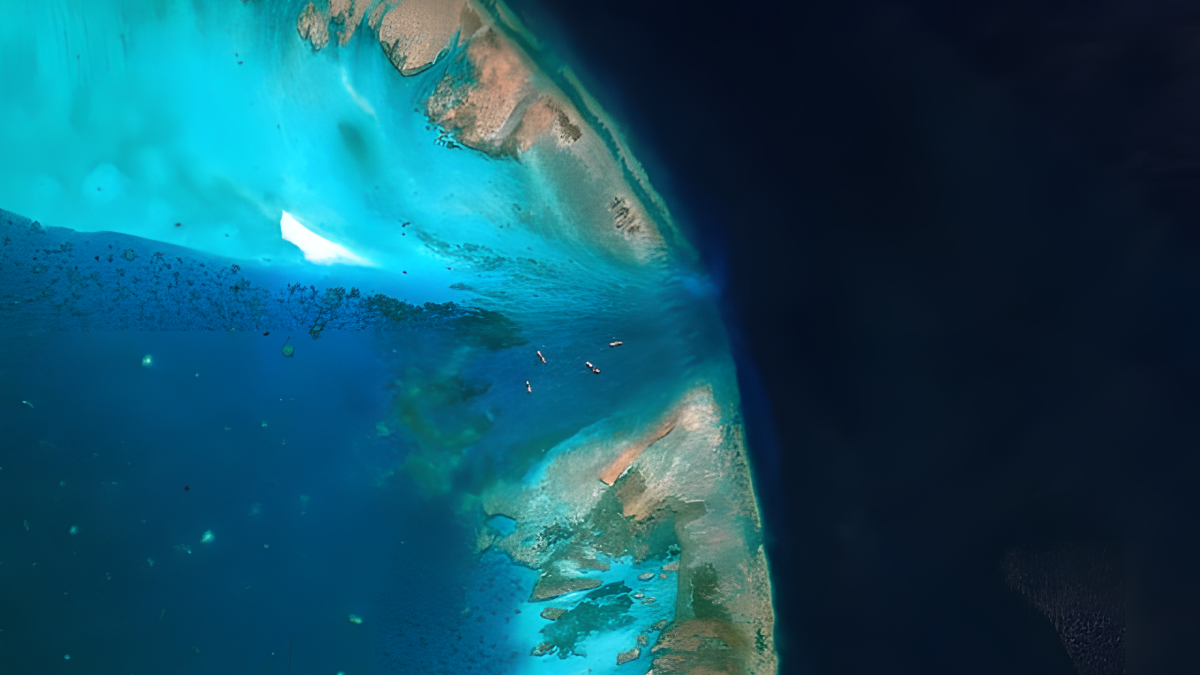
China has carried out extensive land reclamation in the region, building artificial islands equipped with airstrips, radar systems and missile facilities.
Last September, Beijing declared a national nature reserve at the disputed Scarborough Shoal, a move widely seen as reinforcing its claim to the area, long contested with the Philippines.
“The facilities on its artificial island bases have allowed Chinese law enforcement, naval, and militia vessels to spend every day of the year patrolling the waters of its neighbours up to 1,000 nautical miles from the Chinese coastline,” said Gregory Poling of the Washington-based CSIS think tank.
Pushback from regional powers
China’s growing presence in the South China Sea - through which more than $3 trillion in trade passes annually - is prompting increased resistance.
Earlier this month, a senior Taiwanese official made a rare visit to Itu Aba, a Taiwan-controlled island in the Spratly Islands. The island has a runway capable of handling military resupply flights and a wharf, opened in 2023, that can accommodate a 4,000-tonne patrol ship.
Regional cooperation is also intensifying. The Philippines, the U.S. and partner nations have launched large-scale joint military exercises, including live-fire operations across the Philippine archipelago.
Poling said Beijing’s strategy may be losing effectiveness. “Beijing seems to have hit a point of diminished returns,” he said. “It has not succeeded in stopping a single Southeast Asian energy project, resupply or construction mission, or the like, in at least four years.”
While China may be moving towards a nuclear-powered carrier, it faces growing resistance in the region.













What is your opinion on this topic?
Leave the first comment