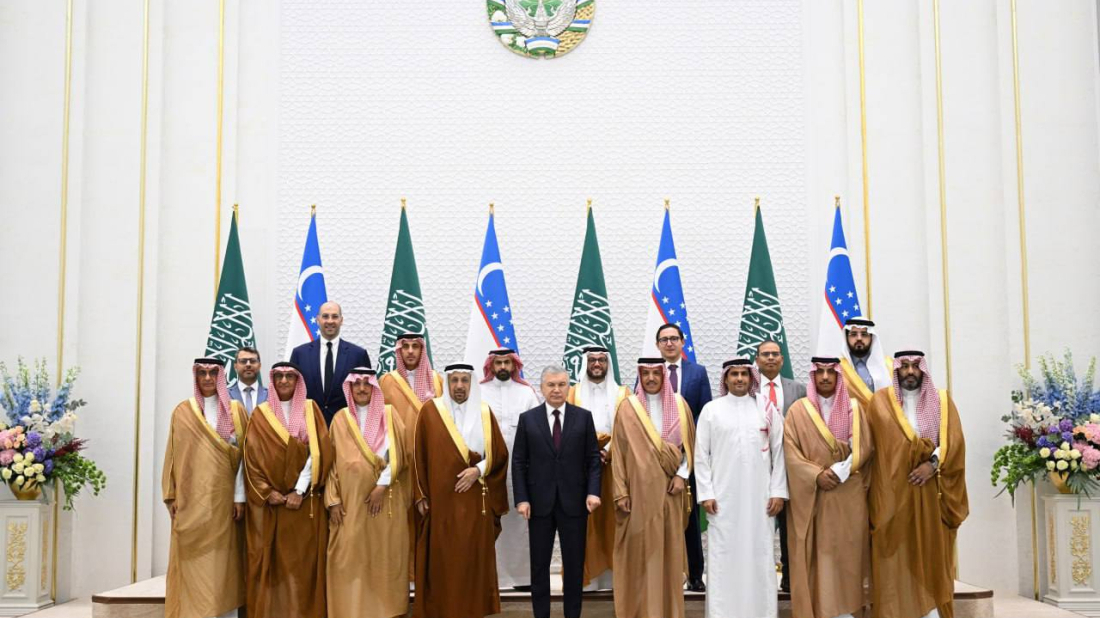
Uzbekistan and Saudi Arabia have strengthened their strategic economic partnership with new projects in the capital’s development plan, including the construction of the ‘Riyadh Quarter’ in New Tashkent and the launch of a new international airport.
The agreements, signed during high-level meetings, bring the total portfolio of joint initiatives to $30 billion.
Investment Portfolio
At the latest session of the Uzbekistan–Saudi Arabia Intergovernmental Commission and Business Council, the two sides signed 10 new agreements worth $4 billion across energy, healthcare, industry, and transport. Minister of Investments, Industry and Trade Laziz Kudratov said these were “not sovereign loans but direct foreign investments — a sign of Saudi Arabia’s trust in Uzbekistan”.
Saudi Arabia’s ACWA Power continues to play a central role in Uzbekistan’s renewable energy transition, operating solar and wind plants in Tashkent, Bukhara, and Karakalpakstan, as well as managing the Shirin Energy College in Syrdarya. A major new project with Vision Invest (Saudi Arabia) and Air Products (United States) will focus on producing sustainable aviation fuel (SAF) for Uzbekistan’s expanding aviation sector.
New Tashkent Projects
One of the flagship Saudi-backed projects will be the construction of the ‘Riyadh Quarter’ in New Tashkent, to be developed jointly by Al Majdiah and First Avenue companies from Saudi Arabia. The initiative is expected to become a residential and commercial hub symbolising bilateral friendship. President Shavkat Mirziyoyev described it as “a bridge uniting the two nations”.
Aviation Expansion
As part of Uzbekistan’s broader infrastructure modernisation, President Mirziyoyev has also laid the foundation for a new international airport in New Tashkent, to be built in partnership with Vision Invest (Saudi Arabia, 45%), Sojitz Corporation (Japan, 30%), Incheon Airport Corporation (South Korea, 15%), and Uzbekistan Airports (10%). The $2.6 billion project, designed by Dutch firm NACO Consulting, will cover 1,310 hectares and serve up to 20 million passengers annually.
The country also plans to increase its total aircraft fleet from 105 to 180 over the next five years. Recent contracts include Uzbekistan Airways’ order for 14 Boeing 787-9 Dreamliners and an option for 8 more, as well as agreements to acquire 14 Airbus aircraft and lease 5 additional planes.
These steps would help transform Uzbekistan into a “regional aviation hub connecting East and West”. The expanded fleet and airport complex could generate $700 million in annual revenue.











What is your opinion on this topic?
Leave the first comment