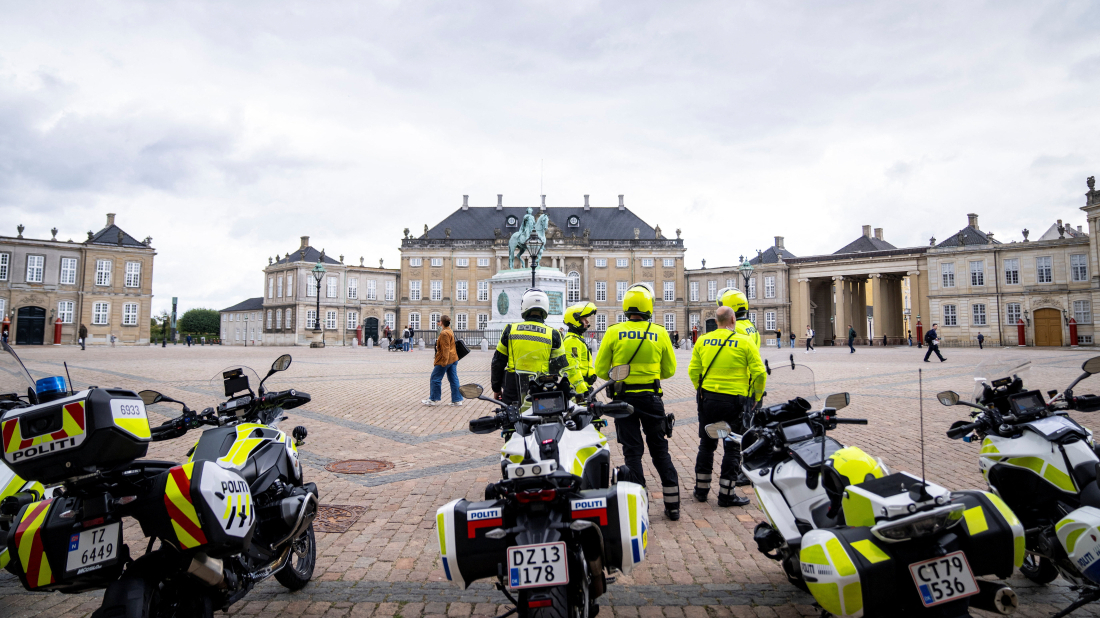
Security has tightened in Copenhagen ahead of European summits this week with France, Germany and Sweden sending extra military personnel and anti-drone systems to Denmark to boost security following drone incursions that forced the temporary closure of several Danish airports.
Danish Prime Minister Mette Frederiksen described the incidents as a “hybrid attack” on her nation.
On Sunday, Denmark banned civilian drone flights after drones were also spotted near several military sites overnight.
Copenhagen is due to host EU leaders on Wednesday, followed by a summit on Thursday of the wider, 47-member European Political Community.
Joining European allies in the offer of support, British defence minister John Healey said the UK was sending counter-drone technology to the country.
"No one should be in any doubt that we are facing a level of grey-zone activity and aggression which is testing us and testing other countries," Healey told Politico in an interview.
France announced that it would be sending a Fennec military helicopter, as well as a 35-strong team who would handle aspects of anti-drone work.
Germany will deploy around 40 soldiers to Copenhagen to help with detecting, identifying and defending against drones, a Berlin government spokesperson told reporters in a briefing on the EU summit on Monday.
The operation will last until 7 October and the soldiers will carry the appropriate equipment with them, the spokesperson said.
Swedish Prime Minister Ulf Kristersson said his country was sending "Counter-UAS" - Counter-Unmanned Aircraft System - as well as "a handful" of radar systems to Denmark.
Swedish police separately said they would send a significant force to Copenhagen at Denmark's request, and that Norwegian law enforcement officers would also take part.
“Around one week ago, the first indications emerged that drones were blocking airports in Copenhagen," said Kristersson.
"I was in contact with Mette Frederiksen, the Danish prime minister… this came immediately after Poland had confirmed drone attacks, Russian ones, and then airspace violations in Estonia and Romania. So we took this very seriously,” he added.
Meanwhile, NATO said on Saturday it was upgrading its mission in the Baltic Sea in response to the situation in Denmark, and a German air defence frigate arrived in Copenhagen on Sunday to assist with airspace surveillance.
Worry over Russia threat to Europe
Denmark has stopped short of saying definitively who it believes is responsible for the drone attacks, but Frederiksen has suggested it could be Moscow, calling Russia the primary "country that poses a threat to European security". The Kremlin denies involvement.
"(President Vladimir) Putin wants to divide us. I will do everything I can to ensure that he never succeeds," she wrote in a post on Instagram on Monday.
Last week, Frederiksen linked the drone sorties in Denmark to a series of other suspected Russian drone incursions and other disruption across Europe. These have included drone sorties into Polish and Romanian airspace, as well as Estonia reporting on 19 September that Russian fighter jets had entered its airspace for 12 minutes.












What is your opinion on this topic?
Leave the first comment