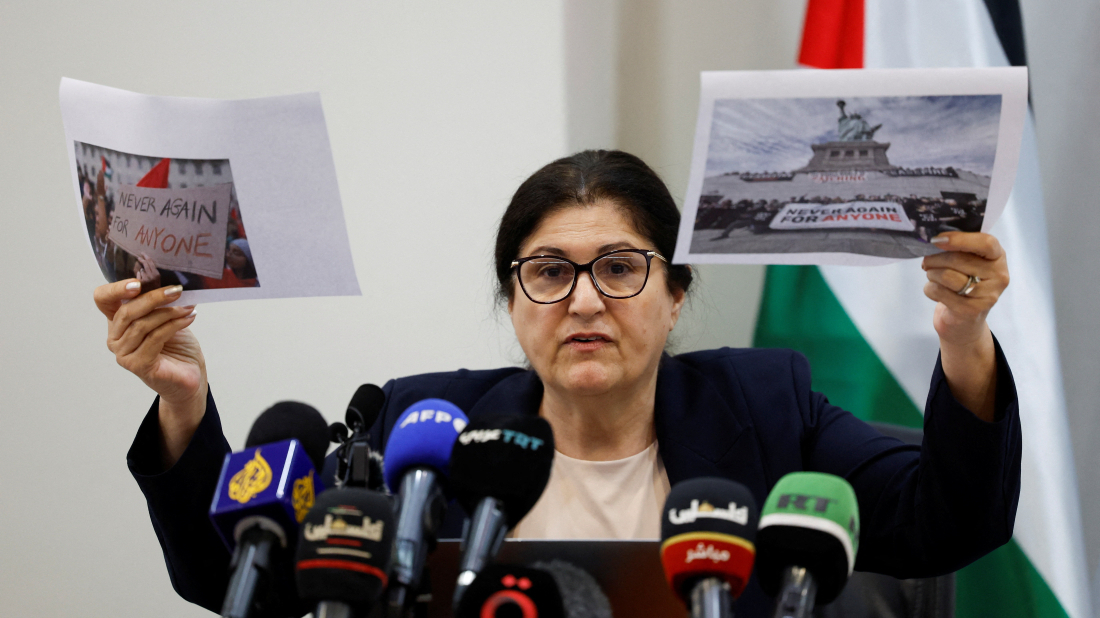
Palestinian Foreign Minister Varsen Aghabekian Shahin stated that countries recognising a Palestinian state this week were taking an irreversible step that safeguarded the two-state solution and brought Palestinian independence and sovereignty closer.
The UK, Canada, and Australia formally recognised a Palestinian state on Sunday, joining other nations in an effort to revive momentum for a two-state solution—a move that has drawn criticism from Israel and the United States.
"Now is the time. Tomorrow marks a historic moment that we need to build upon. This is not the end," Shahin told reporters in Ramallah. "It is a step bringing us closer to sovereignty and independence. It may not end the conflict immediately, but it is progress, which must be reinforced and amplified," she added, referring to Israel’s nearly two-year military campaign in Gaza.
Netanyahu: "There Will Never Be a Palestinian State"
Israel has sharply condemned the decision, with some ministers dismissing it as inconsequential, arguing it does not alter the realities on the ground. Others insist that Palestinian statehood can only be achieved through direct negotiations between Israelis and Palestinians. Prime Minister Benjamin Netanyahu reaffirmed this month that a Palestinian state will never come into existence.
Shahin highlighted Israel’s unwillingness to negotiate, citing Netanyahu’s recent remarks at a ceremony for a new settlement in the Israeli-occupied West Bank, which would sever northern Palestinian communities from those in the south.
"This recognition is far from symbolic. It is a practical, tangible, and irreversible step that countries committed to preserving the two-state solution must take," she said.
France and Saudi Arabia have spearheaded efforts to revive momentum for the two-state solution, with several countries expected to recognise a Palestinian state at this week’s United Nations General Assembly in New York.
The U.S. Ambassador to Israel, Mike Huckabee, dismissed these efforts as a stunt and counterproductive.
Meanwhile, Israeli officials have hardened their positions on settlement expansion and West Bank annexation as international support for Palestinian statehood grows.
Israel faces increasing diplomatic isolation this year, with most of its closest allies—apart from the United States—condemning its assaults on Gaza. Some have even sanctioned Israeli ministers for inciting violence against Palestinians.
Shahin stressed that political pressure on Israel should be supplemented with economic measures to "hold Israel accountable and protect the Palestinian people."
"Today, Gaza burns. Today, Gaza is destroyed. Today, people in Gaza are being systematically murdered," she said, accusing Israel of committing genocide in Gaza, an allegation that Israel denies.
A United Nations Commission of Inquiry last week concluded that Israel has committed genocide in Gaza, a finding echoed by a scholars’ association, Amnesty International, and two leading human rights organisations in Israel.



















What is your opinion on this topic?
Leave the first comment