Colombian Senator and presidential candidate Miguel Uribe, who was shot in the head during a campaign rally two months ago, died early Monday at the age of 39, the hospital treating him announced.
Uribe, a member of a well-known political family and a senator from the right-wing opposition, was attacked on 7 June in Bogotá while campaigning for his party’s nomination in the 2026 presidential elections.
His wife, Maria Claudia Tarazona, confirmed his death on social media, writing: “I ask God to show me the way to learn to live without you. Rest in peace, love of my life, I will take care of our children.”
The shooting was Colombia’s worst act of political violence in nearly 20 years, recalling the turbulent 1980s and 1990s when four presidential hopefuls were assassinated in separate incidents linked to drug cartels.
Santa Fe Foundation hospital, where supporters held vigils throughout Uribe’s treatment and multiple surgeries, said over the weekend that his condition had deteriorated due to a central nervous system haemorrhage. On Monday, it confirmed he died at 1:56 a.m. (0656 GMT).
Former President Álvaro Uribe, leader of the senator’s Democratic Center party but not related to him, wrote on X: “Evil destroys everything; they killed hope. May Miguel’s fight be a light that illuminates Colombia’s right path.”
U.S. Secretary of State Marco Rubio expressed condolences, saying the United States stands with Uribe’s family and Colombia “in mourning and demanding justice for those responsible.”
Authorities have arrested six people in connection with the attack, including two men allegedly involved in planning the assassination in Medellín. A 15-year-old accused of firing the fatal shot was detained hours after the incident, reportedly admitting he was hired by a local drug dealer. Police say they are still searching for those who ordered the killing.
Defence Minister Pedro Sanchez pledged to capture all those involved, offering a 3 billion peso (about $740,000) reward for information. The United States, United Kingdom, and United Arab Emirates are assisting in the investigation.
Uribe’s death adds another chapter to a family marked by tragedy. His mother, journalist Diana Turbay, was killed in 1991 during a failed rescue mission after being kidnapped by Pablo Escobar’s Medellín Cartel.
A rising political figure, Uribe was known for his sharp criticism of President Gustavo Petro’s administration, opposing his labour reform referendum and restrictions on the oil industry. He promised policies to attract investment and provide legal certainty for businesses.
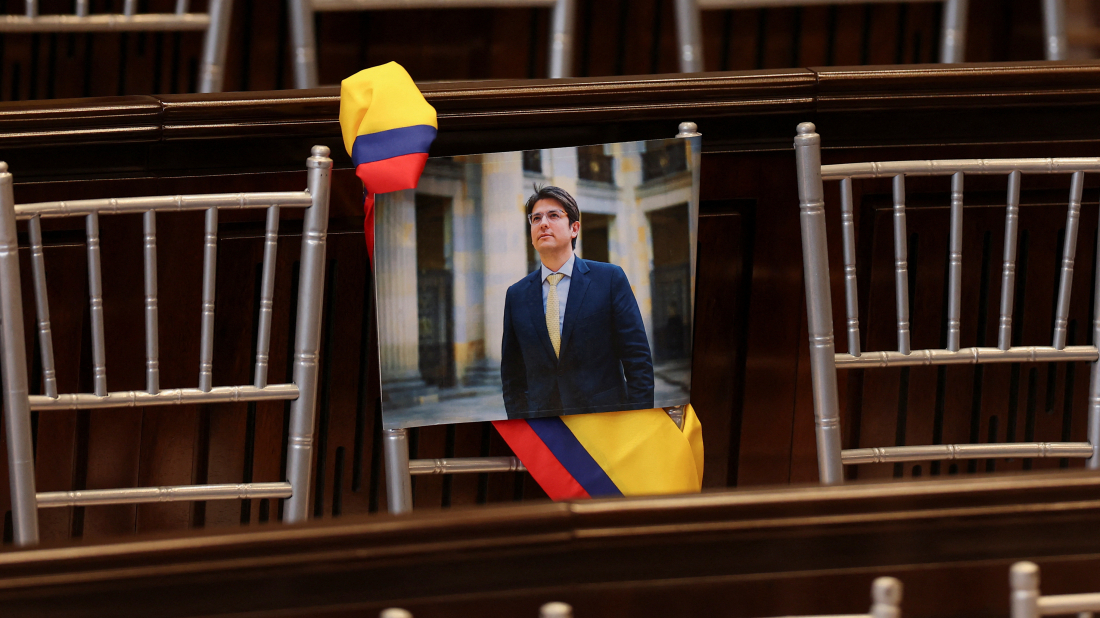
Elected to Bogotá’s city council at 25, Uribe became a prominent critic of Petro during his mayoralty, particularly over waste management and social programmes. In 2022, he headed the Senate list for the Democratic Center party. Since the attack, his Senate seat has been draped with the Colombian flag.
Uribe’s maternal grandfather, Julio César Turbay, served as Colombia’s president from 1978 to 1982, while his paternal grandfather, Rodrigo Uribe Echavarría, led the Liberal Party and supported Virgilio Barco’s successful 1986 presidential bid.
He is survived by his wife, son, stepdaughters, father, and sister.













What is your opinion on this topic?
Leave the first comment