The European Union and Japan announced the launch of a Competitiveness Alliance to boost cooperation on trade, economic security, and innovation and the twin transitions.
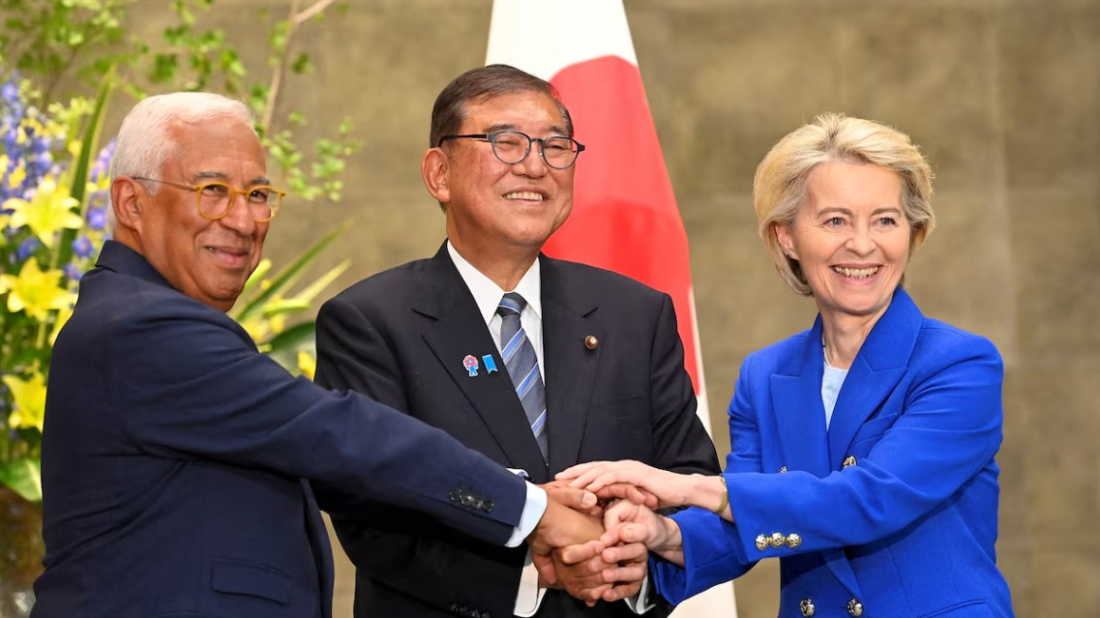
President Ursula von der Leyen and the President of the European Council, António Costa met Japan's Prime Minister Shigeru Ishiba in Tokyo for the 30th EU-Japan Summit.
They adopted a joint statement and launched a new competitiveness alliance to further strengthen a stable and predictable rules-based free and fair economic order, reinforce a competitive business environment and enhance joint competitiveness in a strategic manner.
President António Costa affirmed that Japan is “the EU’s closest partner in the Indo-Pacific,” a sentiment echoed by President von der Leyen, who described the two sides as “close and trusted friends” in recognition of their deepening partnership.
"Together we represent a fifth of the world's GDP. Our Economic Partnership Agreement is solid, and it delivers. This Summit is our chance to take the next steps: To strengthen our joint competitiveness, enhance our common security, and set global standards aligned with our values," - she stated.
Von der Leyen said the EU and Japan would seek to strengthen economic security.
"We will also work more closely together to counter economic coercion and to address unfair trade practices," she said, adding later: "We believe in global competitiveness and it should benefit everyone."
Ishiba told reporters that the EU and Japan would work to maintain and strengthen a rules-based, free and fair economic order.
The leaders committed to enhance joint competitiveness and reduce strategic dependencies, particularly through the newly launched Competitiveness Alliance, as well as to deepen cooperation in several key areas, including defence and space, critical raw materials, energy, digital transformaiton, research and innovation, critical and emerging technologies, including semiconductors.
Ishiba added that the EU and Japan had agreed to work to strengthen the defence industry and to start talks for an information security agreement.
"In the field of security, we agreed to cooperate to launch a defense industry dialogue to strengthen the defense industrial base, which is a priority for both sides, and to begin official negotiations on a Japan-EU information security agreement," Ishiba said.
The EU and Japan reaffirmed their commitment to addressing common global challenges and advancing their security and defence partnership. Areas of cooperation include cybersecurity, hybrid threats—particularly foreign information manipulation and interference (FIMI)—space security, disarmament, non-proliferation, peace and security agenda.
In this context, the leaders underscored the importance of maritime security, highlighting the need to ensure freedom of navigation and protection of critical undersea infrastructure, in line with international law.
A joint statement also noted that both sides aim to strengthen cooperation under the EU–Japan Digital Partnership and Green Alliance, with a focus on advancing the circular economy and supporting decarbonisation efforts.
"Recognising the triple global crisis of climate change, biodiversity loss and pollution, the leaders also expressed their support for the Paris Agreement and the Kunming-Montreal global biodiversity framework, as well as their commitment to contribute to a successful outcome of COP30 so as to keep the 1.5 ⁰C goal within reach," - the statement reads.












What is your opinion on this topic?
Leave the first comment