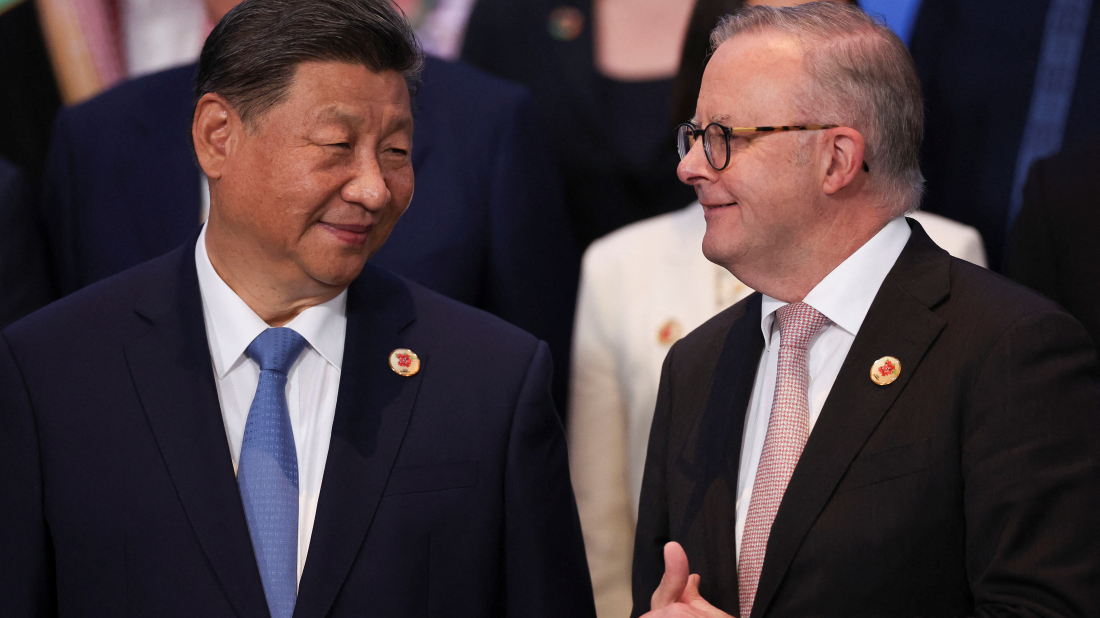
Australian Prime Minister Anthony Albanese arrived in Shanghai, beginning a six-day tour across three Chinese cities, with discussions expected to focus on regional security concerns and strengthening economic relations.
This marks Albanese’s second visit to China, where he is scheduled to meet President Xi Jinping. The trip comes as Australia tightens scrutiny of Chinese investments in critical minerals and amid growing global economic uncertainty due to sweeping tariffs introduced by U.S. President Donald Trump.
Here is a summary of key developments in Australia-China relations in recent years:
Nov 2014: Australia finalises a landmark free trade agreement with China after a decade of talks, which takes effect in 2015.
Dec 2017: In response to concerns over foreign influence, Australia bans political donations from abroad.
Aug 2018: Huawei is barred from providing equipment for Australia’s 5G network due to security concerns.
Apr 2020: Australia calls for an independent probe into COVID-19’s origins. China’s ambassador warns of boycotts targeting Australian wine, beef, and tourism.
Jun 2020: China cautions students about studying in Australia, citing racism, threatening a major education export market.
Aug 2020: Australian journalist Cheng Lei is detained in China.
Nov 2020: China imposes anti-dumping tariffs on Australian wine and restricts imports of lobster, timber, and barley. Its embassy issues a list of 14 grievances, including blocked Chinese investments.
May 2022: Albanese’s Labor Party wins the federal election, ending nearly ten years of conservative governance.
Nov 2022: Albanese meets Xi on the sidelines of the G20, their first leaders’ meeting since 2016.
Jan 2023: China allows select companies to resume coal imports from Australia.
Aug 2023: Tariffs on Australian barley are removed.
Oct 2023: Cheng Lei is released from prison after three years in detention.
Oct 2023: China agrees to review its 218% tariffs on Australian wine, prompting Australia to pause a WTO case.
Nov 2023: During his Beijing visit, Albanese tells Xi and Premier Li that strong bilateral ties are vital for the future. Xi echoes the sentiment, calling for deeper cooperation.
Jan 2024: Australia pushes back against China’s attempts to shift blame over a naval incident that injured Australian divers near Japan.
Feb 2024: Australian writer Yang Hengjun is given a suspended death sentence after five years in detention.
Mar 2024: China lifts wine tariffs, spurring renewed imports.
Dec 2024: Final restrictions on Australian beef are removed; China resumes lobster imports.
Dec 2024: Australia funds rugby league in Papua New Guinea in exchange for the island nation avoiding security ties with China.
Feb 2025: Foreign Minister Penny Wong criticises China for giving insufficient notice about a live-fire naval drill that disrupted civilian air traffic near Australia and New Zealand.
May 2025: Albanese secures a second term as prime minister following national elections.
















What is your opinion on this topic?
Leave the first comment