President Ilham Aliyev said 2025 has politically closed the Armenia-Azerbaijan conflict, as a Trump-era reset in U.S. ties, new transport corridors and a push into AI, renewables and defence production reshape Azerbaijan’s priorities.
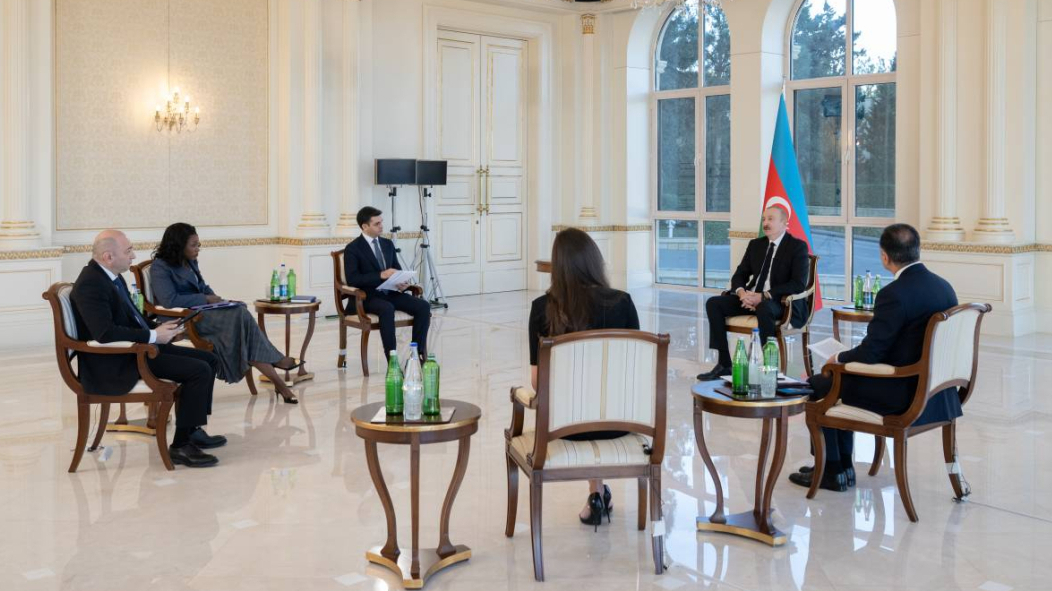
In an interview with local TV channels on 5 January, President Ilham Aliyev described 2025 as a historic year, arguing it has marked the political end of the Armenia-Azerbaijan conflict and the start of a period in which Azerbaijan is learning what “living in peace” looks like after decades of instability.
He linked this shift to a more upbeat domestic mood, stronger confidence in stability and security, and new space for economic and political planning.
U.S. relations and Section 907
President Aliyev said Azerbaijan’s engagement with the United States has taken a decisive turn under President Donald Trump.
He pointed to Trump’s move to end Section 907 at a White House ceremony attended by Aliyev, while noting Congress has not yet lifted it formally.
He also said a strategic working group has been launched to prepare a strategic partnership charter, with work already underway.
Aliyev argued Section 907 has long overshadowed bilateral ties, blaming anti-Azerbaijan forces and lobbying in the U.S. political system.
He described its adoption in 1992 as unjust and said it carried practical costs when Azerbaijan was economically weak and dealing with large-scale displacement.
He said the waiver after 11 September 2001 lasted until 2024 because Azerbaijan was needed for U.S. operations in Afghanistan, before the Biden administration stopped waiving it after the U.S. mission ended.
He criticised that decision and said the Trump administration’s approach has shifted the relationship onto a more “practical and result-oriented” track.
Aliyev said he expects Congress to abolish Section 907 permanently, arguing the original justification of a “blockade” does not exist and pointing to cargo transiting Azerbaijan to Armenia and even Azerbaijani oil products being exported to Armenia.
The Zangezur corridor and parallel routes via Iran
President said the opening of the Zangezur Corridor has been effectively endorsed in Washington and that the corridor may carry different branding but not a different substance.
He said Azerbaijan began implementing its side soon after the Second Karabakh conflict, with railway foundations laid in early 2021.
He put road readiness on Azerbaijan’s side at about 95 per cent for the highway and 70 per cent for the railway, while noting a 42km segment still needs to be built on Armenia’s territory.
Aliyev said the project’s cargo capacity is projected at 15 million tonnes and positioned it as a branch of multiple corridors, including East-West, East-South, and a second North-South route that would revive a Soviet-era connection towards Iran and the Persian Gulf.
He also referenced Türkiye’s decision on building the Kars-Nakhchivan railway to connect Nakhchivan into Türkiye’s rail network.
Alongside the Armenia route, Aliyev said Azerbaijan is building a bridge over the Araz in Aghband to create an additional corridor through Iran, cutting the distance for travel to Nakhchivan and creating two connections between the main part of Azerbaijan and Nakhchivan.
Foreign policy highlights: China, D-8, Central Asia, and Turkic cooperation
Ilham Aliyev listed closer ties with China as a major foreign policy result, and also pointed to Azerbaijan having joined the D-8 and being elected a full member of the Consultative Meeting of the Heads of State of Central Asia.
He said this effectively turns C5 into C6 and strengthens Azerbaijan’s role as a reliable connector for cargo flows between Central Asia and the West.
He cited rising transit volumes, including a first-time milestone of 100,000 containers passing through Azerbaijan, and said this is forcing new investment in transport infrastructure.
Aliyev also referenced high-level diplomacy and hosting, including the ECO Summit in Khankendi and the Organization of Turkic States summit in Gabala, alongside forums held in Shusha, Lachin and Aghdam.
On security cooperation, he said he proposed joint military exercises of Turkic states in Azerbaijan this year, arguing the global environment increasingly rewards strength, alliances and mutual support, while insisting he is not proposing a new military organisation.
Economy, investment and the AI hub ambition
Speaking to AnewZ, President Aliyev said the peace agreement initialled in Washington has oppened opportunities for investment, including from the U.S., and said Azerbaijan is considering shifting some investments towards the real economy.
He also set out an ambition for Azerbaijan to become a regional AI and IT hub, including through data centres, arguing that Azerbaijan has around 2,000 megawatts of spare power capacity that could be exported or used domestically.
On macro stability, he said Azerbaijan’s foreign debt has fallen to a historically low level around 6.3-6.4% of GDP, while reserves exceed foreign debt by 16-17 times.
He also said reserves fluctuate daily and were around 83-84 billion U.S. dollars at the time, and argued Azerbaijan’s credit rating is underappreciated despite Moody’s and Fitch upgrades to investment level.
He said borrowing may resume in limited amounts, potentially a few billion U.S. dollars, to finance connectivity, transport, water and sanitation projects without cutting funding for social policy, defence or Karabakh reconstruction.
Social policy and labour market reforms
President Aliyev said social policy remains central and should balance investment priorities, while avoiding populism and unpayable promises.
He mentioned the minimum wage has increased more than 40 times over 20 years, and that five social reform packages over seven years covered about 4 million people, totalling roughly 8 billion manats, including 1.4 billion in budget funds spent last year alone.
He said more than 100,000 people have benefited from self-employment programmes, and highlighted job creation, including in Karabakh and East Zangezur. He also referenced support measures for families of those killed and those disabled, including apartments, cars and advanced prostheses.
Karabakh reconstruction and the “Great return”
On reconstruction, Aliyev said the initial priority was connectivity and energy supply, describing the creation of a “circular” energy system and hydropower capacity, alongside roads, bridges, tunnels, rail links and water infrastructure.
President noted 70,000 people already live in the liberated areas across 32 cities and villages, and suggested the population there could rise to around 120,000-140,000 by the end of the year, depending on project delivery.
He said work is sequenced under master plans and stressed quality control, saying he has not set fixed deadlines for resettlement and construction.
Defence industry expansion
Ilham Aliyev said Azerbaijan is reshaping defence production by bringing private companies into a space previously treated as a state monopoly.
He said 15 companies have been licensed, seven private companies have begun production, and about one billion manats were invested in 2024-2025 in new and expanded sites, with half of that coming from the private sector.
He said military products worth 1.4 billion manats were produced last year, with exports to about 20 countries, and that Azerbaijan has established joint ventures with international defence firms to produce systems including unmanned aerial vehicles and artillery.
He set a short-term goal of raising defence exports to one billion dollars within three to four years.
International law and security outlook
President Aliyev said international law norms are not functioning in practice and argued that Azerbaijan’s experience, including long-unimplemented UN Security Council resolutions, shaped its view that realities are ultimately decided on the ground.
He said peace is preferable but requires strength, and urged countries to build resilience rather than rely on paper guarantees.
Gaza and overseas missions
Asked about possible involvement in stabilisation operations in the Gaza Strip, Aliyev said Azerbaijan had received inquiries but required clarity on the mandate, command structure and whether any mission would involve peacekeeping or peace enforcement.
He said Azerbaijan would not participate in combat operations outside its territory. He also said Baku had not given consent, despite claims by the U.S. ambassador to the United Nations, describing such statements as unacceptable.
Aliyev said Azerbaijan had submitted a questionnaire of more than 20 questions to the American side and that no participation was envisaged until responses were received.
Renewables and energy exports
President said Azerbaijan’s wind energy potential exceeds 150 gigawatts and argued the country is moving to scale solar, wind and hydropower while expanding the grid to absorb future capacity.
He cited renewable projects involving Masdar, ACWA Power and bp, and said Azerbaijan plans to integrate 6,000 megawatts of renewable and hydropower capacity by 2030, rising to 8,000 megawatts by 2032.
He said battery storage systems are also being introduced, with an initial 250 megawatts already under installation.
Aliyev said increased renewable capacity would allow Azerbaijan to redirect saved natural gas to export markets.
He referenced the Black Sea electricity cable project and said Azerbaijan plans to build new transmission lines to the Georgian border, while partner countries cover remaining financing.
Gas exports and production growth
Aliyev said Azerbaijan currently supplies pipeline gas to 14 countries, with 11 regular buyers, and expects to add two more European markets this year, bringing the total to 16.
He said exports exceeded 25 billion cubic metres last year and identified two drivers for further growth: expanded renewable energy freeing up gas, and increased production from new fields.
He said output is expected to rise from the Azeri-Chirag-Gunashli deep gas project starting this year, alongside further production from Shah Deniz Compression and fields including Absheron and Babek.
Aliyev also described Syria as a new partner, saying Azerbaijani gas helps reduce electricity shortages there by about four hours per day and that an increase in supply is being considered.
Transport and urban development in Baku
Aliyev said traffic congestion in Baku is being addressed through expanded public transport, new metro stations, road upgrades and urban redevelopment.
He cited the redevelopment of the Sovetsky area into public spaces and parks, plans for artificial lakes, expanded metro connectivity including a station in White City, and the introduction of bicycle lanes.
He also highlighted the annual purchase of hundreds of buses, including locally produced electric vehicles, and said rail transport would play a greater role, pointing to the Baku–Sumgayit line. He said major transport challenges should be resolved within five years under a fully funded programme.










What is your opinion on this topic?
Leave the first comment