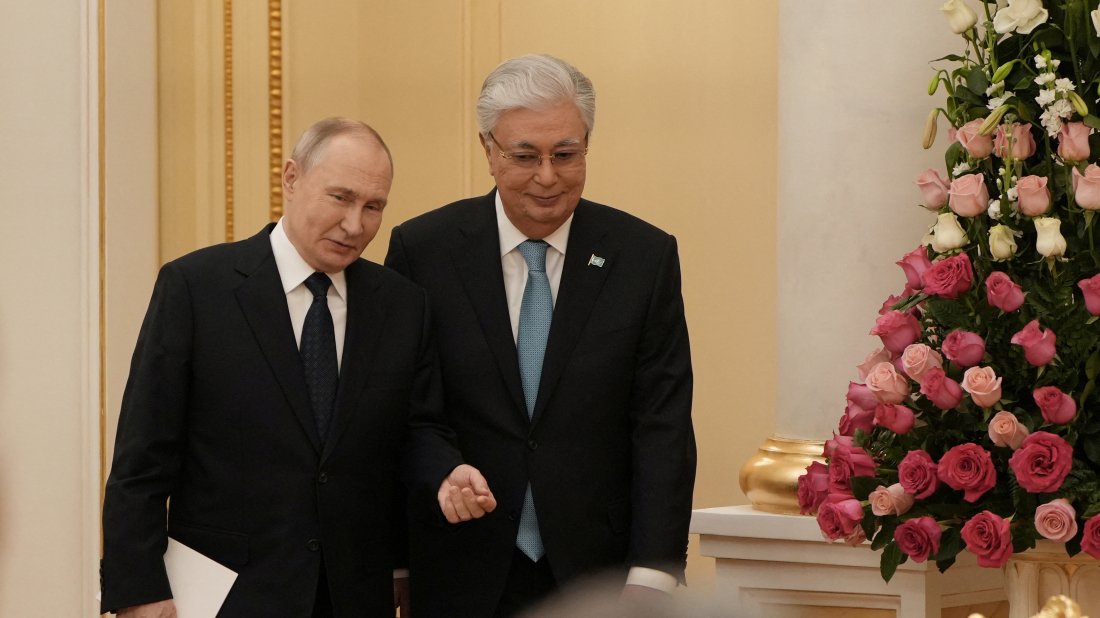
Russian President Vladimir Putin visited Kazakhstan on Wednesday, and discussed boosting energy and industry ties and easing a row over farm goods with the Central Asian nation which exports most of its oil through Russia but is exploring alternatives.
Russian President Vladimir Putin visited Kazakhstan on Wednesday, and discussed boosting energy and industry ties and easing a row over farm goods with the Central Asian nation which exports most of its oil through Russia but is exploring alternatives.
Kazakhstan has tried to distance itself from Moscow's war in Ukraine. Yet the country remains highly dependent on Russia for exporting oil to Western markets and for imports of food, electricity and other products.
"Our countries are ... constructively cooperating in the oil and gas sector," Putin wrote in an article "Russia – Kazakhstan: a union demanded by life and looking to the future" for the Kazakhstanskaya Pravda newspaper and published on the Kremlin's website late on Tuesday.
Kazakhstan's energy minister said on Monday his country could sharply increase its crude oil exports out of Turkey's port of Ceyhan, a move that would reduce the share it sends via Russia.
Underscoring that more than 80% of Kazakhstan's oil is exported to foreign markets via Russia, Putin said he and President Kassym-Jomart Tokayev always focused on "a specific result" in their talks.
Kremlin foreign policy aide Yuri Ushakov told journalists on Tuesday that Putin and Tokayev would sign a protocol on extending an agreement on oil supplies to Kazakhstan. He did not give details.
The two leaders did not mention a protocol in remarks after their meeting on Wednesday. They did say they had discussed plans to increase the transit through Kazakhstan of Russian natural gas to Uzbekistan and Kyrgyzstan, part of Moscow's pivot away from European energy markets. They also said they talked about joint projects in hydroelectric power, car tyres and fertilisers and other areas.
NUCLEAR PLANT
Putin also said in his article that Russia's state nuclear corporation Rosatom - already involved in some projects in Kazakhstan - was "ready for new large-scale projects".
In October, Kazakhstan, a nation of 20 million, voted in favour of constructing its first nuclear power plant, under a Tokayev-backed plan that faced criticism from Kazakhs concerned by the involvement of a neighbour that has invaded another.
Neither leader mentioned the nuclear project after their talks.
Tokayav said he had raised the issue of agricultural trade following a Russian ban on imports of grain, fruit and other farm products from Kazakhstan in October. Moscow imposed the ban after Kazakhstan barred Russian wheat imports in August to protect its producers.
"Our countries should not compete on the Eurasian Economic Union market or foreign markets," Tokayev said, referring to agricultural exports within and outside a Moscow-led post-Soviet trade bloc.
While Tokayev has made a number of gestures welcomed by Moscow, such as initiating the creation of an international body to support the Russian language across the former Soviet space, his government has also sought to maintain friendly ties with the West.
Last month, Astana said it had no plans to join BRICS, the bloc of emerging economies that Putin hopes to build into a powerful counterweight to the West in global politics and trade.
Kazakhstan has also pledged to abide by Western sanctions on Russia, although some Kazakh companies have been caught skirting them.
Security was tight in Astana on Wednesday, with whole blocks of the city cordoned off and military helicopters and fighter jets patrolling the sky.











What is your opinion on this topic?
Leave the first comment