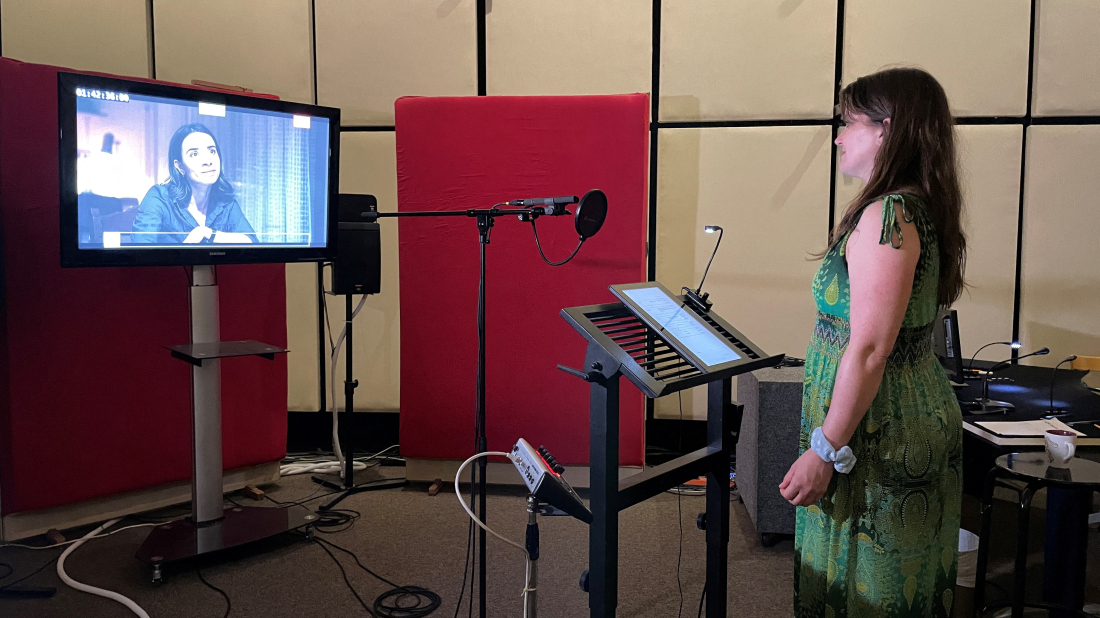
Voice actors across Europe are sounding the alarm over the rise of artificial intelligence in the dubbing industry, warning that the use of AI-generated voices could jeopardize jobs, creative quality, and intellectual property rights.
"I feel threatened even though my voice hasn't been replaced by AI yet," said Boris Rehlinger, the French voice behind Ben Affleck, Joaquin Phoenix, and Puss in Boots.
Rehlinger is part of TouchePasMaVF, a French initiative pushing back against synthetic dubbing.
He emphasized the collaborative effort behind quality dubbing: “There is a team of professionals, including actors, translators, production directors, dialogue adapters, and sound engineers, to ensure audiences barely notice that the actor on screen is speaking a different language than they hear.”
With streaming platforms such as Netflix driving global demand for dubbed content, the industry is growing fast. Business Research Insights projects the market will reach $4.3 billion in 2025 and $7.6 billion by 2033.
According to consumer research firm GWI, 43% of viewers in Germany, France, Italy, and Britain prefer dubbing over subtitles.
But as platforms seek to scale efficiently and win over advertisers, the appeal of cost-effective AI-generated dubbing is rising — triggering concern among industry professionals.
Voice actor associations across Europe are calling for stronger EU regulations to protect human dubbing professionals and their work.
“We need legislation: Just as after the car, which replaced the horse-drawn carriage, we need a highway code,” Rehlinger said.
Concerns over AI’s role in entertainment have persisted since the Hollywood labor unrest of 2023, which led to new guidelines on its use.
AI remains a flashpoint in the industry.
Netflix, which declined to comment on its AI dubbing use, has begun experimenting with generative AI to produce visual effects for its series “El Eternauta (The Eternaut)”.
The company has also tested GenAI to synchronize actors’ lip movements with dubbed dialogue using local voice actors.
Such practices are allowed under the new SAG-AFTRA contract for dubbing foreign-language content into English, as long as the voice actor is paid for their work.
In Germany, twelve well-known voice actors went viral on TikTok in March with their campaign “Let’s protect artistic, not artificial, intelligence,” amassing 8.7 million views.
A related petition by the VDS voice actors' association gathered more than 75,500 signatures, demanding that AI companies obtain explicit consent from artists when using their voices to train models and fairly compensate them.
The petition also called for transparent labeling of AI-generated content.
“When intellectual property is no longer protected, no one will produce anything anymore because they think 'tomorrow it will be stolen from me anyway',” said Cedric Cavatore, a VDS member who has worked on films and games, including Final Fantasy VII Remake.
VDS works alongside United Voice Artists, a global network of more than 20,000 voice actors advocating for ethical AI use and fair contracts. In the U.S., SAG-AFTRA recently secured a new contract with video game studios focusing on AI protections.
Some studios are cautiously embracing AI.
Eberhard Weckerle, managing director of Neue Tonfilm Muenchen, hopes AI and human dubbing can coexist, but warns of the risk of quality loss.
“The fear is that AI will be used to make something as cheap as possible and then people will say, 'Okay, I'll accept that I'll have poorer quality'. And that would actually be the worst thing that could happen to us,” said Weckerle, whose studio has dubbed Conclave and is currently working on a Guy Ritchie film.
Earlier this year, streaming service Viaplay pulled its German-dubbed version of the Polish crime series Murderesses after viewers criticized the monotony of the AI-generated dialogue. The hybrid dubbing, produced with Israeli startup DeepDub, used a mix of human and AI voices.
DeepDub did not respond to a request for comment.
“We'll continue offering subtitles and reserve dubbing for select content,” said Vanda Rapti, executive vice president of Viaplay Group, Viaplay Select & Content Distribution.
Despite the criticism, GWI found nearly half of viewers said their opinion would not change if they learned a show they liked was dubbed with AI. About 25% said they would like it slightly less, and just 3% said they would like it much more.
Stefan Sporn, CEO of Audio Innovation Lab, believes AI will reshape — but not replace — voice work.
His company used AI to dub the Cannes Film Festival entry Black Dog from Chinese to German.
“Humans will always be needed for emotion, scripting, and language nuance — just not to the same extent,” he said.
Audio Innovation Lab’s technology modifies the original actor’s voice to match the target language, aiming for both efficiency and authenticity. “Interest is huge,” said Sporn. “Producers, studios, and advertisers all want to know how well it works.”
Another startup, Flawless AI, positions itself as an ethical AI firm, working with local voice actors while using its technology to synchronize lip movements with dubbed dialogue.
“When AI technologies are used in the right way, they are a silver bullet to change how we can film-make in a new way,” said co-CEO Scott Mann.





















What is your opinion on this topic?
Leave the first comment