Germany's Merz says 'disaster' result after far-right AfD leads another state election
The far-right Alternative for Germany (AfD) took first place in state elections in northeastern Germany on Sunday,...
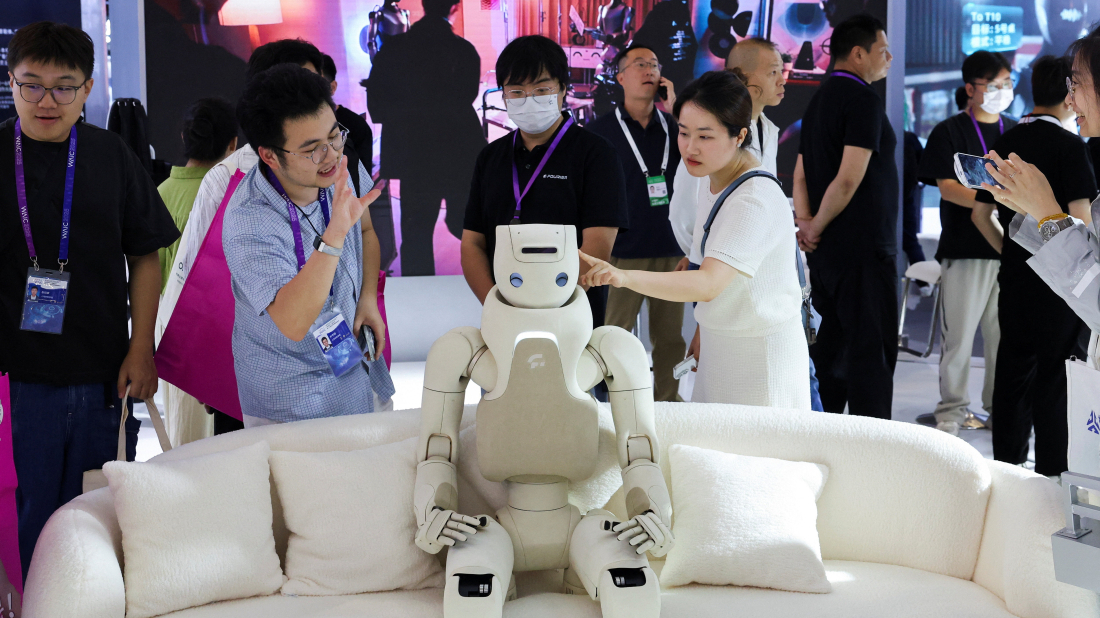
China has signalled plans to establish an international organisation for artificial intelligence, seeking to position itself as a counterweight to the United States in shaping the future of the technology.
Premier Li Qiang announced the proposal at the World Artificial Intelligence Conference in Shanghai, saying Beijing wanted to help coordinate global regulation of AI and share its advances, especially with developing nations. He warned against allowing AI to become the preserve of a few powerful countries and companies.
The plan comes as Washington pursues its own AI blueprint, unveiled by President Donald Trump’s administration this week, aimed at boosting American AI exports to allies and maintaining a competitive edge over China.
Li said China was prepared to share its experience and products with the Global South, describing the current state of AI governance as fragmented. He called for a global framework with broad consensus and urged greater cooperation to overcome bottlenecks such as limited AI chip supplies and restrictions on talent exchange.
Vice Foreign Minister Ma Zhaoxu told a roundtable of delegates from more than 30 countries that the new body would promote pragmatic cooperation and could be headquartered in Shanghai. China’s foreign ministry also published an action plan for global AI governance, inviting governments, companies and research institutions to collaborate through open-source platforms.
The three-day Shanghai event has drawn more than 800 companies and 3,000 products, including 40 large language models, 50 AI-powered devices and 60 intelligent robots. Leading Chinese firms Huawei and Alibaba are showcasing innovations alongside international players such as Tesla, Alphabet and Amazon.
Saturday’s speakers included Anne Bouverot, the French president’s special envoy for AI, computer scientist Geoffrey Hinton and former Google CEO Eric Schmidt. Tesla chief Elon Musk, a regular presence in past years, did not speak at this year’s conference.
Washington has imposed restrictions on exporting advanced AI chips to China, citing concerns about military use, even as Chinese firms continue to make breakthroughs that have drawn close U.S. scrutiny.

Saudi civil defence sent an all-clear on Saturday after issuing alerts for a second time for potential danger in Riyadh and the city of Al-Kharj east of the capital, amid an uptick in attacks by Iran-aligned Houthis on the Gulf country.
Houthi attacks target Riyadh amid concerns over Saudi oil supplies, as Iran says it will not reopen the Strait of Hormuz until its conditions are met and U.S. commitments are implemented, parliament speaker Mohammad Bagher Ghalibaf said on Sunday.
The U.S. State Department approved a $2.7 billion military sale to Ukraine for air-defence development upgrades, along with related equipment and services, the department said. Meanwhile, Ukrainian authorities reported at least 10 people had died in Russian attacks over the last 24 hours.
The death toll from an overnight Russian attack on the Kyiv region rose to four, including three children, Kyiv regional authorities said on Sunday. A mother and her two 3-year-old children were killed when a Russian drone strike hit a private home, the emergency service said.
Russian authorities have reported attacks on voting systems and communication lines as the country’s parliamentary election entered its second day on Saturday (19 September).
U.S. President Donald Trump announced on Saturday (19 September) the creation of an “AI Force” and plans to appoint an artificial intelligence (AI) czar, while rejecting calls to slow the development of increasingly powerful AI systems.
Google’s Gemini AI model accessed the internet and hacked three companies during a cybersecurity test, in what is believed to be the first known case of the company’s AI systems autonomously carrying out such activity.
Here's your AnewZ Daily Brief for 18 September 2026. These are the top five stories making headlines in the field of science.
French prosecutors have launched a criminal investigation into suspected sexual harassment involving smart glasses, amid mounting global concern over the privacy risks posed by the devices.
Some of the world’s most powerful technology executives are lobbying U.S. President Donald Trump over artificial intelligence regulation, exposing growing divisions within the industry over how governments should respond to rapidly advancing AI.
You can download the AnewZ application from Play Store and the App Store.
What is your opinion on this topic?
Leave the first comment