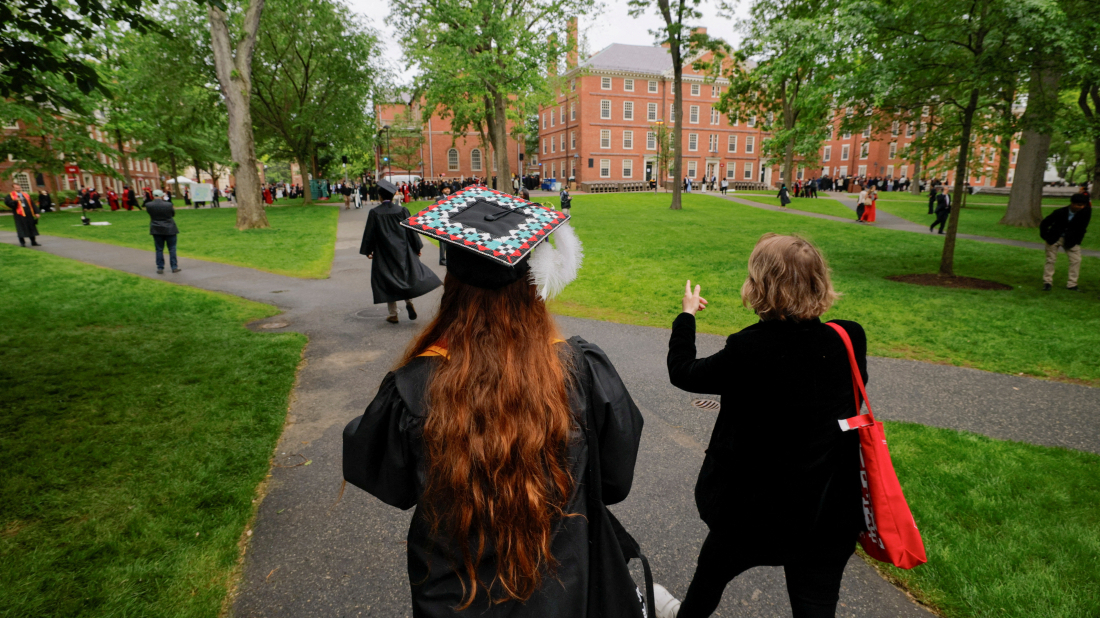
U.S. President Donald Trump on Wednesday suspended for an initial six months the entry into the United States of foreign nationals seeking to study or participate in exchange programs at Harvard University, amid an escalating dispute with the Ivy League school.
Trump's proclamation cited national security concerns as a justification for barring international students from entering the United States to pursue studies at the Cambridge, Massachusetts-based university.
Harvard in a statement called Trump's proclamation "yet another illegal retaliatory step taken by the Administration in violation of Harvard’s First Amendment rights."
"Harvard will continue to protect its international students," it added.
The suspension can be extended beyond six months. Trump's proclamation also directs the U.S. State Department to consider revoking academic or exchange visas of any current Harvard students who meet his proclamation's criteria.
The directive on Wednesday came a week after a federal judge in Boston announced she would issue a broad injunction blocking the administration from revoking Harvard's ability to enroll international students, who make up about a quarter of its student body.
The administration has launched a multifront attack on the nation's oldest and wealthiest university, freezing billions of dollars in grants and other funding and proposing to end its tax-exempt status, prompting a series of legal challenges.
Harvard argues the administration is retaliating against it for refusing to accede to its demands to control the school's governance, curriculum and the ideology of its faculty and students.
Harvard sued after Homeland Security Secretary Kristi Noem on May 22 announced her department was immediately revoking Harvard's Student and Exchange Visitor Program certification, which allows it to enroll foreign students.
Her action was almost immediately temporarily blocked by U.S. District Judge Allison Burroughs. On the eve of a hearing before her last week, the department changed course and said it would instead challenge Harvard's certification through a lengthier administrative process.
Nonetheless, Burroughs said she planned to issue a longer-term preliminary injunction at Harvard's urging, saying one was necessary to give some protection to Harvard's international students.
In an internal cable seen by Reuters that was issued a day after that court hearing, the State Department ordered all its consular missions overseas to begin additional vetting of visa applicants looking to travel to Harvard for any purpose.
Wednesday's two-page directive said Harvard had "demonstrated a history of concerning foreign ties and radicalism," and had "extensive entanglements with foreign adversaries," including China.
The FBI had "long warned that foreign adversaries take advantage of easy access to American higher education to steal information, exploit research and development and spread false information," the proclamation said.
It said Harvard had seen a "drastic rise in crime in recent years while failing to discipline at least some categories of conduct violations on campus," and had failed to provide sufficient information to the Homeland Security Department about foreign students' "known illegal or dangerous activities."
















What is your opinion on this topic?
Leave the first comment